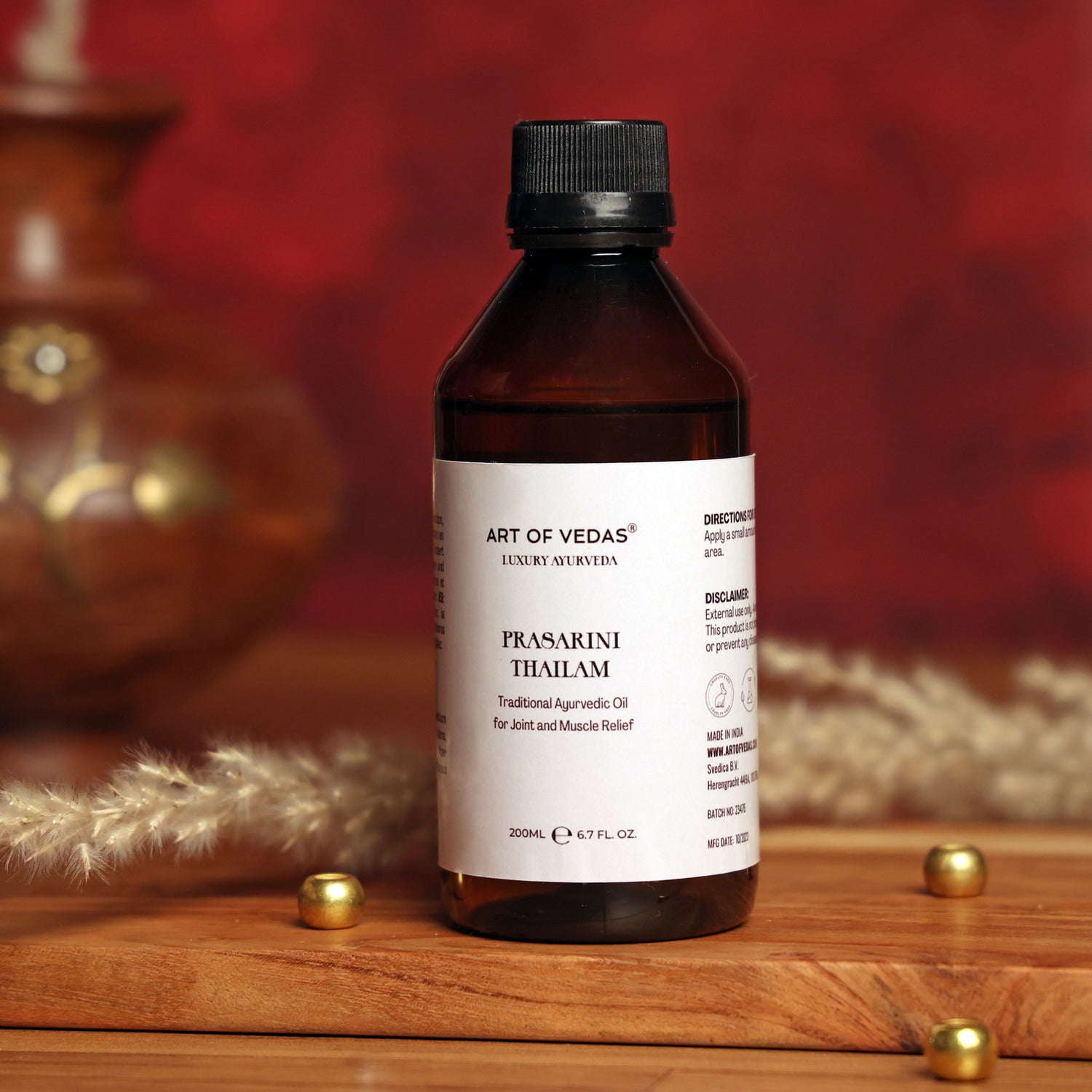








Prasarini Thailam

(3)

Classical Ayurvedic Oil for Joint Stiffness & Muscle Comfort

€18,00

Prasarini Thailam je klasično ayurvedsko ulje posebno formulirano za podršku pokretljivosti zglobova, ublažavanje ukočenosti mišića i promicanje udobnosti u mišićno-koštanom sustavu. Navedena u Sharangdhara Samhita, ova tradicionalna formula kombinira 13 ayurvedskih biljaka u bazi sezamovog ulja, obrađenu s fermentiranom tekućinom od žitarica (Dhanyamla) i jogurtom za poboljšanu apsorpciju i učinkovitost.

Formulacija se temelji na Prasarini (Paederia foetida), biljci čije ime na sanskrtu znači "ono što se širi", što se odnosi na njezinu tradicionalnu sposobnost prodiranja duboko u ukočena, stegnuta tkiva. U kombinaciji s zagrijavajućim biljkama poput Devadaru (Himalajski cedar), Chitraka (Leadwort) i jačajućim svojstvima Laksha (Lac), ovo ulje nudi ciljanu podršku onima koji osjećaju nelagodu u zglobovima, napetost mišića i opću ukočenost tijela—posebno kada je povezana s neravnotežom Vata.

Neto sadržaj

SASTOJCI

Lac, fermentirana tekućina za žitarice, sezamovo ulje, anethum sowa, cedrus deodara, glicirrhiza glabra, peedaria foetida, plumbago zeylanica, piper offinarum, rock sol, jogurt, scindapsus oficilas, semicarpus anacardus

Prasarini Thailam

€18,00

€18,00

Prasarani Thailam - Ayurvedic Herbal Oil and Thailam by Art of Vedas. Shop Online.

Prasarini Thailam: olakšanje za zglobove i mišiće

Prasarini Thailam holds a unique position among Ayurvedic oils. While many Thailams address general Vata imbalance, Prasarini Thailam was specifically developed for conditions where stiffness, rigidity, and restricted movement predominate. Documented in the Sharangdhara Samhita, one of Ayurveda's most respected pharmaceutical texts, this formula has been used for centuries to support those experiencing joint limitations, muscle tightness, and reduced flexibility.

In Ayurveda, joints and muscles are primary sites of Vata dosha. When Vata becomes aggravated, these tissues can become dry, cold, stiff, and uncomfortable. Prasarini Thailam addresses this through a carefully balanced combination of warming, penetrating, and nourishing herbs that work together to restore comfort and ease of movement.

The Foundation: Prasarini (Paederia foetida)

The formulation takes its name from Prasarini, a climbing vine that grows throughout the Himalayas and across India. The Sanskrit name "Prasarini" derives from "prasarana," meaning spreading or extending—a name that perfectly describes this herb's unique therapeutic quality.

In classical Ayurvedic understanding, Prasarini has a special ability to "spread" into contracted, stiff tissues, helping to restore their natural flexibility. This spreading quality (Sara Guna) is considered the herb's defining characteristic and the reason it was chosen as the primary ingredient for this formulation.

Prasarini is traditionally valued for:

  • Its warming nature that counters cold, stiff tissues
  • Its penetrating quality that reaches deep into muscles and joints
  • Its ability to support comfortable movement
  • Its grounding, strengthening effect on the body

Kako koristiti Prasarini Thailam

  1. Warm the Oil: Heat a small amount of Prasarini Thailam gently until it is slightly warm to touch, enhancing its penetration and effectiveness.
  2. Apply Gently: Massage the oil into the affected areas, focusing on joints and muscles where pain and stiffness are prevalent.
  3. Massage Techniques: Use circular motions for joints and long strokes for muscles to help the oil penetrate deeper and stimulate circulation.
  4. Rest Period: Allow the oil to absorb into the skin for at least 30 minutes; overnight application can maximize benefits.
  5. Wash Off: Optionally, you can wash off the oil with warm water if needed after the rest period.

Klasični ayurvedski priručnik

Prasarini Thailam is documented in several authoritative Ayurvedic texts:

Sharangdhara Samhita (Madhyama Khanda, Chapter 9, Verses 119-123.5) — The primary classical reference, appearing in the Taila Prakarana (chapter on medicated oils). This 13th-century text is one of Ayurveda's most important pharmaceutical references.

Bhaishajya Ratnavali (Vatavyadhi Adhikara) — Lists Prasarini Thailam among formulations for Vata disorders. Also describes Maharaja Prasarini Thailam, an enhanced variant.

Sahasrayogam (Taila Prakarana) — The Kerala compendium of formulations includes this oil in its collection of traditional Thailams.

Yoga Ratnakara — Another classical text referencing Prasarini formulations.

Ayurvedic Formulary of India, Volume 1 — The modern official reference containing the standardised formula.

Sanskrit Name and Etymology

Sanskrit: प्रसारिणी तैलम् (Prasāriṇī Tailam)

Breakdown:

  • प्रसारिणी (Prasāriṇī) — from "prasaraṇa" meaning spreading, extending, dispersing
  • तैलम् (Tailam) — oil, specifically medicated oil

The name carries dual significance: it describes both the climbing, spreading growth habit of the Prasarini plant and its therapeutic action of "spreading" into contracted, stiff tissues to restore flexibility and ease.

The plant is also known as Gandha Prasarini ("that which spreads smell") due to its characteristic sulfurous odour when fresh.

Classical Indications

The Sharangdhara Samhita lists Prasarini Thailam for:

  • Hanustambha — Locked jaw, jaw stiffness
  • Katishoola — Lower back discomfort
  • Gridhrasi — Sciatica-like conditions
  • Ardita — Facial conditions affecting movement
  • Pakshaghata — Conditions affecting one side of the body
  • Sarva Vata Vyadhi — All Vata-related disorders
  • Manya Stambha — Neck stiffness

Classification

Prasarini Thailam is classified as:

  • Vatahara Thailam — Vata-pacifying oil
  • Vatakaphahara Thailam — Pacifies both Vata and Kapha (due to heating potency)
  • Bahya Parimarjana — External application medicine

Ayurvedic Pharmacology (Dravyaguna)

Rasa (Taste): Tikta (Bitter), Katu (Pungent), Madhura (Sweet)

Guna (Quality): Guru (Heavy), Sara (Spreading), Snigdha (Unctuous), Sukshma (Subtle/Penetrating)

Virya (Potency): Ushna (Heating)

Vipaka (Post-digestive effect): Madhura (Sweet) — indicating nourishing rather than depleting action

Dosha Action: Vata Shamaka (strongly pacifies Vata), Kapha Shamaka (mildly reduces Kapha)

Karma (Actions):

  • Vatahara — Pacifies Vata dosha
  • Vedanasthapana — Supports comfort
  • Shothahara — Supports healthy inflammatory response
  • Srotoshodhana — Cleanses channels
  • Balya — Promotes strength
  • Sandhaniya — Supports bone and tissue integrity

Dhatu Affinity:

  • Primary: Mamsa (muscle tissue), Majja (nervous tissue/marrow)
  • Secondary: Asthi (bone tissue), Snayu (ligaments/tendons)

The Concept of Sara Guna

The defining characteristic of Prasarini Thailam is the Sara Guna (spreading quality) derived from its primary herb. In Ayurvedic pharmacology, Sara Guna indicates a substance that:

  • Moves and spreads through the body's channels
  • Promotes flow where there is stagnation
  • Penetrates deep into tissues
  • Disperses accumulations