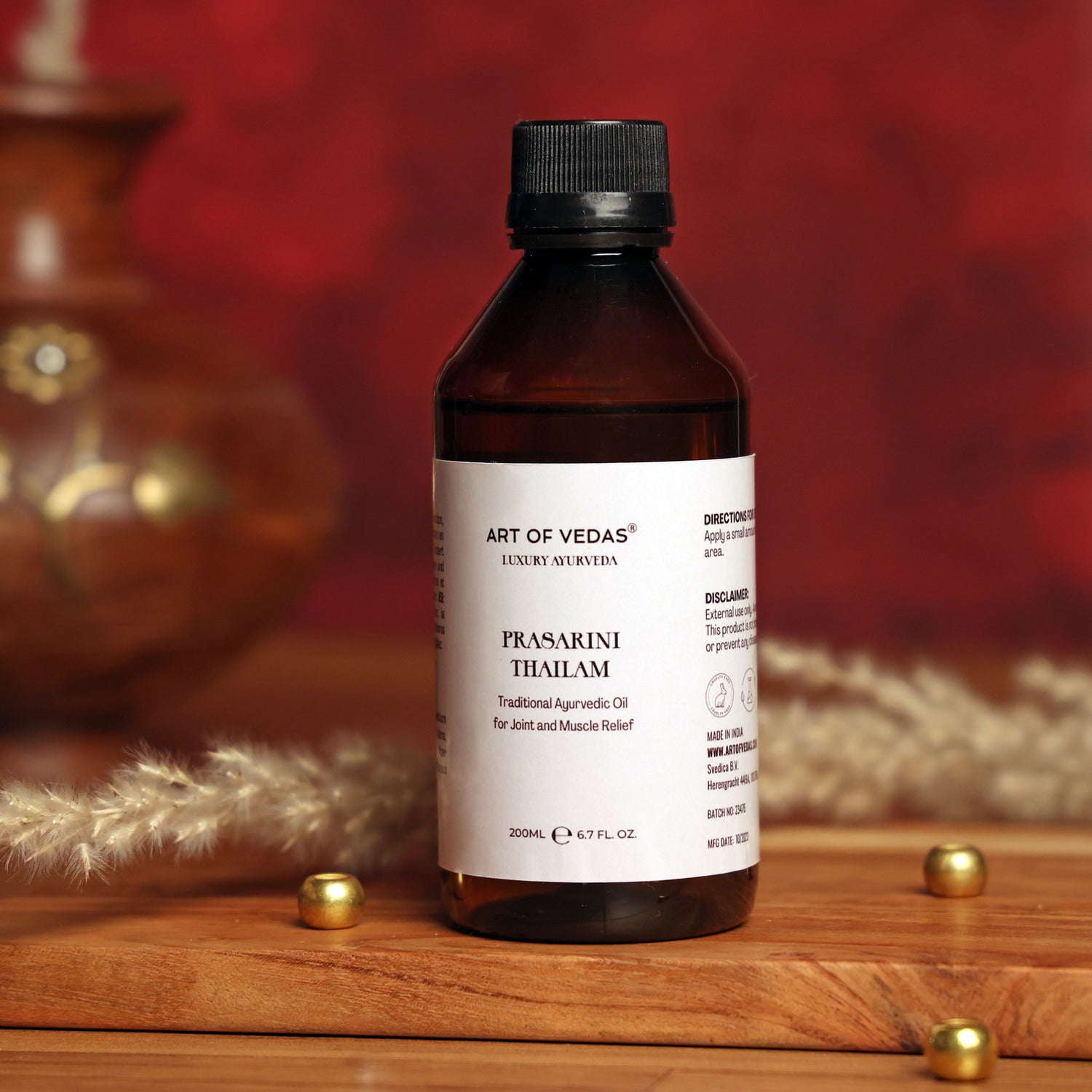








Prasarini Thailam

(3)

Classical Ayurvedic Oil for Joint Stiffness & Muscle Comfort

€18,00

A Prasarini Thailam egy klasszikus ayurvédikus olaj, amelyet kifejezetten az ízületi mozgékonyság támogatására, az izommerevség enyhítésére és az izom-csontrendszer kényelmének elősegítésére fejlesztettek ki. A Sharangdhara Samhita-ban hivatkozott hagyományos formula 13 ayurvédikus gyógynövényt kombinál szezámolaj alapban, amelyet erjesztett gabonafolyadékkal (Dhanyamla) és joghurttal dolgoznak fel a jobb felszívódás és hatékonyság érdekében.

A készítmény középpontjában a Prasarini (Paederia foetida) áll, egy olyan gyógynövény, amelynek szanszkrit neve azt jelenti, hogy „ami szétterjed”, utalva hagyományos képességére, hogy mélyen behatoljon a merev, összehúzódott szövetekbe. Melegítő gyógynövényekkel, mint a Devadaru (Himalájai cédrus), Chitraka (vezetővirág) és a Laksha (Lakk) erősítő tulajdonságaival kombinálva ez az olaj célzott támogatást nyújt azoknak, akik ízületi kellemetlenségekkel, izomfeszültséggel és általános testmerevséggel küzdenek – különösen, ha ezek Vata egyensúlyhiányhoz kapcsolódnak.

Nettó tartalom

ÖSSZETEVŐK

Sesamum Indicum (Sesame) Seed Oil, Laccifer Lacca Extract, Fermented Cereal Liquid, Paederia Foetida Extract, Cedrus Deodara Wood Extract, Glycyrrhiza Glabra Root Extract, Plumbago Zeylanica Root Extract, Anethum Sowa Extract, Piper Longum Extract, Scindapsus Officinalis Extract, Semicarpus Anacardium Extract, Sodium Chloride (Rock Salt), Yogurt

Prasarini Thailam

€18,00

€18,00

Prasarani Thailam - Ayurvedic Herbal Oil and Thailam by Art of Vedas. Shop Online.

Why Choose Prasarini Thailam

Prasarini Thailam holds a unique position among Ayurvedic oils. While many Thailams address general Vata imbalance, Prasarini Thailam was specifically developed for conditions where stiffness, rigidity, and restricted movement predominate. Documented in the Sharangdhara Samhita, one of Ayurveda's most respected pharmaceutical texts, this formula has been used for centuries to support those experiencing joint limitations, muscle tightness, and reduced flexibility.

In Ayurveda, joints and muscles are primary sites of Vata dosha. When Vata becomes aggravated, these tissues can become dry, cold, stiff, and uncomfortable. Prasarini Thailam addresses this through a carefully balanced combination of warming, penetrating, and nourishing herbs that work together to restore comfort and ease of movement.

The Foundation: Prasarini (Paederia foetida)

The formulation takes its name from Prasarini, a climbing vine that grows throughout the Himalayas and across India. The Sanskrit name "Prasarini" derives from "prasarana," meaning spreading or extending—a name that perfectly describes this herb's unique therapeutic quality.

In classical Ayurvedic understanding, Prasarini has a special ability to "spread" into contracted, stiff tissues, helping to restore their natural flexibility. This spreading quality (Sara Guna) is considered the herb's defining characteristic and the reason it was chosen as the primary ingredient for this formulation.

Prasarini is traditionally valued for:

  • Its warming nature that counters cold, stiff tissues
  • Its penetrating quality that reaches deep into muscles and joints
  • Its ability to support comfortable movement
  • Its grounding, strengthening effect on the body

Hogyan használjuk a Prasarini Thailam terméket

Klasszikus ájurvéda referencia

Prasarini Thailam is documented in several authoritative Ayurvedic texts:

Sharangdhara Samhita (Madhyama Khanda, Chapter 9, Verses 119-123.5) — The primary classical reference, appearing in the Taila Prakarana (chapter on medicated oils). This 13th-century text is one of Ayurveda's most important pharmaceutical references.

Bhaishajya Ratnavali (Vatavyadhi Adhikara) — Lists Prasarini Thailam among formulations for Vata disorders. Also describes Maharaja Prasarini Thailam, an enhanced variant.

Sahasrayogam (Taila Prakarana) — The Kerala compendium of formulations includes this oil in its collection of traditional Thailams.

Yoga Ratnakara — Another classical text referencing Prasarini formulations.

Ayurvedic Formulary of India, Volume 1 — The modern official reference containing the standardised formula.

Sanskrit Name and Etymology

Sanskrit: प्रसारिणी तैलम् (Prasāriṇī Tailam)

Breakdown:

  • प्रसारिणी (Prasāriṇī) — from "prasaraṇa" meaning spreading, extending, dispersing
  • तैलम् (Tailam) — oil, specifically medicated oil

The name carries dual significance: it describes both the climbing, spreading growth habit of the Prasarini plant and its therapeutic action of "spreading" into contracted, stiff tissues to restore flexibility and ease.

The plant is also known as Gandha Prasarini ("that which spreads smell") due to its characteristic sulfurous odour when fresh.

Classical Indications

The Sharangdhara Samhita lists Prasarini Thailam for:

  • Hanustambha — Locked jaw, jaw stiffness
  • Katishoola — Lower back discomfort
  • Gridhrasi — Sciatica-like conditions
  • Ardita — Facial conditions affecting movement
  • Pakshaghata — Conditions affecting one side of the body
  • Sarva Vata Vyadhi — All Vata-related disorders
  • Manya Stambha — Neck stiffness

Classification

Prasarini Thailam is classified as:

  • Vatahara Thailam — Vata-pacifying oil
  • Vatakaphahara Thailam — Pacifies both Vata and Kapha (due to heating potency)
  • Bahya Parimarjana — External application medicine

Ayurvedic Pharmacology (Dravyaguna)

Rasa (Taste): Tikta (Bitter), Katu (Pungent), Madhura (Sweet)

Guna (Quality): Guru (Heavy), Sara (Spreading), Snigdha (Unctuous), Sukshma (Subtle/Penetrating)

Virya (Potency): Ushna (Heating)

Vipaka (Post-digestive effect): Madhura (Sweet) — indicating nourishing rather than depleting action

Dosha Action: Vata Shamaka (strongly pacifies Vata), Kapha Shamaka (mildly reduces Kapha)

Karma (Actions):

  • Vatahara — Pacifies Vata dosha
  • Vedanasthapana — Supports comfort
  • Shothahara — Supports healthy inflammatory response
  • Srotoshodhana — Cleanses channels
  • Balya — Promotes strength
  • Sandhaniya — Supports bone and tissue integrity

Dhatu Affinity:

  • Primary: Mamsa (muscle tissue), Majja (nervous tissue/marrow)
  • Secondary: Asthi (bone tissue), Snayu (ligaments/tendons)

The Concept of Sara Guna

The defining characteristic of Prasarini Thailam is the Sara Guna (spreading quality) derived from its primary herb. In Ayurvedic pharmacology, Sara Guna indicates a substance that:

  • Moves and spreads through the body's channels
  • Promotes flow where there is stagnation
  • Penetrates deep into tissues
  • Disperses accumulations