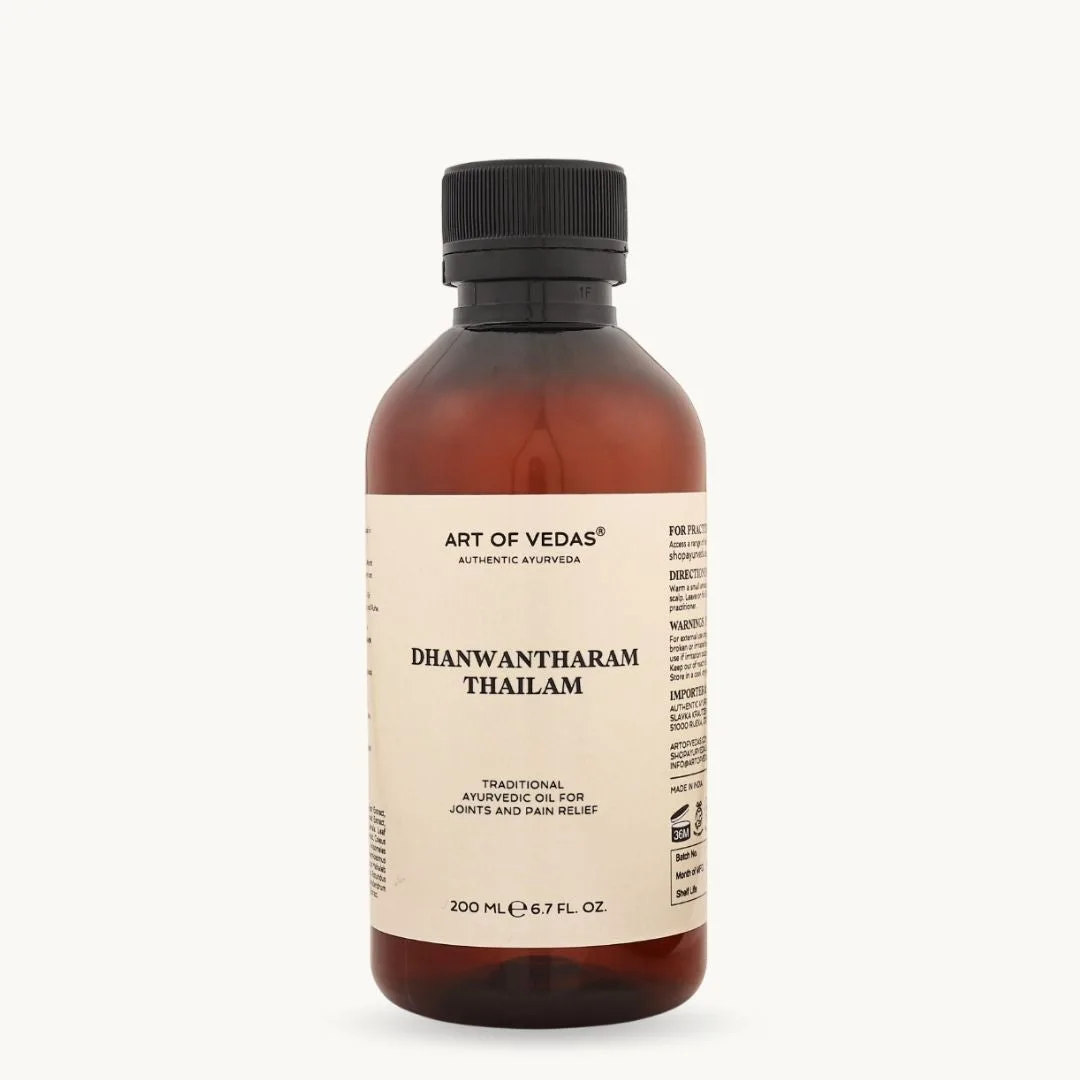
This article is part of our The Complete Guide to Dhanwantharam Thailam: Ancient Ayurvedic Oil for Modern Wellness guide series.
Among the classical Ayurvedic Thailams, Dhanwantharam Thailam holds a particularly prominent position. It is referenced in multiple classical texts - the Ashtanga Hridayam, the Sahasrayogam, the Charaka Samhita and others - in the context of Vata disorders, full-body Abhyanga, and as a primary oil in Panchakarma Purvakarma (preparatory oleation). It is named for Dhanvantari - the physician of the gods in Hindu cosmology and the patron deity of Ayurveda - a naming that reflects the esteem in which this formula has been held in the classical tradition.
This is not a recent formulation. It is a classical oil with a multi-century clinical history, still prepared according to the traditional Sneha Paka method by carefully made manufacturers, and still among the most widely used classical Ayurvedic Abhyanga oils in professional and home practice across the world.
This guide covers the classical context, the key ingredients and their properties, the specific indications, and exactly how to use Dhanwantharam Thailam in practice.
Classical Context and Textual References
Dhanwantharam Thailam appears prominently in the Sahasrayogam (classical tradition) and is referenced in the Ashtanga Hridayam in the context of Vata-related conditions. The formula is described in classical texts with specific indications including:
- Conditions described in classical terminology as involving Vata vitiation of the musculoskeletal system
- Neurological and neuromuscular presentations associated with excess Vata
- General Vata pacification for body, joints and nervous system
- Pre-Panchakarma Snehana (external oleation) as part of Purvakarma preparation
- Postpartum care (Sutika Paricharya) - a specific classical indication in which Dhanwantharam has a well-documented role in the classical tradition
The oil is considered a broad-spectrum Vatahara (Vata-pacifying) oil in the classical literature - one of the oils most consistently recommended for general full-body Abhyanga in Vata conditions and for anyone whose constitution is primarily Vata-dominant.
The Key Ingredients and Their Classical Properties
Dhanwantharam Thailam is a complex multi-herb formula. The full ingredient list includes many dozens of herbs in the classical preparation. The primary herbs and their classical roles:
Bala - Sida cordifolia
The primary herb in the Dhanwantharam formula and the name most associated with it in classical references. Bala (meaning strength in Sanskrit) is classically described as a Balya herb - one that promotes strength, nourishes the tissue layers and supports overall vitality. It is specific to Vata conditions: nourishing the nerves, muscles and joints through its heavy, warm and oily properties. Bala is the herb most classically referenced for debility, muscle wasting and neuromuscular weakness associated with Vata excess.
Dashamoola - Ten-Root Formula
Dashamoola is itself a classical compound of ten specific roots, widely used in Ayurvedic formulas for Vata conditions. It is classically described as anti-inflammatory in the Vata sense - specifically addressing the pain, stiffness and restricted movement that excess Vata produces in the joints and musculoskeletal system. The Ashtanga Hridayam references Dashamoola as a cornerstone ingredient in Vata-pacifying preparations.
Ashwagandha - Withania somnifera
One of the most well-known Ayurvedic herbs in the contemporary world, and for good reason. In classical Ayurvedic pharmacology, Ashwagandha is described as a Balya and Rasayana herb - strengthening and rejuvenating. It is specifically Vata-pacifying through its warm, heavy and nourishing qualities. In the external application context of Dhanwantharam Thailam, its properties contribute to the formula's overall nourishing and strengthening action on the musculoskeletal system.
Shatavari - Asparagus racemosus
Shatavari is classically described as a Rasayana herb with specific affinity for the reproductive and nervous system tissues. In compound Vata formulas, its nourishing, cooling and Ojas (vital essence) supporting properties add a dimension of deep nourishment that complements Bala's strengthening action.
Sesame Oil (Tila Taila) - The Base
Sesame oil is the classical Vata oil base, consistently referenced as the most appropriate oil for Vata Abhyanga. Classically described as warm, heavy, penetrating and nourishing - exactly the qualities that oppose Vata's cold, light, dry and mobile nature. The combination of sesame's deep-penetrating properties with the specific herbs of the Dhanwantharam formula produces an oil whose warming and nourishing action reaches the deeper tissue layers (Dhatus) through the skin.
What Dhanwantharam Thailam Is Used For
Full-Body Abhyanga for Vata Constitution
This is the primary everyday use - regular full-body self-massage for anyone with a primarily Vata constitution or currently experiencing elevated Vata. The oil's warming, nourishing, Vatahara properties make it the most classically referenced choice for daily Abhyanga in Vata conditions.
For Vata types practicing daily or near-daily Abhyanga: this is the foundational oil.
Musculoskeletal and Joint Support
The combination of Bala, Dashamoola and the other classical Vata herbs gives Dhanwantharam Thailam a specific classical association with conditions of the joints and musculoskeletal system - stiffness, restricted movement and the discomfort associated with cold, dry Vata accumulation in the joints. In Ayurvedic clinical practice, it is among the most consistently used oils for local application to joints and muscles.
In EU-compliant language: traditionally used in Ayurveda as a warming, nourishing oil applied to the joints and muscles as part of a self-care practice.
Pre-Panchakarma External Oleation (Bahya Snehana)
In professional Panchakarma practice, Dhanwantharam Thailam is among the most commonly used oils for the Purvakarma (preparatory) Abhyanga - the daily full-body oil massage that prepares the tissues for the primary elimination procedures. Its deep-penetrating properties and broad Vata-pacifying action make it effective for moving accumulated Doshas toward the digestive channel through the medium of sustained oil massage.
Evening and Sleep-Support Abhyanga
The warming, grounding properties of Dhanwantharam Thailam make it particularly appropriate for an evening foot and scalp application for sleep support - the classical Abhyanga practice described in the Ashtanga Hridayam as benefiting sleep quality. Read the full guide.
How to Use Dhanwantharam Thailam
Warming the Oil
Always warm Dhanwantharam Thailam before application. Place the bottle in a cup of hot water for 3 to 5 minutes. Test on the inner wrist - it should feel comfortably warm, not hot. Cold sesame oil applied to the body has significantly diminished absorption and a contracting effect on the tissues.
Full-Body Abhyanga Application
The standard Abhyanga technique applies: long strokes along the limbs from the extremities toward the torso, circular strokes at the joints, spending extra time on the lower back (primary Vata seat), hips, knees and feet. 15 to 20 minutes of application, followed by 15 to 20 minutes of rest before a warm shower.
Complete Abhyanga technique guide Choosing oils for different Vata presentations
Local Application
For specific areas of Vata-associated stiffness or discomfort: warm oil applied and worked into the area with sustained circular pressure for 5 to 10 minutes, covered with a warm cloth afterward to support absorption.
Frequency
For Vata types: daily, or as close to daily as the routine allows. Even 3 to 4 times per week produces significant cumulative effect. Consistency matters more than duration - a shorter daily practice is more effective than a thorough weekly one.
Dhanwantharam vs Mahanarayana: Which to Choose?
Both are classically referenced Vata-pacifying full-body oils. The distinction:
Dhanwantharam Thailam: The broader spectrum Vatahara oil. Appropriate for general Vata pacification, full-body daily Abhyanga, general musculoskeletal support and as the standard Panchakarma Purvakarma oil. The choice for most people practicing daily Vata-support Abhyanga.
Mahanarayana Thailam: More specifically indicated in classical texts for Vata conditions involving the musculoskeletal and neurological systems - particularly presentations with significant stiffness, restricted mobility and the classical Vata presentation in the joints and nerves. Considered more concentrated and more specific in its indication than Dhanwantharam. Often used for local application to specific areas of concern, in addition to or instead of full-body application.
For most people beginning a Vata-support Abhyanga practice, Dhanwantharam Thailam is the classical starting point. Read the Mahanarayana Thailam guide here.
Sourcing and Preparation Standards
Art of Vedas sources Dhanwantharam Thailam from carefully made Indian manufacturers whose preparation follows the classical Sneha Paka method: the combination of herbal decoction (Kashaya), herbal paste (Kalka) and sesame oil base, cooked at controlled temperature until the water content is fully evaporated and the oil has absorbed the active constituents of all herbs.
This is not a herb-infused sesame oil. It is a classical Thailam prepared according to the method described in the classical texts - a distinction that matters both for the quality of the preparation and for its classical therapeutic properties.
Explore Dhanwantharam Thailam
Browse all classical Ayurvedic massage oils
Take our free Dosha test to confirm whether Dhanwantharam Thailam is the right starting oil for your practice. Start here
For a personalised Abhyanga protocol - including oil, technique, frequency and seasonal adaptation - our AYUSH-certified Ayurvedic doctors offer personalised online consultations from anywhere in Europe.
Book an online consultation with an AYUSH-certified Ayurvedic doctor
Frequently Asked Questions
Can Pitta or Kapha types use Dhanwantharam Thailam? Dhanwantharam is a warming oil in a sesame base - primarily indicated for Vata. Pitta types generally do better with a cooling oil for Abhyanga, and Kapha types with a lighter, more stimulating formula. However, in Vata season (autumn-winter), both Pitta and Kapha types may benefit from Dhanwantharam Thailam as a seasonal adaptation, particularly for joint and musculoskeletal application.
Is Dhanwantharam Thailam available in different preparations? Classical texts describe Dhanwantharam in several forms including the standard Thailam and an Avartita (repeatedly processed) version for more intensive applications. The standard Thailam is appropriate for daily self-care Abhyanga.
How does Dhanwantharam Thailam smell? The natural scent of the classical formula - a distinctive warm, herbal and slightly earthy scent from the sesame base and the compound of Vata herbs. It is the characteristic scent of classical Ayurvedic sesame-based Thailams and is very different from refined or synthetic products.
Is Dhanwantharam Thailam safe for daily use on the face? Dhanwantharam Thailam is a body oil - its sesame base and herb concentration are calibrated for body tissue. For the face, a face-specific classical formula such as Eladi Thailam is the appropriate choice. Daily body Abhyanga with Dhanwantharam Thailam and facial Abhyanga with Eladi Thailam is the classical combination for Vata and Vata-Pitta types.
Read more: Vata Dosha guide Vata imbalance guide Full Abhyanga guide