This article is part of our Eladi Thailam vs Kumkumadi Thailam: Which Classical Ayurvedic Face Oil Is Right for You? guide series.
Important Disclaimer: Eladi Thailam is a traditional Ayurvedic wellness oil for external use only. It is not a medicine and does not treat, cure, or prevent any disease or medical condition. For any skin condition requiring medical attention, please consult a qualified healthcare professional.
Not all Eladi Thailam is the same.
Walk into any Ayurvedic pharmacy or browse online and you will find dozens of products carrying the Eladi Thailam name - ranging in price from a few euros to well over a hundred. Some are authentic preparations prepared according to classical methods with genuine ingredients. Others are pale imitations: cheap base oils with a handful of low-grade herb extracts, synthetic fragrance added to mimic the distinctive cardamom-saffron aroma, and little else.
The difference matters enormously. A genuinely prepared Eladi Thailam, made with authentic herbs cooked in quality sesame oil using the traditional Sneha Paka Vidhi process, delivers the full botanical complexity that classical Ayurveda intended. A poorly made version delivers very little beyond the label.
This guide teaches you how to tell the difference - through aroma, colour, texture, ingredient transparency, and the story a brand tells about how their product is made.
Why Quality Varies So Dramatically
The Raw Material Challenge
A manufacturer seeking to cut costs has many opportunities. They can substitute cheap alternative herbs for expensive ones. They can use low-grade or old stock that has lost much of its active compound content. They can add synthetic fragrance compounds to mimic the aroma of saffron or sandalwood without including meaningful quantities of those ingredients. And they can dilute the formula - using far more base oil per unit of herb than classical proportions specify.
The Preparation Method Gap
The Sneha Paka Vidhi process - the classical method for preparing medicated Ayurvedic oils - is time-consuming, labour-intensive, and requires genuine expertise. Done properly, it involves carefully preparing each herb, combining them with the base oil and a calculated water-based decoction, and then cooking the mixture at carefully controlled temperatures over many hours - sometimes over multiple days for premium preparations.
Many commercial producers use shortcuts: solvent extraction of individual herbal compounds, high-temperature processing that destroys heat-sensitive active compounds, or simple cold infusion that cannot achieve the compound saturation of true Sneha Paka.
The Regulatory Environment
Ayurvedic products in India are regulated under the Drugs and Cosmetics Act, but enforcement varies considerably. Classical formulations like Eladi Thailam have established formulae in official pharmacopoeias, but compliance is not always verified at the production level. This means that brand integrity and transparency become critically important - the consumer must do their own due diligence.
The Gold Standard: What Genuine Eladi Thailam Looks, Smells, and Feels Like
Colour: Deep Amber-Gold to Rich Brown
Genuine Eladi Thailam has a characteristic deep amber-gold to rich brown colour - the natural golden tone of sesame oil deepened by the herbs infused into it. The specific shade varies depending on which herbs dominate and how long the preparation was cooked, but the colour should be:
Rich and deep - not pale yellow or clear. A pale, light-coloured oil strongly suggests minimal herb content. Genuine Sneha Paka produces a noticeably darkened oil as the herb compounds transfer into the base.
Consistent - no separation, cloudiness from water contamination, or unusual sediment. A small amount of fine herbal sediment at the bottom after sitting is normal and actually a sign of genuine botanical content. This should settle clear when the bottle is gently warmed.
Natural-looking - the colour should look like a product of nature. The gold-red notes in genuine Eladi come partly from saffron (which imparts its characteristic yellow-orange pigment) and partly from haridra (turmeric) and daruharidra (Indian barberry). An Eladi Thailam without noticeable warmth in its colour likely contains very little of these ingredients.
Aroma: Complex, Layered, and Unmistakably Natural
The aroma of Eladi Thailam is its most immediately identifiable quality - and the one that most clearly distinguishes a genuine preparation from a synthetic or low-quality one.
The first note you encounter is cardamom - green and bright, slightly sweet, with that characteristic cooling aromatic quality. This is the namesake ingredient and should be the dominant initial impression.
Beneath the cardamom, you should detect sandalwood - warm, woody, deep, and slightly creamy. True sandalwood has a complexity that synthetic sandalwood entirely lacks. Genuine sandalwood oil has a warmth and depth that seems to shift slightly as you breathe it in.
Saffron's contribution is subtle - a faint, slightly honied, almost metallic-floral note that is more felt than explicitly identified. But its presence or absence makes a significant difference to the overall aromatic character. Oils without genuine saffron tend to smell flat in comparison.
Red flags in the aroma: A sharp, one-dimensional cardamom smell without sandalwood and earthy base notes suggests synthetic fragrance rather than genuine botanical content. An overly strong, perfume-like herbal smell suggests essential oil addition to a cheap base oil. A smell of rancid or stale oil beneath the herbal fragrance indicates either old oil or low-quality sesame that was not properly processed.
Texture and Feel: Nourishing Without Greasiness
Genuine Eladi Thailam has a medium weight - not as light as rosehip oil, not as heavy as castor oil. The oil should feel gently warming as it is massaged into the skin. A properly applied amount (3 to 5 drops) should be substantially absorbed within 5 to 10 minutes, leaving skin nourished and smooth rather than coated or greasy. After absorption, there should be no tacky, sticky, or waxy residue.
Reading the Ingredient List: What to Look For and What to Avoid
The Base Oil Should Be First
Ingredient lists in the EU are required to be written in descending order of concentration. For Eladi Thailam, the base oil (Sesamum indicum seed oil for the sesame variant, or Cocos nucifera oil for the coconut variant) should appear first. If the first ingredient is mineral oil (Paraffinum liquidum) or an unusual low-cost alternative not associated with traditional Eladi formulation, this is a significant red flag.
Look for the Named Classical Herbs
The ingredient list of genuine Eladi Thailam should include recognisable Ayurvedic herbs listed under their Latin names (Elettaria cardamomum for cardamom, Crocus sativus for saffron, Santalum album for sandalwood, Rubia cordifolia for manjishtha) or their Sanskrit names. A genuinely formulated Eladi Thailam should list a substantial number of botanical ingredients - typically 15 or more distinct herbs. An ingredient list containing only 5 or 6 herbs is not a complete classical formulation, regardless of what the label says.
Fragrance and Parfum - A Major Red Flag
The listing of "Fragrance" or "Parfum" on an Eladi Thailam ingredient list is a significant concern. These INCI terms often indicate that synthetic fragrance has been added - potentially to mask the absence of genuine aromatic herbs. Genuine Eladi Thailam should not require the addition of synthetic fragrance. Its aroma comes entirely from the herbs themselves.
Price as a Quality Indicator
Genuine Eladi Thailam cannot be cheap. When you consider the cost of authentic saffron, genuine sandalwood oil, legal sustainable skilled labour for the Sneha Paka process, and the full range of 25 or more botanical ingredients - the cost of producing genuine Eladi Thailam is substantial.
This does not mean the most expensive product is automatically the best. But it does mean that Eladi Thailam sold at very low prices is almost certainly not a complete, genuine classical preparation. The economics simply do not work for authentic ingredients and traditional preparation at those price points.
Why Art of Vedas Eladi Thailam
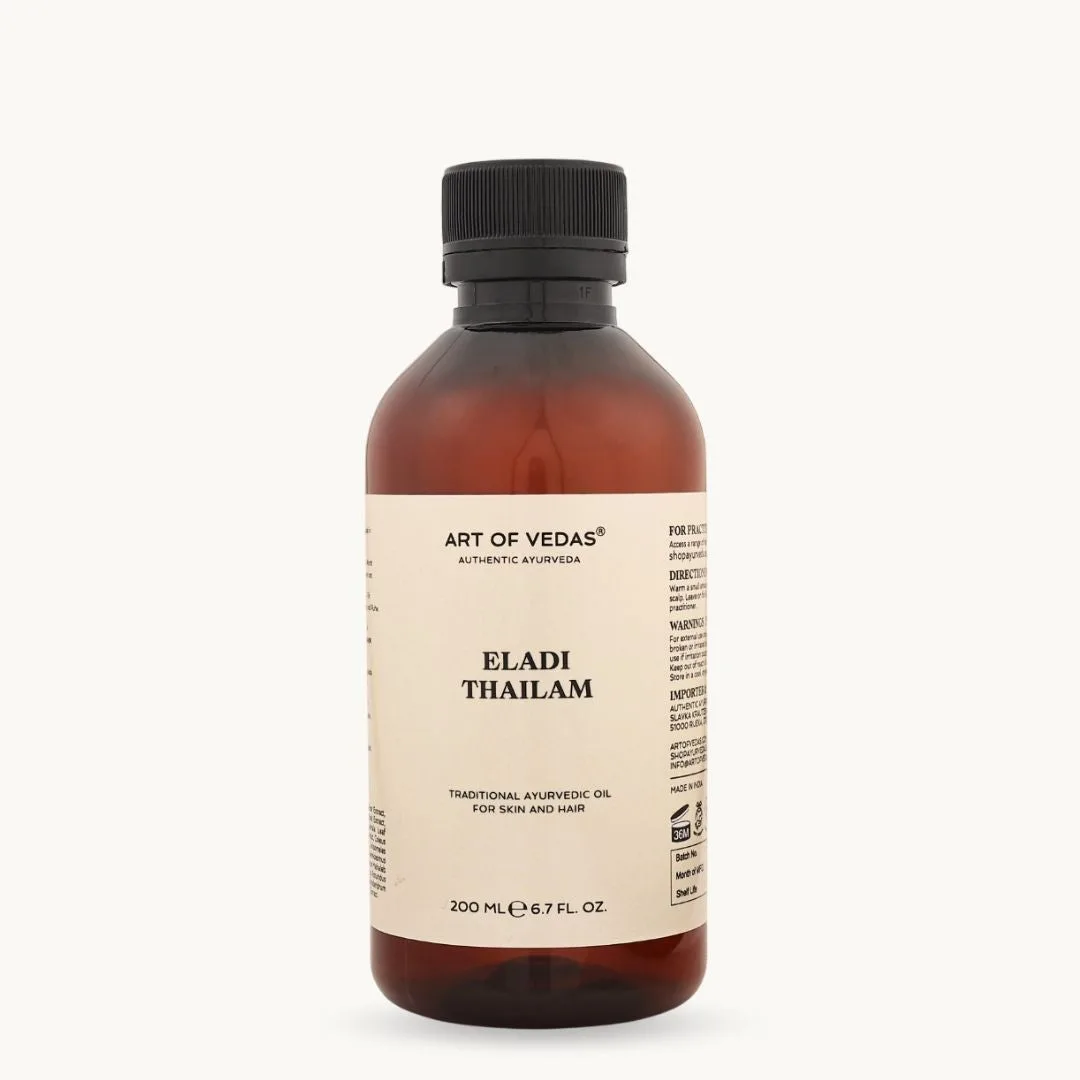
At Art of Vedas, our Eladi Thailam is prepared following the classical formula documented in Sahasrayogam and related Ayurvedic texts. The herbs are carefully selected. The preparation follows the Sneha Paka Vidhi process with three-component combination, controlled-temperature cooking, and traditional filtering.
We source genuine saffron. We use certified sustainable sandalwood. Our sesame oil base is selected for quality and freshness. And we are transparent about our formulation - the complete ingredient list is available, and we welcome questions about how our oil is made.
Shop Eladi Thailam - and experience what a genuine classical preparation actually delivers.
Continue Your Eladi Exploration