This article is part of our Ghrithams: Classical Ayurvedic Medicated Ghee guide series.
Among the four classical preparation forms described in the Ashtanga Hridayam's Kalpa Sthana - Churna (powder), Kashayam (decoction), Asavam-Arishtam (fermented preparations) and Sneha (fat-based preparations) - the Sneha preparations hold a uniquely important position. And within the Sneha category, Ghritham (medicated ghee) is described by the classical authors as the most therapeutically refined and the most broadly applicable.
The Charaka Samhita, Sutrasthana Chapter 13 (Sneha Adhyaya - the chapter on oleation), opens its treatment of ghee with a statement that has guided Ayurvedic therapeutics for centuries: Sarvesham Snehanam Ghritam Uttamam - among all fats, ghee is the best. This is not merely a dietary preference. It reflects a precise pharmacological understanding of why ghee, as a carrier medium for therapeutic herbs, achieves what no other preparation form can.
This guide covers the complete classical framework for understanding Ghritham - what it is, why ghee was chosen as the primary Rasayana carrier, how the classical Sneha Kalpana preparation method works, which conditions the classical texts describe Ghritham for, and how each of the Ghritham preparations in the Art of Vedas Ghritham collection fits within this framework.
Why Ghee? The Classical Pharmacological Rationale
The classical texts provide a detailed rationale for ghee's superiority as a therapeutic carrier that maps remarkably well onto modern understanding of fat-soluble bioavailability. The Charaka Samhita, Sutrasthana Chapter 13, lists ghee's key pharmacological properties:
Sukshma (subtle and penetrating): Ghee's molecules are small enough to pass through the finest channels of the body - the Srotas (channels) that carry nutrient fluid to individual cells, and ultimately the finest channels of the nervous system and brain. No water-based preparation can achieve this penetration. This is why the classical texts consistently prescribe Ghritham for conditions involving the nervous system, brain, sensory organs and subtle mental channels - the Majja Dhatu (nervous tissue) and Mano Vaha Srotas (mental channels) are only accessible through lipophilic carriers.
Yogavahi (carries the properties of whatever is added to it): This is perhaps the most clinically significant property of ghee in the classical formulation framework. Yogavahi means that ghee amplifies and carries the pharmacological properties of any herb processed into it - without losing its own qualities. When Brahmi is processed into ghee as Brahmi Ghritham, the ghee carries Brahmi's Medhya properties deeper into the nervous tissue than any other preparation form could achieve. The Charaka Samhita explicitly uses Yogavahi as the primary justification for ghee as the Rasayana carrier.
Snigdha (unctuous) and Mridu (soft): These Gunas (qualities) directly pacify the two most destructive Vata qualities - Ruksha (dry) and Tikshna (sharp). Vata's tendency to dry and erode the finest channels - particularly the neural channels and the Majja Dhatu - is directly countered by ghee's moistening, softening action. This makes ghee uniquely suited for the nourishment of depleted nervous tissue.
Sheeta Virya (cooling energy) with Madhura Vipaka (sweet post-digestive effect): Ghee cools while nourishing - making it applicable for conditions involving both depletion (needing nourishment) and excess Pitta heat (needing cooling). This combination is unusual; most nourishing substances are warming. Ghee's cooling nourishment makes it one of the few carriers suitable for Pitta-dominant depletion conditions where warming Rasayana herbs like Ashwagandha would be contraindicated.
Sneha Kalpana: The Classical Preparation Method
The classical preparation method for all Ghritham formulations is described in precise detail in the Ashtanga Hridayam, Kalpa Sthana Chapter 1. The method - Sneha Kalpana (fat preparation process) - has four stages:
Stage 1 - Kashayam preparation (herb decoction): The therapeutic herbs listed in the classical formula are first prepared as a concentrated decoction by simmering them in four parts water until reduced to one quarter. This extracts the water-soluble active compounds of the herbs.
Stage 2 - Kalka preparation (herb paste): A fresh paste of the same herbs is prepared separately. This provides a second extraction medium - the paste form releases different compounds than the decoction alone.
Stage 3 - Sneha Paka (fat cooking): The purified ghee (Shuddha Ghrita), the herb decoction and the herb paste are combined in the classical ratio - typically one part ghee, four parts decoction, one quarter part herb paste - and cooked over a carefully controlled low heat. The classical texts describe specific tests for completion: the paste no longer sticks to the fingers, the ghee has become clear and fragrant, and it forms characteristic threads when pulled. This process can take many hours of careful, sustained attention.
Stage 4 - Filtration and storage: The completed Ghritham is filtered while still warm to remove the herb residue, then stored in a clean vessel. The classical texts specify copper, silver or glass as the ideal storage materials - all of which Art of Vedas honours in its product packaging.
The significance of this process is that the therapeutic compounds of the herbs are transferred twice - once through the decoction water and once through the paste - into the ghee, which then binds them through its Yogavahi quality. The completed Ghritham contains the active pharmacology of the herbs in a lipophilic form that is far more bioavailable to the nervous system and brain than any water-based preparation.
The Four Classical Ghritham Categories
The classical texts organise Ghritham formulations into several broad therapeutic categories, each with a characteristic herb group and target tissue or channel:
Medhya Ghritham (mind-nourishing ghee): Formulations centred on Medhya herbs - those with specific affinity for the mind, nervous system and brain channels. The primary example at Art of Vedas is Brahmi Ghritham, built on Brahmi's classical Medhya Rasayana action. These formulations are described in the classical texts as supporting Dhi (intellect), Dhrti (sustained attention), Smriti (memory) and overall Sadhaka Pitta function - the Pitta sub-type governing mental clarity and emotional processing.
Tikta Ghritham (bitter ghee): Formulations built on bitter (Tikta rasa) herbs - Neem, Guduchi, Triphala, Patola and related plants - whose combined action is strongly Pitta-reducing, Rakta Dhatu (blood tissue) purifying and channel-opening. The primary examples at Art of Vedas are Thikthakam Ghritham (a focused bitter formula) and Mahathiktakam Ghritham (the larger, more comprehensive bitter formula). The Tikta Ghritham family is among the most frequently described Ghritham type in the classical texts across a wide range of Pitta and Rakta conditions.
Vata-pacifying Ghritham: Formulations built on the same herb groups as the major Vata-pacifying oils - Dashamula, Bala, Ashwagandha and related plants - providing the same Sarva Vata Hara action as the classical oils but through the internal oral route and with ghee's additional nourishing, channel-penetrating character. The primary example at Art of Vedas is Dhanwantharam Ghritham - the internal ghee form of the classical Dhanwantharam formulation.
Ghritham and the Oral Route: Why Internal Use Matters
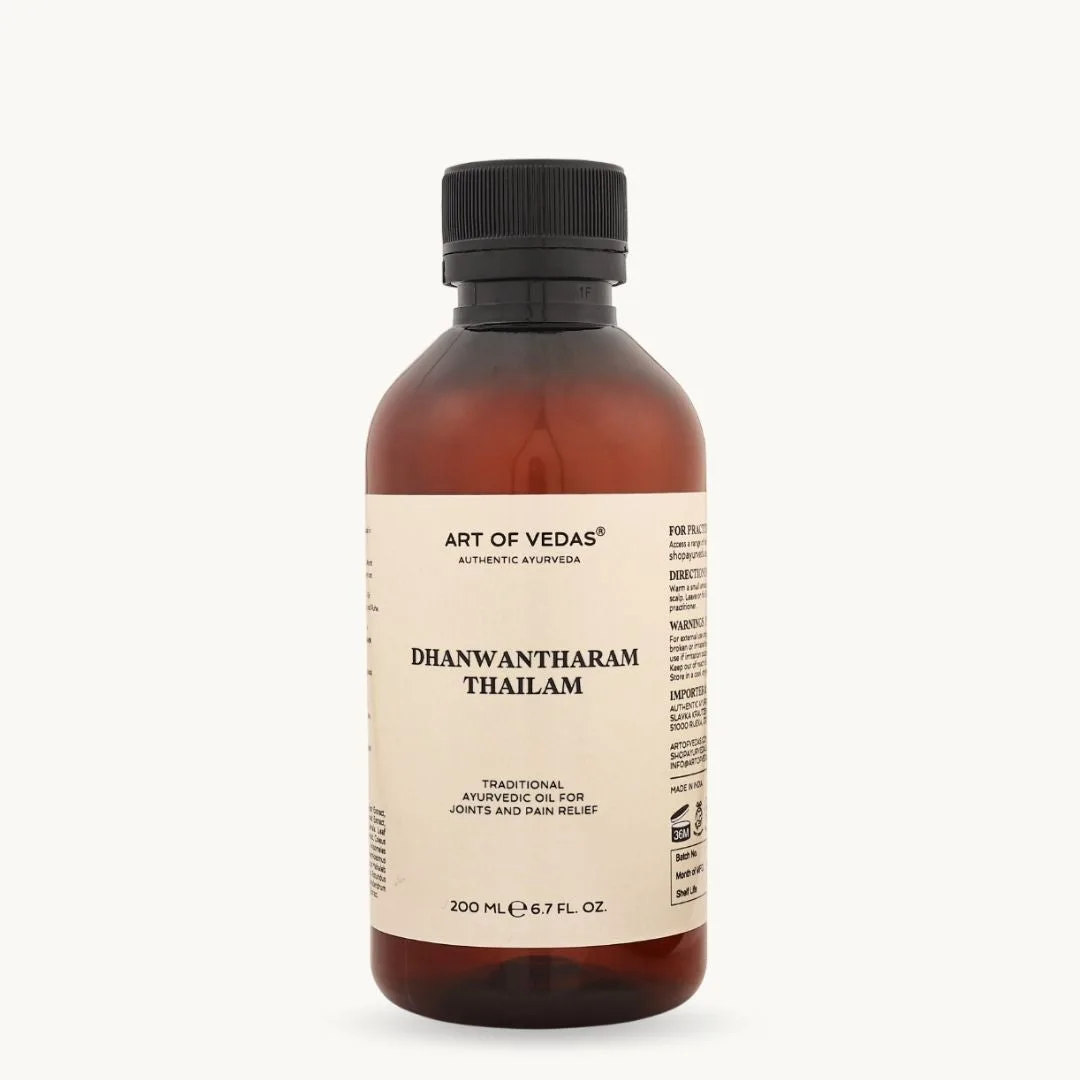
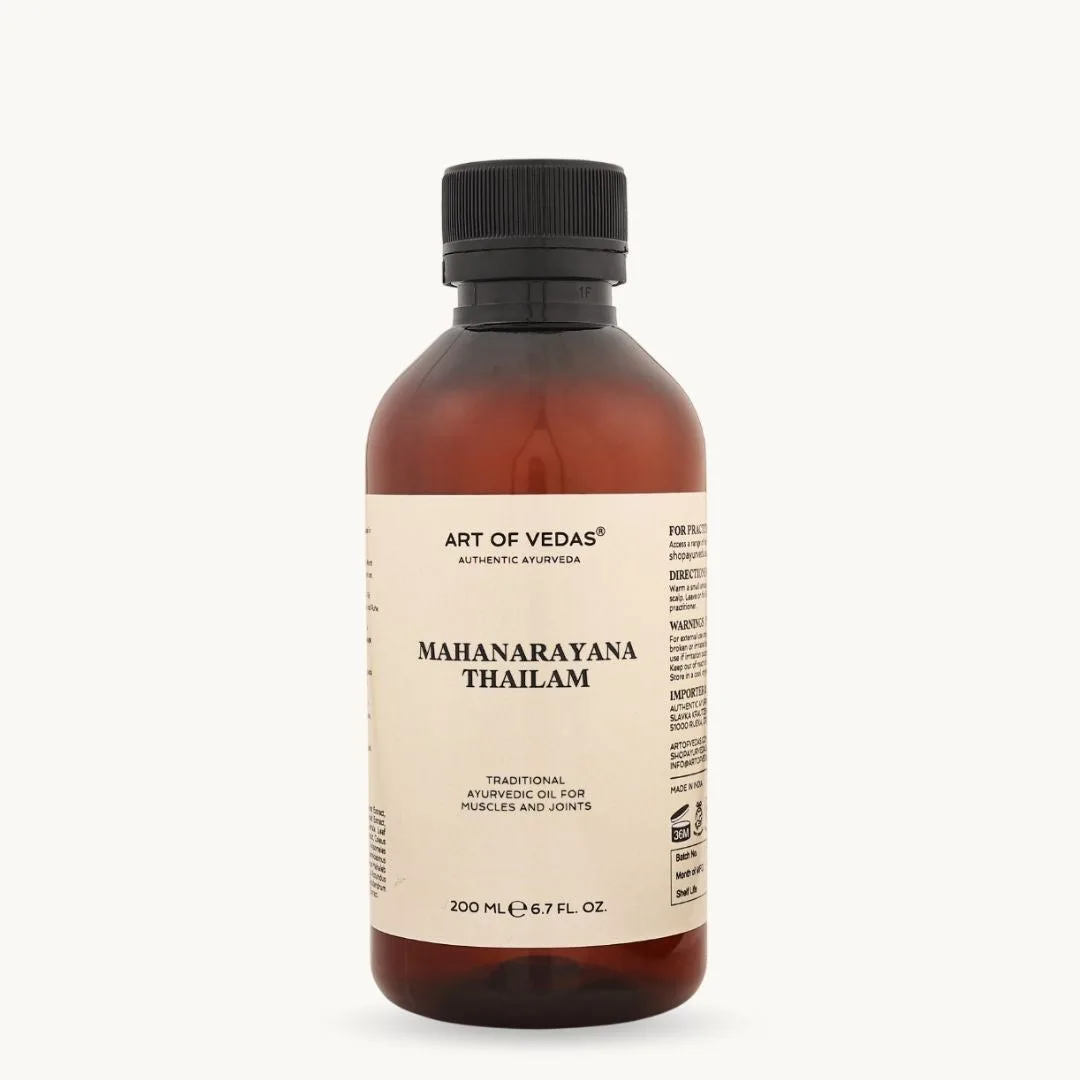
The external Abhyanga oils described throughout the Art of Vedas guide collection - Dhanwantharam Thailam, Mahanarayana Thailam, Brahmi Thailam and the others - work through the transdermal route: the therapeutic compounds penetrate through the skin via the Bhrajaka Pitta (skin channel network) and reach the body channels through the subcutaneous and deeper layers.
The Ghritham preparations work through the oral-digestive route: taken internally, the therapeutic compounds enter directly through the Rasa Dhatu (plasma-lymph tissue) and are then carried to all downstream Dhatus through the normal tissue nourishment sequence. For conditions involving the nervous system and brain - where the finest channels require fat-soluble compounds delivered from within - the oral Ghritham route reaches where even the most penetrating external oil cannot.
The classical texts consistently describe using internal Ghritham alongside external Abhyanga as a combined approach - particularly in formal Panchakarma, where internal oleation (Snehapana) with Ghritham for several days prepares the body for the purification procedures that follow. The internal oleation saturates all tissues with therapeutic ghee, loosening accumulated Doshas from the deep channels and mobilising them toward the elimination routes.
For home daily practice without formal Panchakarma, the Ghritham formulations at Art of Vedas are designed for sustained daily use as food supplements - taken in small quantities each morning as a Rasayana practice, complementing the external oil and tool practices of the daily Dinacharya.
The Ghritham Collection at Art of Vedas
The Ghritham collection at Art of Vedas includes four classical formulations covering the primary therapeutic categories described above:
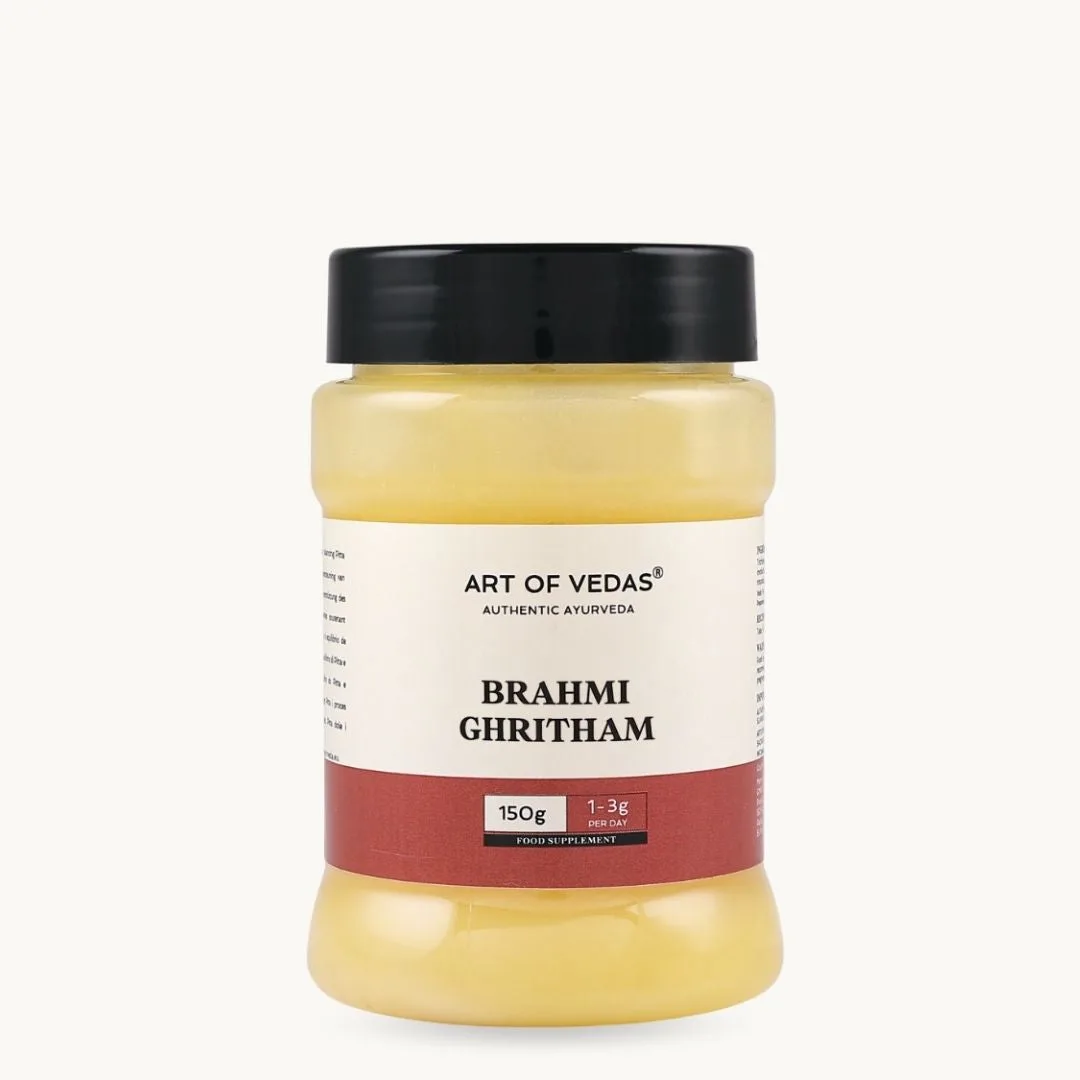
Brahmi Ghritham - the classical Medhya Rasayana ghee for mental clarity, cognitive nourishment and Pitta-cooling head channel support. Covered in the dedicated Brahmi Ghritham guide.
Dhanwantharam Ghritham - the internal ghee form of the classical Dhanwantharam formulation, for comprehensive Vata-pacifying nourishment through the oral route. Covered in the dedicated Dhanwantharam Ghritham guide.
Thikthakam Ghritham - the focused classical bitter ghee for Pitta and Rakta Dhatu support. Covered in the dedicated Thikthakam Ghritham guide.
Mahathiktakam Ghritham - the comprehensive classical bitter ghee with a larger herb group for broader Pitta-Rakta channel support. Covered in the dedicated Mahathiktakam Ghritham guide.
For the complete external oil range that complements these internal preparations, the Ayurvedic Thailams collection and the comparing classical oils guide provide the full framework. The Abhyanga guide covers how to integrate external oils into the daily practice that Ghritham supports from within.
Frequently Asked Questions
Is medicated ghee the same as regular cooking ghee?
No. Regular ghee (clarified butter) is a food ingredient - pure fat with no therapeutic herb processing. Classical Ghritham is the product of the Sneha Kalpana process described above: therapeutic herbs are decocted, pasted and cooked into the ghee through a multi-hour process that transfers the herbs' pharmacological compounds into the fat. The resulting preparation retains ghee's carrier qualities but carries a full therapeutic herb payload that regular ghee does not have.
Can I take multiple Ghritham preparations together?
The classical texts do describe combined Ghritham use in specific Panchakarma contexts, but for daily home Rasayana practice, beginning with one Ghritham preparation appropriate to the primary presentation - Brahmi Ghritham for mental-cognitive support, Dhanwantharam Ghritham for Vata nourishment, Tikta Ghritham for Pitta-Rakta presentations - is the simpler and more focused classical approach. If you are uncertain which is most appropriate for your constitution, a qualified Ayurvedic practitioner can advise.
When is the best time to take Ghritham?
The classical texts describe Ghritham taken on an empty stomach in the morning - specifically at the natural hunger transition of the early morning, before the first meal. This maximises absorption through the Rasa Dhatu before food competes for digestive attention. A small amount - half to one teaspoon - warmed to liquid consistency and taken with warm water is the classical daily Rasayana method. For specific indications such as sleep support (Brahmi Ghritham) or evening Vata calming (Dhanwantharam Ghritham), evening before-sleep use with warm water is also described in the classical texts.
How does Ghritham relate to the Panchakarma practice of Snehapana?
Snehapana (internal oleation) is the formal Panchakarma pre-procedure in which increasing quantities of medicated ghee are taken daily for 3, 7 days before the main purification procedures. This saturates all Dhatus with oleation, loosening deep-seated Doshas from the finest channels and preparing them for elimination. The Ghritham preparations at Art of Vedas are designed for daily Rasayana use - not for formal Snehapana dosing, which requires clinical supervision and progressive dose escalation. For formal Panchakarma programmes, these preparations are used under qualified practitioner guidance.
This guide presents classical Ayurvedic concepts about Ghritham for educational purposes. The Ghritham preparations at Art of Vedas are food supplements for daily Rasayana use and are not intended to diagnose, treat, cure or prevent any disease. Consult a qualified Ayurvedic practitioner for personalised guidance and before use during pregnancy or if taking medications.