In brief: Short answers to the questions people most often put to a search engine about Thailam, the classical herbal oil of Ayurveda: what the word means, how it is prepared, how the base oil is chosen and which Thailam is used for massaging the body. Where a fuller guide or a matching Art of Vedas product exists, the answer links to it.
Thailam is also written without the h, as thylam, or in its root form taila. The questions below come from real searches, with the spelling corrected.
What is a Thailam?
A Thailam is a classical Ayurvedic herbal oil. It is made by slowly cooking a water decoction and a fine paste of herbs into a base oil, until the water has gone and the oil carries the character of the plants. Most Thailams stand on sesame oil and are applied to the skin, above all in Abhyanga, the massage of the body with warm oil.
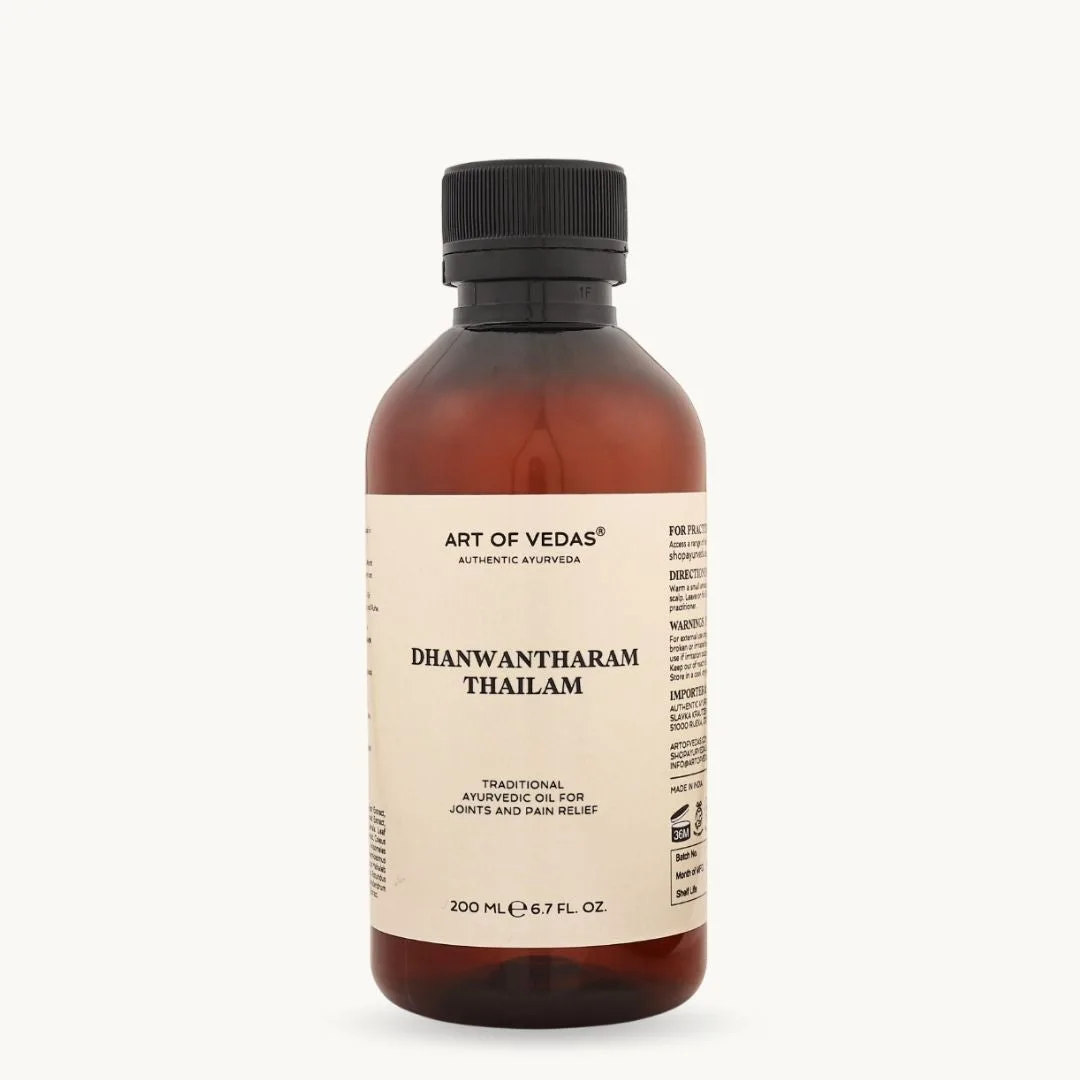
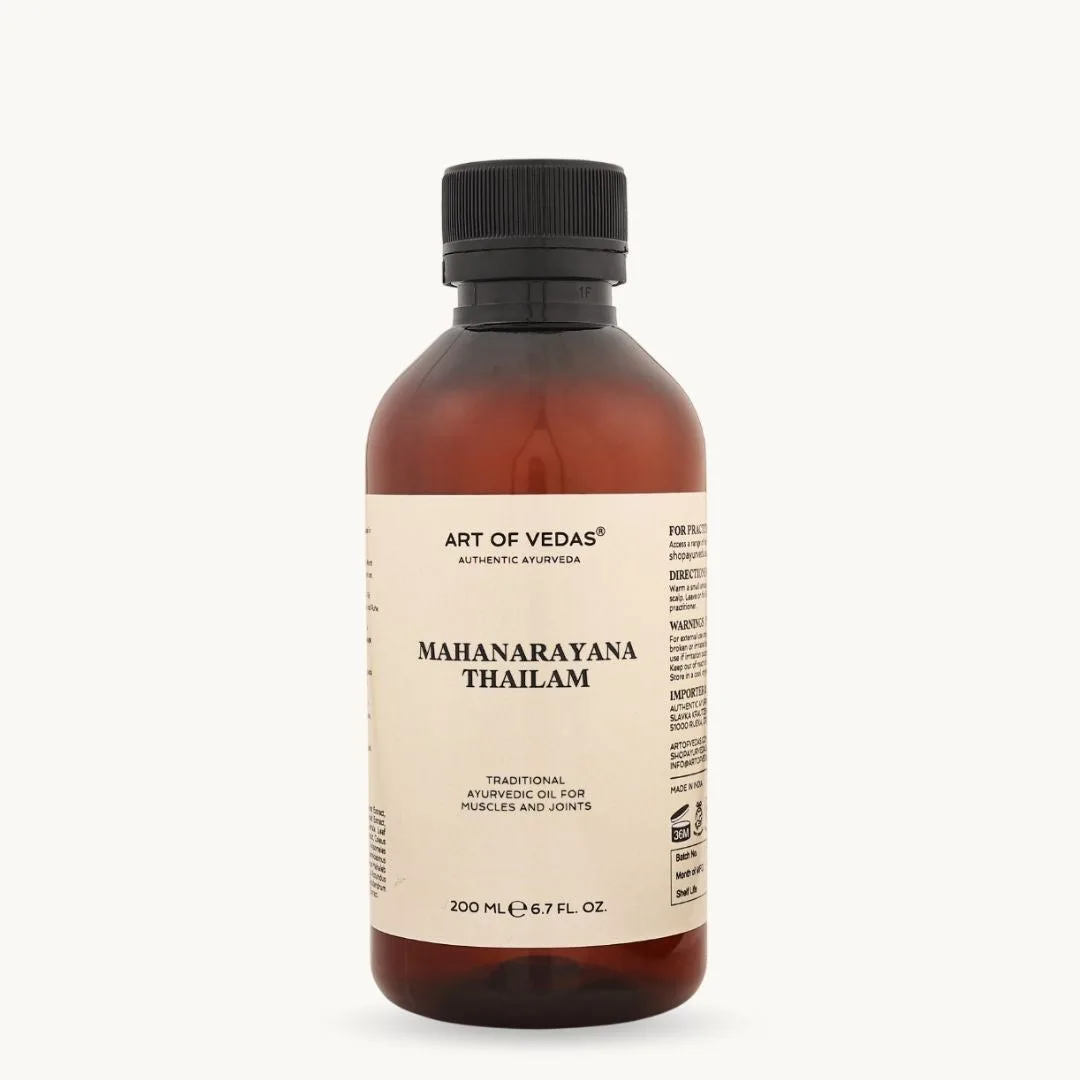
Names such as Mahanarayana or Dhanwantharam are classical formulations, set side by side in our guide to traditional Ayurvedic Thailams.
What does Thailam mean?
Thailam comes from the Sanskrit word taila, which means oil. Taila in turn comes from tila, the sesame seed, so the word first meant the oil of sesame and then oil in general. When the classical texts say taila without naming a plant, sesame oil is understood.
The classical texts, the Charaka Samhita among them, take sesame oil as the reference against which other oils are described. See our guide to Tila Taila, sesame oil in Ayurveda.
What is Thailam in English?
In English, Thailam simply means oil. In Ayurveda the word is kept for an oil into which herbs have been cooked by the classical method, so the closest English name is classical herbal oil. Mahanarayana Thailam can be read as Mahanarayana oil.
Are taila and Thailam the same in an Ayurvedic formulation?
Yes. Taila is the Sanskrit word, and Thailam is the same word in the spelling Art of Vedas uses. Thylam and the spelling without the h are further variants. A formula name means the same preparation whichever spelling follows it.
Thailam vs oil: what is the difference?
A plain oil, such as sesame or coconut oil, is a single oil with nothing added. A Thailam starts from such an oil, which is then cooked with a herbal decoction and a herb paste according to a classical formula, so it carries the character of its herbs as well as of the oil. Herbs stirred or steeped into an oil do not make a Thailam.
How do you prepare a Thailam?
A Thailam is prepared by the classical method called Taila Paka Vidhi, literally the method of cooking oil. Three things go into the vessel: the base oil, a Kashayam (a water decoction of the herbs) and a Kalka (a fine herb paste). They are cooked together over a low, steady heat until all the water has left, and the oil is then strained through cloth.
The finished stage is judged by classical signs: the herb paste, for one, can be rolled into a wick between the fingers. Dhanwantharam Thailam is prepared in this way. Each stage is set out in our guide to the texts and preparation of Mahanarayana Thailam.
How are base oils selected for herbal infusions in taila preparations?
The base oil is decided first, because it sets the character of the finished preparation more than any single herb. Sesame is the usual base, read by the tradition as warming and associated with Vata. Coconut is read as cooling and light and is associated with Pitta and the warmer months. Castor is dense and warming and gives a markedly thicker oil.
What are the different types of Thailam?
Thailams can be grouped in three practical ways. By base oil: sesame, coconut or castor. By use: for full-body Abhyanga, for one area of the body, for the face, for the head and scalp, or for Nasya. And by consistency: the liquid Thailam has two firmer relatives, the Kuzhambu and the Mezhukupakam.
What is sesame oil (Tila Taila) used for in Ayurveda?
Sesame oil, Tila Taila, has three classical uses: it is the plain oil for Abhyanga, the base into which the herbs of most Thailams are cooked, and the oil the classical texts name for the oral practices Kavala and Gandusha. The tradition describes it as warming and associates it first with Vata.
Which use suits a particular person is a matter for a qualified Ayurvedic practitioner.
Which Ayurvedic Thailam is used for massaging the body?
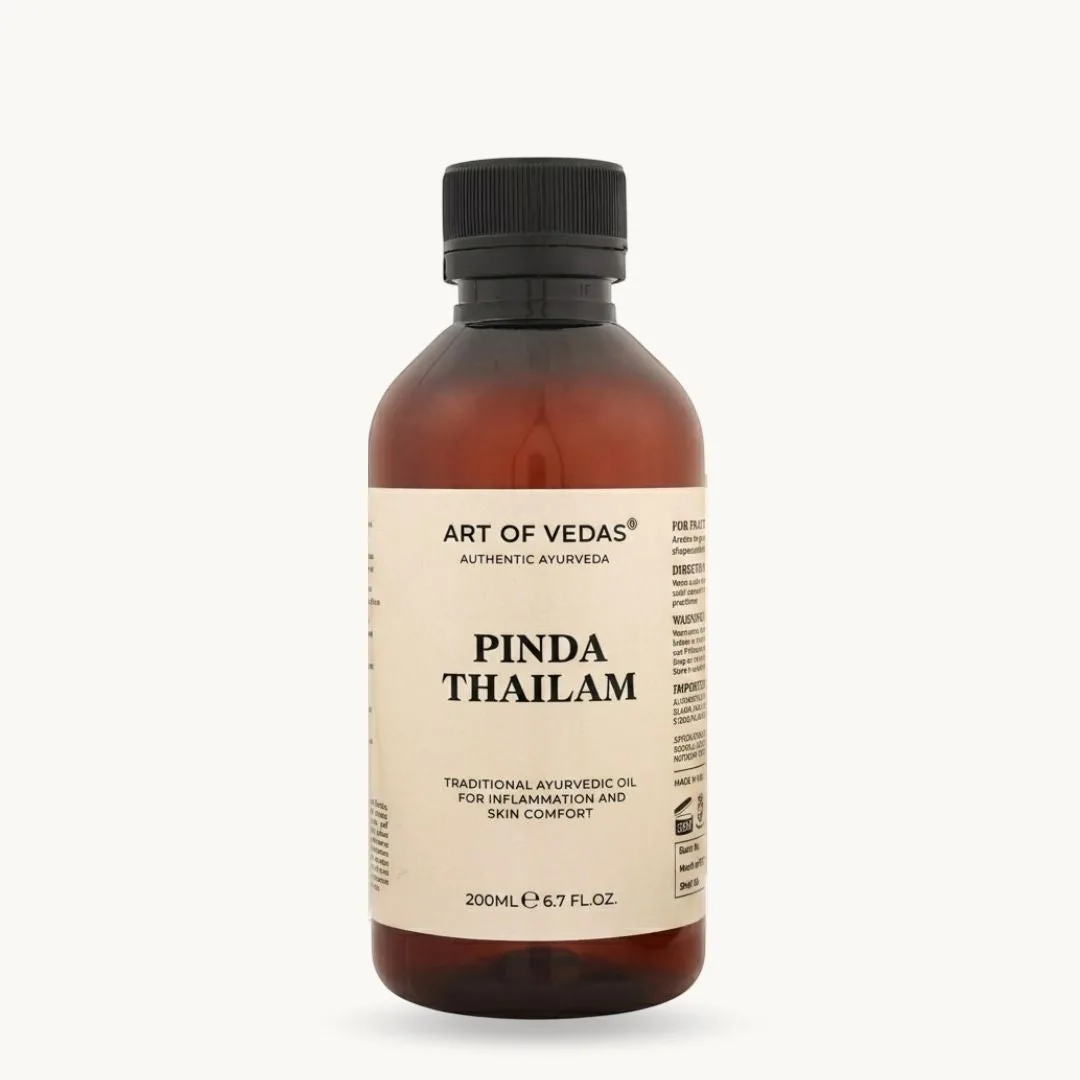
There is no single one: for full-body Abhyanga the tradition uses a liquid Thailam and matches it to the person and the season. Mahanarayana Thailam is a warming oil on a sesame base and Dhanwantharam Thailam a sesame-based oil with Bala; both are used for Abhyanga and classically associated with Vata. Pinda Thailam is a cooling oil classically associated with Pitta. The whole range is in the Thailam collection.
Vata Thailam or Pitta Thailam: which oil goes with which Dosha?
The classical shorthand goes by opposites. Heavier, warming oils on a sesame base are matched with Vata, cooler and lighter preparations with Pitta, and lighter oils used sparingly with Kapha. Karpooradi Thailam, a warming oil with camphor, is classically associated with Kapha and Vata.
This is an orientation, not a rule, because season and person both count. If you do not know your constitution, start with the Dosha test; our guide on how to choose an Ayurvedic oil or Thailam explains the rest.
What is the difference between a Thailam and a Kuzhambu?
A Thailam is a liquid oil on a single base oil; it spreads easily and is the classical format for full-body Abhyanga. A Kuzhambu is not liquid at all: it is a thick, semi-solid preparation. It is made by the same method, classically on a base of several fats, and reduced further, so it stays where it is placed and is used on one area at a time.
Dhanwantharam Kuzhambu is the semi-solid form of the Dhanwantharam formula. A Ghritham is different again: its base is ghee, and the Ghritham preparations at Art of Vedas are food supplements, outside the scope of this page. See Thailam vs Kuzhambu.
What is the method of application of Mahamasha Thailam?
Mahamasha Thailam is applied warm, as an oil for Abhyanga. Stand the closed bottle in warm water until the oil is pleasantly warm, never hot. Apply it to the whole body or to one area with long strokes along the limbs, leave it on for about 20 minutes and follow with a warm shower or bath.
It is named after Masha, black gram, and is a warming Thailam on a sesame base, classically associated with Vata. Anything beyond how the oil is applied is a question for a qualified Ayurvedic practitioner.
What is Brahmi Thailam used for?
Brahmi Thailam is an oil for the head. It is made with Brahmi (Bacopa monnieri), liquorice and camphor in sesame oil, and it is massaged into the scalp with the fingertips, the practice known as Shiroabhyanga. It is described as a cooling oil and is classically associated with Pitta.
Warm a little between the palms, work it into the scalp with gentle circular movements, leave it for at least 30 minutes and wash it out.
What is the time frame for a Thailam?
Two time frames matter. On the skin, the directions for the body Thailams allow 15 to 30 minutes between application and bathing, depending on the oil. On the shelf, the product information gives about three years when the oil is stored correctly, and the date printed on the bottle is the one that counts.
Store a Thailam in a cool, dry place away from direct sunlight, with the bottle tightly closed. If the oil thickens in a cold room, which is normal, stand the closed bottle in warm water for a few minutes. Do not use a microwave.
Products mentioned on this page
- Mahanarayana Thailam: warming, on a sesame base, for Abhyanga; classically associated with Vata.
- Dhanwantharam Thailam: sesame-based, with Bala, for full-body Abhyanga; classically associated with Vata.
- Pinda Thailam: cooling, with Manjishta and Sariva on a sesame base; classically associated with Pitta.
- Karpooradi Thailam: warming, with camphor on a sesame base; classically associated with Kapha and Vata.
- Mahamasha Thailam: warming, on a sesame base, named after Masha, black gram; classically associated with Vata.
- Brahmi Thailam: a cooling scalp oil with Brahmi, liquorice and camphor in sesame oil; classically associated with Pitta.
- Nalpamaradi Kera Thailam: a classical skin oil in a coconut base.
- Dhanwantharam Kuzhambu: semi-solid, on a sesame and castor base, for one area at a time; classically associated with Vata.
Read further
More questions answered
For external use only. Not a substitute for professional medical advice.