





Trusted by Our Customers
These are the products our customers choose again and again. Trusted for their authenticity, quality and the way they feel in daily practice, each one has earned its place through real Ayurveda Experience.

A set of two handcrafted pure copper eye cups, shaped to fit comfortably over the eye socket for Netra Prakshalana, the Ayurvedic practice of eye cleansing.
The rim of each cup creates a gentle seal around the orbital bone, allowing you to hold a rinse solution in place while you blink softly beneath it. The liquid washes over the surface of the eye, lifting dust, residue, and the accumulated strain of the day. One cup for each eye — you never cross-contaminate.
In Ayurveda, the eyes are governed by Alochaka Pitta, the subtle fire responsible for visual perception. Of all the senses, sight is considered the most Pitta dependent, and therefore the most vulnerable to heat, overuse, and fatigue. Netra Prakshalana is the classical practice designed to cleanse, cool, and restore the eyes as part of your daily or weekly Dinacharya routine.
For anyone who spends long hours on screens, works under artificial light, or lives in dry or dusty environments, this is one of the simplest and most immediate rituals in Ayurveda.

Ashwagandha (Withania somnifera) is one of the most revered Rasayana herbs in Ayurveda, referenced in the Charaka Samhita and Ashtanga Hridayam. The name means "the smell of a horse," reflecting the vitality and stamina it traditionally imparts. With a warming Virya and sweet post-digestive effect, it is especially suited for Vata and Kapha constitutions.
Classical texts describe Ashwagandha as Balya (strength-promoting), Rasayana (rejuvenative) and Vrishya (vitality-enhancing). One of the finest adaptogenic herbs in the Ayurvedic pharmacopoeia, ideal for autumn and winter routines. Take 2 capsules daily with warm water, or as advised by your healthcare professional.
This product is a food supplement. Not intended to diagnose, treat, cure or prevent any disease. Not suitable for children, pregnant or breastfeeding women.

This is where the ritual ends. After your face oil, after your Kansa wand, you press this in and you are done.
A traditional Ayurvedic face cream built on Varnya herbs: Saffron, Manjishtha, Nalpamaradi Oil, and Sandalwood. Rich in consistency, but it absorbs cleanly and leaves no residue. Your skin feels soft, nourished, and settled, not coated.
It works morning or evening, but it earns its place most in the evening ritual. Apply it as the final step after your oil and Kansa massage, when the skin is warm and ready to absorb. A small amount is enough. Press it in, don't rub.

Brahmi Ghritham is the classical ghee preparation of Brahmi (Bacopa monnieri), the primary Medhya Rasayana of the Ayurvedic tradition. Documented in the Ashtanga Hridayam (Uttarasthana) and Charaka Samhita, this formulation combines 10 carefully selected herbs processed into purified cow's ghee through the traditional Sneha Kalpana method. The ghee carrier reaches the finest channels of the nervous system, delivering Brahmi's cooling, mind-nourishing properties to Majja Dhatu (nervous tissue) with exceptional depth.
Brahmi Ghritham is Tridoshic with a cooling Virya, particularly valued for Pitta-predominant conditions of the mind. Classical texts describe it as Medhya (intellect-nourishing), Rasayana (rejuvenative) and Majja Dhatu Poshaka (nervous tissue-nourishing). It complements the external application of Brahmi Thailam: the Ghritham works through the internal digestive channels, while the Thailam works through the scalp and transdermal route.
Take 1-3g daily on an empty stomach, warmed to liquid consistency, with warm water, or as directed by your Ayurvedic practitioner.
This product is a food supplement. Not intended to diagnose, treat, cure or prevent any disease. Do not exceed the recommended daily dose. Consult a qualified practitioner before use if pregnant, breastfeeding or taking medication.

A pure copper tongue cleaner with two handles and a wide U-shaped scraping edge to cover the full width of your tongue in a single, steady pass.
Where the single-handle tongue scraper uses a narrower edge for precise, targeted scraping, the double-handle design takes the opposite approach. The wider edge spans the tongue from side to side, and the two-handed grip distributes pressure evenly across the entire surface. One stroke covers what the single handle does in two or three.
Hold one handle in each hand. Place the curved edge at the back of the tongue. Draw it forward in one smooth, controlled movement. The two-point grip keeps the angle consistent and the pressure balanced, there is no tilting, no uneven contact, no need to adjust mid-stroke. For people who prefer a gentler approach or have a sensitive gag reflex, this level of control makes the practice noticeably more comfortable.

Gokshura (Tribulus terrestris) is a highly regarded classical herb mentioned in the Charaka Samhita and Ashtanga Hridayam as a Rasayana of particular standing. With a sweet taste and cooling Virya, it is one of the few herbs in the classical tradition that pacifies both Vata and Pitta. It is also a key ingredient in the classical compound Gokshuradi Guggulu.
Classical texts describe Gokshura as Balya (associated with vitality in Ayurvedic tradition), Vrishya (a classical Ayurvedic property) and Rasayana (rejuvenative in the classical Ayurvedic sense). Suitable for daily use as part of a wellness-focused routine. Take 2 capsules daily with warm water, or as advised by your healthcare professional.
This product is a food supplement. Not intended to diagnose, treat, cure or prevent any disease. Not recommended during pregnancy or breastfeeding.

Guggulu (Commiphora mukul) is one of the most significant substances in the classical Ayurvedic pharmacopoeia, referenced extensively in the Sushruta Samhita and Charaka Samhita. It is a natural tree resin with a unique Yogavahi property: the ability to carry and enhance the action of other herbs to deeper tissue levels. It has a particular affinity for Vata and Kapha Doshas.
Classical texts describe Guggulu as Rasayana (rejuvenative), Deepana (Agni-kindling) and Shodhana (cleansing). Warming, penetrating and traditionally valued for its purifying qualities. Take 1-2 capsules daily with water, or as advised by your Ayurvedic practitioner.
This product is a food supplement. Not intended to diagnose, treat, cure or prevent any disease. Intended for use under the supervision of a qualified Ayurvedic practitioner.

The Kansa Comb is a scalp tool cast from Kansa metal, the copper-tin bronze used in Ayurvedic ritual practice for centuries. The teeth of the comb are pointed and designed to reach the scalp through the hair, making contact with the marma points of the head as the comb moves slowly across the scalp. This is not a massage tool used with pressure. The correct technique is slow, deliberate, and gentle, the pointed teeth do the work; you simply guide the comb.
Kansa has a naturally cooling quality. In Ayurveda, this is associated with calming Pitta in the head, the accumulated heat that shows as scalp sensitivity, irritation, and a restless, overheated mind. The comb draws that heat gently outward as it moves across the scalp.
This is a tool for daily use. Two to three minutes in the evening, used dry or with a light hair oil, is sufficient. Used consistently, it becomes one of the quieter and more grounding habits in a daily Dinacharya practice of Śīrṣa Abhyanga.

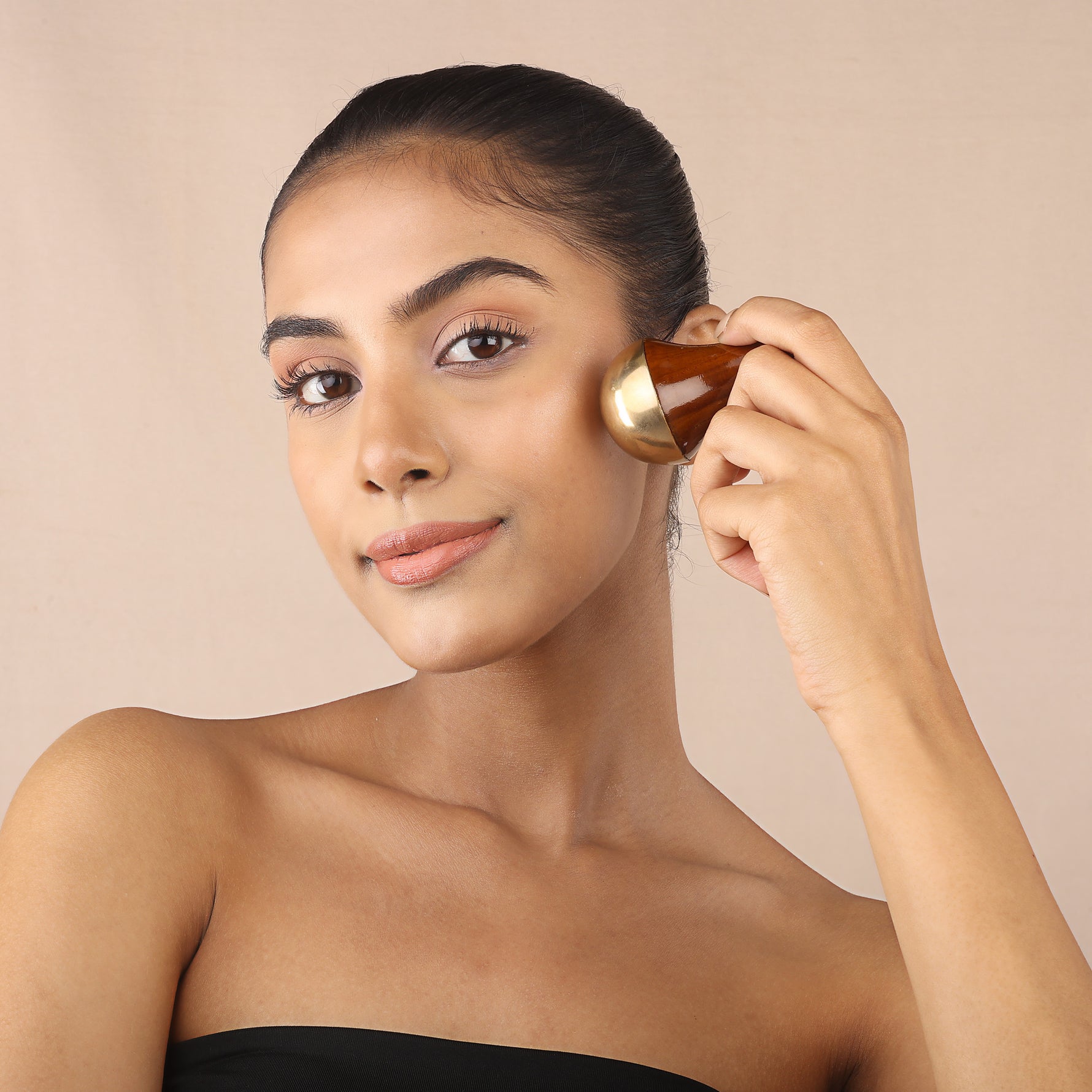
The Kansa Marma Wand is a pointed-tip massage tool hand-cast from Kansa bronze with an ergonomic hardwood handle. The tapered tip is designed for precise, sustained contact on individual marma points, the vital energy junctions described in the Sushruta Samhita. Where broader Kansa tools cover wide areas of the face or body, the Marma Wand focuses on one point at a time.
Apply a small amount of oil to the area first. Place the tip on the marma point and hold with gentle, steady pressure for 10 to 30 seconds before moving to the next point. Commonly used on the face (Sthapani, Shankha, Apanga), the hands (Talahridaya) and the feet (Kshipra, Gulpha). Clean and dry thoroughly after each use. Store away from moisture.
For external use only. Not a substitute for professional medical advice.

Ksheerabala Thailam is a classical Ayurvedic formulation documented in Ashtanga Hridayam and Sahasrayogam. This elegant three-ingredient oil, Bala (Sida cordifolia), cow's milk, and sesame oil is traditionally regarded as a nerve tonic in Ayurveda. Prepared using the Ksheerapaka method (milk processing), Ksheerabala offers a cooling, calming quality that distinguishes it from warming oils like Mahanarayana. Particularly valued for Padabhyanga (foot massage) as part of an evening relaxation ritual.

This is a pure copper drinking glass for Ushapana, the Ayurvedic practice of drinking water that has been stored overnight in a copper vessel.
In the Ayurvedic daily routine (Dinacharya), Ushapana is the final step of Dantacharya, the morning oral care sequence. You scrape your tongue, do oil pulling with Arimedadi Thailam, and then drink your first water of the day from a copper vessel. The classical texts describe this sequence as the correct way to begin every morning.
Copper has been the preferred material for water vessels in India for centuries. The Ayurvedic tradition refers to Tamra (copper) as naturally purifying, and the practice of storing water in copper overnight known as Tamra Jal, is one of the oldest and simplest Ayurvedic recommendations. It requires no preparation, no special knowledge, and no time. You fill the glass before bed. You drink from it when you wake up.
This glass is crafted from solid, food-grade pure copper. It is unlined and uncoated, so the water is in direct contact with the copper surface throughout the night. The size is practical for daily use, enough for one full serving of morning water.

Shallaki (Boswellia serrata) is one of Ayurveda's most celebrated classical herbs, referenced in the Sushruta Samhita and Ashtanga Hridayam. The resin of the Boswellia tree has been valued for centuries in Ayurvedic practice. With a bitter and astringent taste, it has a particular affinity for Vata and Kapha Doshas.
Classical texts describe Shallaki as Shothaghna (comfort-supporting), Vedanasthapana (ease-promoting) and Rasayana (rejuvenative). Suitable for daily use as part of a balanced wellness routine. Take 2 capsules daily with warm water, or as advised by your healthcare professional.
This product is a food supplement. Not intended to diagnose, treat, cure or prevent any disease. Not recommended during pregnancy or breastfeeding.

Shatavari (Asparagus racemosus) is one of Ayurveda's most celebrated Rasayana herbs, praised in the Charaka Samhita and Ashtanga Hridayam for its deeply nourishing qualities. The name means "she who possesses a hundred husbands," reflecting its traditional importance. With a sweet taste, cooling Virya and sweet Vipaka, Shatavari is the quintessential Pitta-pacifying and Vata-nourishing herb.
Classical texts describe it as Balya (strength-promoting), Vrishya (vitality-enhancing) and Jivaniya (life-giving). A valued Rasayana for all constitutions. Take 2 capsules daily with warm water, or as advised by your Ayurvedic practitioner.
This product is a food supplement. Not intended to diagnose, treat, cure or prevent any disease. Not recommended during pregnancy or breastfeeding.

Shatavari Churnam (Asparagus racemosus) is one of the most celebrated Rasayana herbs in classical Ayurveda. The name literally means "she who possesses a hundred husbands," a poetic reference to its deep nourishing and rejuvenating qualities. It is classified as a Stri Rasayana (woman's rejuvenative) par excellence in the Charaka Samhita.
With a sweet taste, cooling Virya and sweet Vipaka, Shatavari is the quintessential Pitta-pacifying and Vata-nourishing herb. Classical texts describe it as Balya (strength-promoting), Vrishya (vitality-enhancing) and Jivaniya (life-giving). While traditionally celebrated for women's wellness, it is equally valued as a general Rasayana for all constitutions.
Take 1/2 to 1 teaspoon (2-3g) mixed with warm milk, ghee or water, once or twice daily. The classical carrier of warm milk with a pinch of sugar enhances its Rasayana qualities.
This product is a food supplement. Not intended to diagnose, treat, cure or prevent any disease. Consult a qualified practitioner before use if pregnant, breastfeeding or taking medication.

Art of Vedas Tri Dosha Massage Oil is a balanced, harmonising Abhyanga blend formulated to suit all three constitutional types: Vata, Pitta and Kapha. While the Vata and Pitta oils are tailored to specific constitutional tendencies, this Tridoshic blend occupies the classical middle ground -- neither too warming nor too cooling, neither too heavy nor too light. It is the practical choice when you are unsure of your constitution, when your preferences shift with the seasons, or when multiple family members share one oil.
The Charaka Samhita and Ashtanga Hridayam describe Abhyanga (traditional warm oil self-massage) as one of the most important daily practices in Dinacharya, valued for every person regardless of constitution. This oil honours that universal principle with a carefully balanced formulation that nourishes the skin, supports a sense of calm and groundedness, and creates a pleasant, centering aromatic experience. The aromatic profile is warm yet gentle, designed to be agreeable across all constitutional types and seasons.
For external use only. Not intended to diagnose, treat, cure or prevent any disease. Not a substitute for professional medical advice. Patch test before first use. Discontinue if irritation occurs. Store in a cool, dry place away from direct sunlight.

Triphaladi Thailam is a classical Ayurvedic Moordhataila (head oil) documented in Sahasrayogam, formulated with the legendary Triphala trio of Amalaki, Haritaki and Bibhitaki at its foundation. This exceptionally comprehensive formulation combines 27 carefully selected herbs including Bhringraj (the "King of Hair"), Neeli (Indigo), Ashwagandha and cooling botanicals like Lotus and Blue Water Lily, all prepared in pure sesame oil using the traditional Sneha Paka Vidhi method.
What sets this Triphaladi Thailam apart is its enhanced formulation. Beyond the classical Triphala base, it includes Neeli (Indigofera tinctoria) traditionally valued for supporting natural hair colour, Ashwagandha for its adaptogenic and stress-relieving properties, and a collection of cooling, Pitta-pacifying herbs that make it ideal for those experiencing scalp sensitivity, excess heat or premature greying.
This tridoshic oil helps restore balance to the scalp environment, supports healthy hair roots and addresses common concerns like dandruff, itching and scalp buildup. Its cooling yet clarifying nature makes it especially beneficial for those with excess Pitta in the head region. Beyond hair wellness, traditional texts note its supportive effects on the sense organs and mental clarity when used regularly for Shiro Abhyanga (head massage).
Showing 34/34
Let customers speak for us

I was struggling to find authentic Ayurvedic items, i am glad to make my order


I ordered several supplements and oils from there and they are great quality

In advice of a good friend, I ordered and received my goods in really good condition. Wands are beautiful and nice to handle. I'm ready to learn more of Ayurveda and looking forward to see what is does with my body & soul. Service (responding to mail) is friendly and correct. Thx so much for that !


The order was quickly, all items in best conditions, massage oils smooth and healthy. I fully recommend.

Love the Art of Vedas high quality products and there follow up with emails. Highly reliable. Highly recommended.
