In brief: Bilva Thailam (also written Bilvadi Thailam, Bilva Taila or Bilva oil) is a classical Ayurvedic medicated oil in which the Bilva tree, Aegle marmelos, is cooked into a sesame oil base. The classical texts place it among the oils of Karna Purana, the traditional ritual of the ear, a practitioner-led procedure and not a home practice. Art of Vedas does not currently offer Bilva Thailam; Bilva appears in our range as one of the Dashamoola roots declared in Dhanwantharam Thailam and Mahanarayana Thailam. This guide covers what Bilva Thailam is, how the texts describe it, and which oils in our range contain Bilva.
What Bilva Thailam is and where the name comes from
Bilva is the Sanskrit name of the bael tree, Aegle marmelos, a thorny tree of the citrus family with a hard-shelled fruit and leaves that grow in threes. It is one of the most respected plants of the Indian tradition, both in the classical texts and in ritual, where its leaves are offered in temple worship. Thailam, Thailam and Taila are the same word in different transliterations and mean a medicated oil: a base oil into which a decoction and a paste of plants have been cooked until the water has gone. Bilva Thailam is therefore the oil made with Bilva. The spelling Bilvadi Thailam, with the suffix adi, means "the oil beginning with Bilva", the usual way a classical recipe is named after its first ingredient. Unlike Mahanarayana or Dhanwantharam Thailam, which are made in quantity for Abhyanga of the whole body, it is a small, specialised oil prepared for one particular procedure, and it remains a product of practitioner dispensaries rather than of the home shelf.
The classical description
The classical recipe names, among others, the Bilva tree, prepared as a decoction and a paste, and a sesame oil base, cooked together by the Sneha Paka method. Some versions add other liquids to the cooking, and the proportions vary between the compendia, so the exact list depends on which text a maker follows. The oil is placed in the chapters of the classical compendia that deal with the ear, and the Sahasrayogam, the collection of recipes used in the southern tradition, lists a Bilva oil in the same context. Where the texts describe it, they do so in the language of the ear ritual and of Vata, and this guide keeps to that description without adding claims of its own.
Bilva itself appears in the texts in two forms that should not be confused. The root and root bark are one of the ten roots of the Dashamoola group, which opens many classical Vata formulas; the unripe fruit is a separate material of the dietary tradition, prepared quite differently. It is the root that the oil tradition uses.
Character in Ayurvedic terms
The tradition describes Bilva as warming, Ushna, with a bitter and astringent taste, and places it with Vata and Kapha. Cooked into sesame oil, itself warming and placed with Vata, the finished Bilva Thailam is described as a warming oil of the Vata group. That is the same family of character as the large Dashamoola oils in our range, which is why those oils are the natural place to look for Bilva if you are shopping for a Thailam.
Karna Purana: the ear ritual in the tradition
Karna Purana, literally the filling of the ear, is one of the procedures of the classical daily and seasonal routine described in the compendia alongside Abhyanga, Nasya and Gandusha. In the tradition it is carried out by a trained practitioner in a clinical setting, with warmed oil retained for a measured time while the practitioner stays present. Bilva Thailam is one of the oils named for this procedure, which is why the two are linked in the texts.
This guide describes the ritual as tradition only. It is not an instruction, and Art of Vedas does not advise anyone to carry out Karna Purana at home or with any oil from our range. Our oils are sold for Abhyanga, the oil massage of the skin, and for the hair and scalp. Anyone interested in the ear ritual as a classical procedure should ask a qualified Ayurvedic practitioner or an Ayurvedic clinic that offers it under supervision.
Bilva within the Dashamoola group
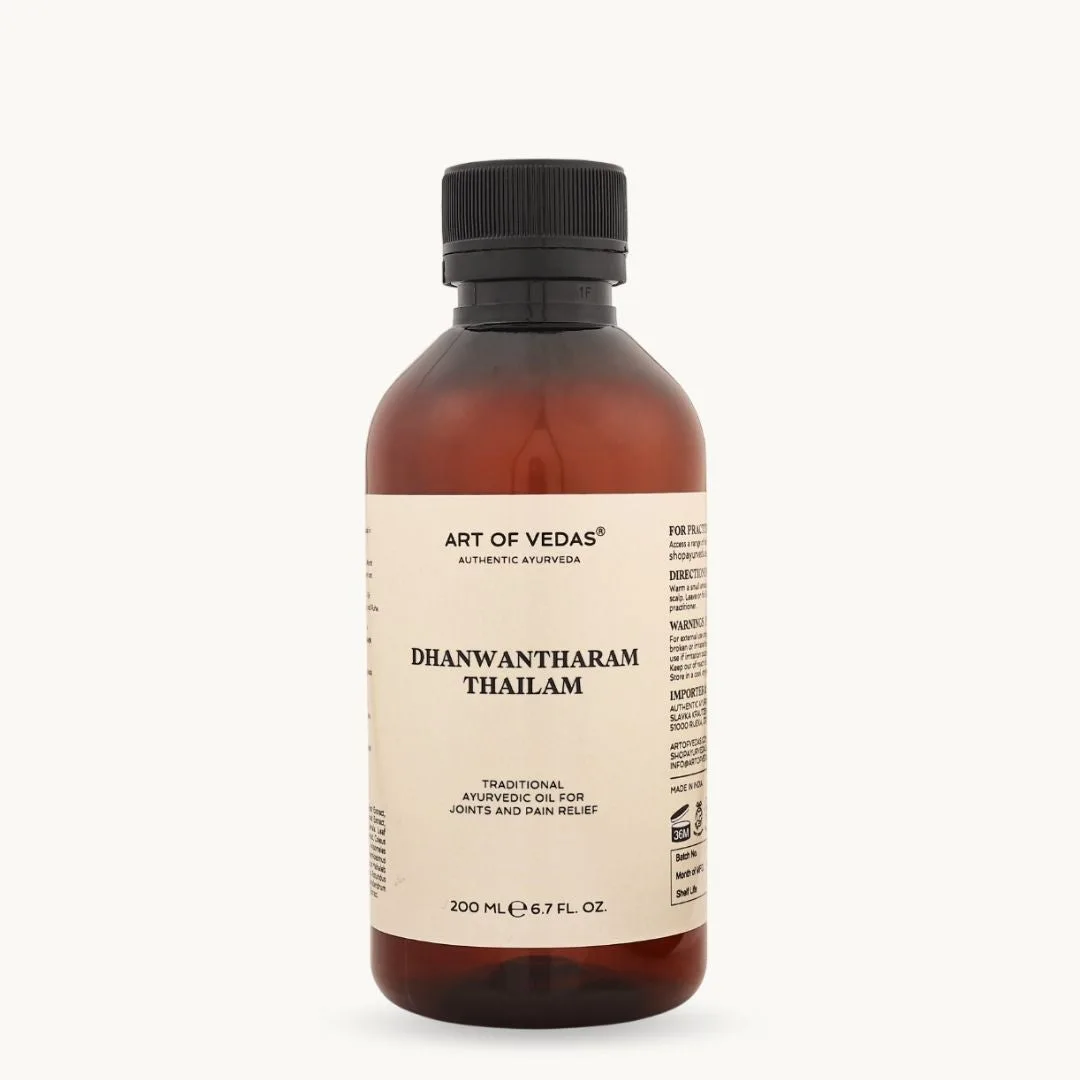
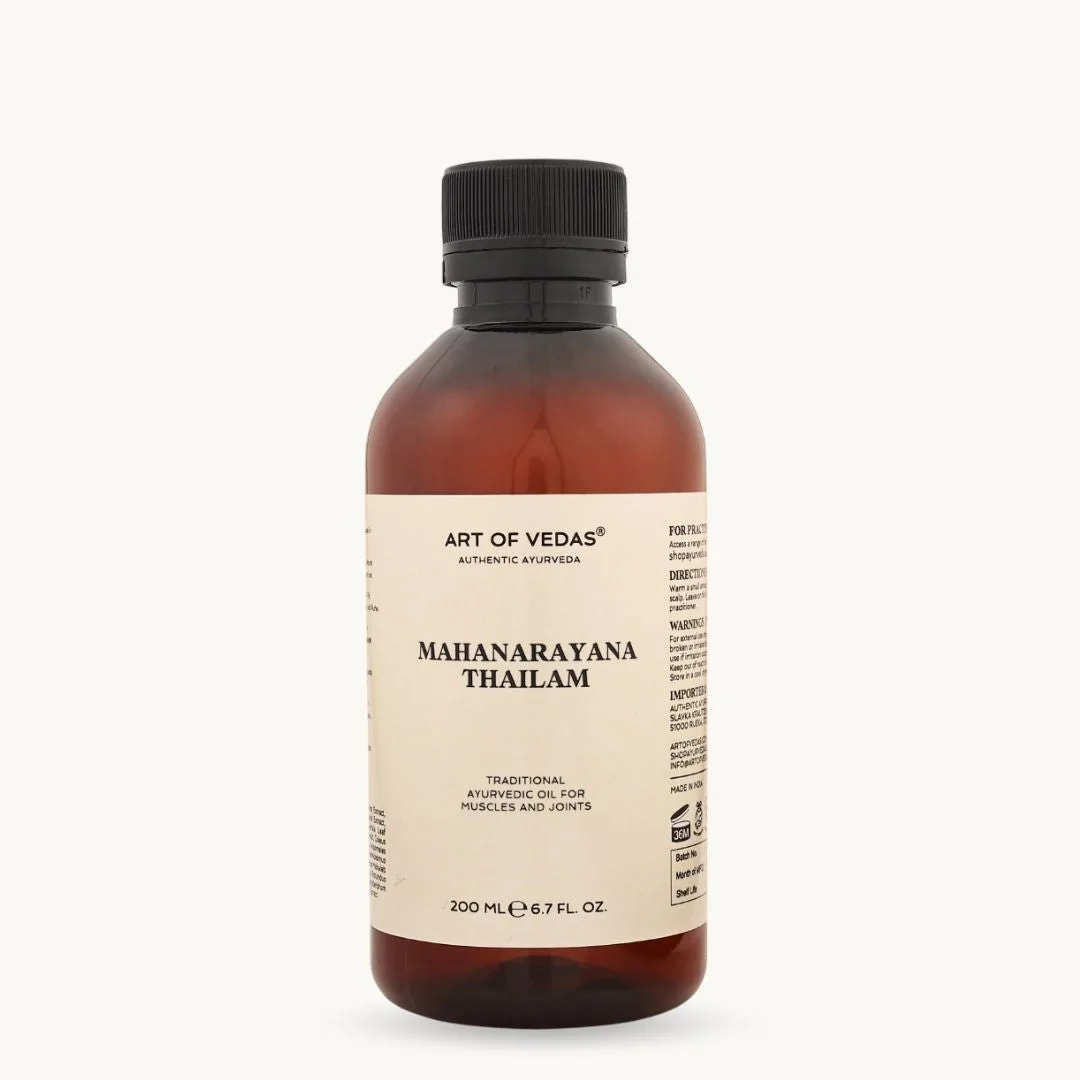
Bilva is met far more often as one root among ten than as an oil of its own. Dashamoola, the ten roots, is a fixed classical group of five tree roots and five shrub roots, and Bilva is the first of the trees. The group is cooked into sesame oil in several of the best-known classical massage oils, and in two Art of Vedas oils it is declared on the label: Dhanwantharam Thailam, a mild, warming oil for regular Abhyanga, and Mahanarayana Thailam, a fuller, warmer oil for Abhyanga of the muscles and joints. Both declare Aegle marmelos, the Bilva, among their plant ingredients.
The difference is one of role. In Bilva Thailam the tree is the defining ingredient of a small, single-purpose oil; in a Dashamoola oil it is one voice in a long list, and the finished oil has one blended character rather than the character of Bilva alone. Anyone who wants an oil with Bilva for massage is well served by the Dashamoola oils; anyone who wants Bilva Thailam itself for the ear ritual needs a practitioner, not a web shop.
How the Dashamoola oils are used in practice
With Dhanwantharam or Mahanarayana Thailam the practice is the ordinary Abhyanga routine. Warm the oil by standing the closed bottle in a bowl of warm water until a drop feels pleasantly warm on the inner wrist; do not use a microwave. Apply it generously with long strokes along the limbs and circular strokes around the joints, or work a smaller amount into one region until it is absorbed. Leave it on the skin for 15 to 20 minutes, then take a warm shower or bath. Daily use follows the classical routine, Dinacharya; two or three times a week is a lighter rhythm for the warmer months. The full method is in our Abhyanga guide.
Who should ask first
All oils in the Art of Vedas range are for external use only. Do a small skin test on the inner forearm before the first full application and keep the oil away from the eyes and broken skin. In pregnancy, and before using any oil on a child, ask your doctor or a qualified Ayurvedic practitioner first. A qualified Ayurvedic practitioner is also the right person to ask which oil suits your constitution and the season, and the only person who should be consulted about Karna Purana or any other classical procedure beyond the oil massage.
Art of Vedas and Bilva Thailam
Art of Vedas does not currently offer Bilva Thailam, and we do not offer Bilva on its own as a powder or food supplement either. The closest oils in our range are the two Dashamoola oils that declare Bilva: Dhanwantharam Thailam and Mahanarayana Thailam. For an overview of every classical oil we carry, how they are made and how to choose between them, see our complete guide to traditional Ayurvedic Thailams.