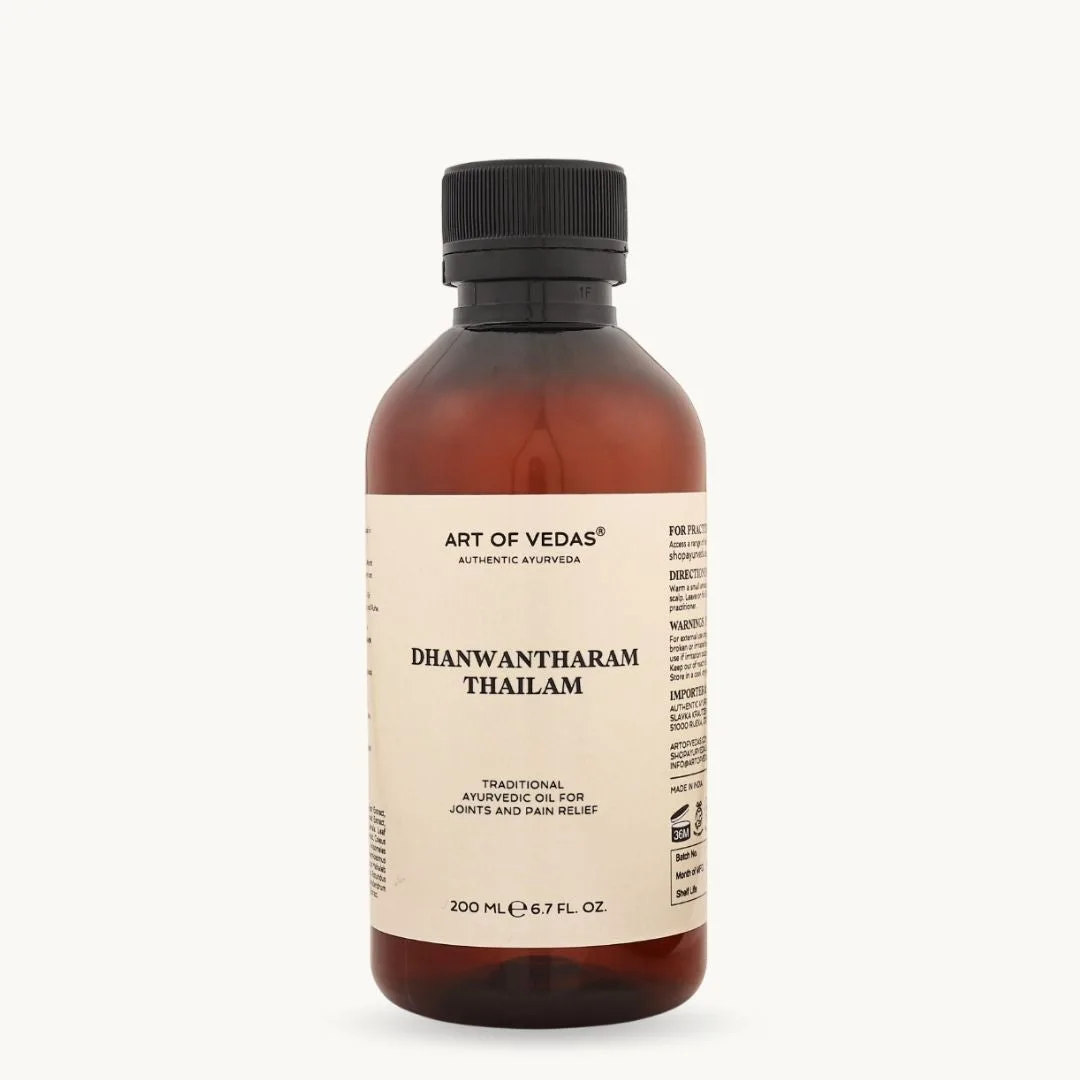
This article is part of our The Complete Guide to Dhanwantharam Thailam: Ancient Ayurvedic Oil for Modern Wellness guide series.
If you search for a classical Ayurvedic oil for Vata conditions, Dhanwantharam Thailam will appear in almost every serious list. It is prescribed by Ayurvedic practitioners across India and Europe, it features in clinical Panchakarma protocols, and it is referenced across multiple classical texts. But the name alone tells you very little about what the oil actually does - why practitioners keep returning to it, what it achieves in the tissues, and how it works according to the classical framework that produced it.
This guide focuses specifically on the benefits of Dhanwantharam Thailam - what the classical texts document, what the formulation's composition explains, and who it is most appropriate for. If you are looking for the full classical background including the complete composition and history of the formulation, Art of Vedas has published a complete guide to Dhanwantharam Thailam covering those dimensions in detail. This guide is for those who already know what Dhanwantharam is and want to understand precisely what it does.
The Classical Framework: What "Benefits" Means in Ayurvedic Terms
In classical Ayurveda, the concept of a therapeutic benefit is always described in terms of Dosha, Dhatu and Srotas - the three organising principles of Ayurvedic physiology. A benefit is not simply a symptom improvement; it is a restoration of balance at one or more of these levels. For an oil like Dhanwantharam Thailam, understanding the benefits means understanding which Dosha it primarily addresses, which Dhatus (tissue layers) it reaches, and through which Srotas (channels) it operates.
Dhanwantharam Thailam is primarily a Vata-pacifying formulation. Vata Dosha - the force of movement, dryness, lightness and the nervous system - governs the musculoskeletal system, the neural pathways, the joints, and the subtle channels throughout the body. When Vata is elevated or imbalanced, the classical consequences include pain, stiffness, weakness, dryness in the tissues, impaired neural function and degeneration. Dhanwantharam Thailam's documented benefits map directly onto these classical Vata consequences.
Benefit 1: Deep Tissue Nourishment - Brimhana Action
The first and most fundamental benefit of Dhanwantharam Thailam is its Brimhana action - a term from classical Ayurveda meaning to nourish, build and increase the density and quality of the tissues. This is not simply moisturising. Brimhana at the tissue level means supporting the development and maintenance of the Dhatus - the seven tissue layers described in classical anatomy.
The primary ingredients responsible for this action are Bala (Sida cordifolia) and Ashwagandha (Withania somnifera), both of which are described in the Charaka Samhita as premier Brimhana and Balya herbs. Bala is considered one of the most important classical herbs for Vata-type weakness - it builds muscle tissue (Mamsa Dhatu), supports nervous tissue (Majja Dhatu) and provides the fundamental nourishment that Vata-depleted tissues require.
The practical experience of this action is the gradual improvement in tissue quality with consistent use: reduced sense of depletion in the muscles, improved skin texture at the application site, and a general sense of groundedness and physical stability that is the classical signature of Vata coming into balance.
Benefit 2: Joint Nourishment and Support - Sandhi Poshana
The Ashtanga Hridayam describes Dhanwantharam Thailam specifically as a formulation for Sandhi (joint) conditions, making it one of the most important classical oils in the Vata Vyadhi (Vata disorders) chapter. The relevant Sanskrit term is Sandhi Poshana - the nourishment and maintenance of the joint structures.
In classical Ayurvedic anatomy, the joints are maintained by a specific form of Kapha called Sleshaka Kapha - the lubricating Kapha that keeps the joints smooth and mobile. When Vata is elevated, it dries out this Sleshaka Kapha, resulting in cracking sounds in the joints, reduced mobility, stiffness on waking and gradual degeneration of the joint surfaces. Dhanwantharam Thailam addresses this pattern through a two-stage mechanism: the Brimhana herbs restore the overall tissue quality, while the Vata-pacifying base (sesame oil processed with milk and herbs) directly counteracts the drying action of elevated Vata in the joint spaces.
This is the primary reason Dhanwantharam Thailam is so consistently recommended for age-related joint stiffness and for those recovering from physical depletion. The classical prescription is not simply for pain - it is for maintaining the structural integrity of the joints before the Sleshaka Kapha deficit becomes advanced.
Benefit 3: Muscular Strength and Recovery - Balya Action
Distinct from the nourishing (Brimhana) action, the Balya - strength-giving - action of Dhanwantharam Thailam is documented in the Ashtanga Hridayam across multiple conditions involving muscle weakness, post-exertion fatigue and recovery from illness or physical depletion. The classical indication extends to post-surgical recovery and convalescence contexts.
Bala (Sida cordifolia) is named literally for its strength-giving property - the Sanskrit word Bala means strength. The Charaka Samhita, Sutrasthana 25, lists Bala as the prime herb of the Balya group - the class of herbs that restore physical strength. Its inclusion as the principal ingredient in Dhanwantharam Thailam means the oil carries this Balya action as a core property rather than a secondary one.
For athletes, for those in recovery from illness, and for those whose work or lifestyle involves physical exertion that regularly depletes the muscles, the post-Abhyanga (self-massage) experience with Dhanwantharam Thailam - a sense of restored strength and reduced fatigue - reflects this classical Balya mechanism in practical terms.
Benefit 4: Neural Support and Nervous System Nourishment
Among the less commonly discussed but classically important benefits of Dhanwantharam Thailam is its action on Majja Dhatu - the nervous tissue in classical anatomy. The Ashtanga Hridayam describes Majja Dhatu as the tissue layer most directly affected by Vata aggravation and most dependent on deep nourishment through medicated oils.
The milk-processing of Dhanwantharam Thailam (the Ksheerapaka method in which herbs are first cooked in milk before the oil is processed) is specifically associated in classical texts with the capacity to reach Majja Dhatu. Milk is described in the classical texts as Majja Dhatu's natural analog - a substance that, when used as a processing medium for medicated oil, allows the finished preparation to reach and nourish the innermost tissue layers.
In practical classical terms, this dimension of Dhanwantharam Thailam's action is most relevant to conditions involving neural discomfort, sensitivity, tingling sensations in the extremities, or the kind of restless nervous energy that classical Ayurveda associates with elevated Vata in the neural channels. For those seeking even deeper neural nourishment, Ksheerabala Thailam - specifically designed around the Ksheerapaka (milk-processing) method - extends this neural nourishing action even further.
Benefit 5: Post-Partum Recovery - Classical Sutika Protocols
One of the most specifically documented classical uses of Dhanwantharam Thailam is in post-partum recovery. The Ashtanga Hridayam Uttarasthana dedicates several chapters to the care of the mother after childbirth - a period classical Ayurveda considers one of the most important windows for restoring health and preventing long-term depletion.
Childbirth involves an extraordinary expenditure of Vata - the force of movement is maximally activated during labour, leaving the body in a deeply Vata-aggravated state. This is why the classical post-partum protocols (Sutika Paricharya) place such emphasis on oil - both internal and external - warmth, and rest. Dhanwantharam Thailam is among the oils most specifically described for this context, addressing both the muscular and neural depletion of the birth process and the need to rebuild the Dhatus that have been taxed.
This classical indication is widely practised in Ayurveda, where the traditional 28 or 42-day post-partum Abhyanga protocol using Dhanwantharam Thailam continues to be a standard clinical recommendation. Art of Vedas recommends consulting a qualified Ayurvedic practitioner for guidance on post-partum protocols and oil selection.
Benefit 6: The Rasayana Dimension - Long-Term Rejuvenation
The Ashtanga Hridayam places Dhanwantharam Thailam within the broader category of Rasayana therapies - the classical Ayurvedic science of rejuvenation and longevity. Rasayana in classical terms does not mean anti-aging in the cosmetic sense; it refers to specific protocols and substances that reverse the natural depletion of the Dhatus over time, supporting vitality, cognitive function and physical resilience.
The Rasayana dimension of Dhanwantharam Thailam is primarily accessible through consistent, long-term use as part of a classical Abhyanga practice. The Charaka Samhita describes daily oil self-massage as itself a Rasayana practice - one that, when maintained consistently over years, contributes to the preservation of tissue quality and the delay of age-related depletion. When the oil used for this practice is a classical medicated formulation like Dhanwantharam Thailam rather than plain oil, the Rasayana effect is amplified through the specific herb combinations.
You can read more about the complete classical science of Rasayana in the Rasayana guide from Art of Vedas, which provides the full framework for understanding this dimension of Ayurvedic therapeutics.
The Kalpas: Why the Number Matters
Dhanwantharam Thailam is available in multiple preparations distinguished by the number of times the oil has been processed through the classical Taila Paka method. The classical designations - Dhanwantharam 7, Dhanwantharam 14, Dhanwantharam 28, Dhanwantharam 101 - refer to the number of processing cycles.
Each cycle increases the concentration of the active principles from the herbs, deepening the penetration capacity and therapeutic potency of the finished oil. Dhanwantharam 7 is appropriate for general Abhyanga and everyday use. Dhanwantharam 101 - the most processed and potent form - is used in clinical Panchakarma contexts and for more advanced Vata conditions under practitioner guidance.
For general self-care use, Art of Vedas provides Dhanwantharam Thailam from the classical preparations appropriate for home Abhyanga. For those working within a Panchakarma or clinical Ayurvedic context, consultation with a practitioner will guide the appropriate Kalpa. The full range of classical Vata oils is available in the Art of Vedas Ayurvedic Thailams collection.
Who Is Dhanwantharam Thailam Most Appropriate For?
Given its documented benefits, Dhanwantharam Thailam is most clearly indicated for:
Those with a Vata-predominant constitution who practice regular Abhyanga and want a classical medicated oil that provides deeper Brimhana and Balya support than plain sesame oil.
Those experiencing age-related joint stiffness, particularly on waking, or a gradual sense of depletion in the muscles and connective tissues.
Those recovering from illness, surgery or prolonged physical or mental stress where tissue depletion is a component of the recovery.
New mothers in the post-partum period, ideally under the guidance of a qualified Ayurvedic practitioner or midwife experienced in classical Sutika protocols.
Those practicing classical Abhyanga as part of a Dinacharya routine who want to use a formulation with both Rasayana and specific Vata-Sandhi benefits rather than a general carrier oil.
If you are unsure whether Dhanwantharam Thailam is the right formulation for your constitution and current condition, the Art of Vedas Dosha assessment is a useful starting point. For a broader comparison of how Dhanwantharam relates to other classical Vata oils such as Mahamasha Thailam or Mahanarayana Thailam, the comparing classical Ayurvedic massage oils guide maps the full range.
Frequently Asked Questions
What are the main benefits of Dhanwantharam Thailam according to classical texts?
The Ashtanga Hridayam documents Dhanwantharam Thailam's benefits under several classical categories: Balya, Brimhana, Vata shamaka (Vata pacifying), and Rasayana. In practical terms, these translate to strengthened muscles, nourished joints, reduced dryness and stiffness in the tissues, improved neural function through Majja Dhatu nourishment, and - with long-term consistent use - a reversal of age-related tissue depletion. The classical texts also specifically document its role in post-partum recovery (Sutika Paricharya) as a primary application context.
How long does it take to experience the benefits of Dhanwantharam Thailam?
Classical Ayurvedic texts describe the progressive nature of oil therapy through a general principle: changes in the outer tissues (skin, muscles) are noticed relatively quickly, while changes in the deeper Dhatus (bones, joints, neural tissue) require sustained use over weeks and months. For general tissue nourishment and surface Vata pacification, most people using Dhanwantharam Thailam for regular Abhyanga notice changes in skin quality and a reduction in surface dryness within a few weeks. For joint and neural tissue effects, consistent use over several months is described in classical protocols as the appropriate timeframe.
Is Dhanwantharam Thailam suitable for Pitta constitutions?
Dhanwantharam Thailam is primarily formulated for Vata conditions and is most clearly indicated for Vata or Vata-Kapha constitutions. For Pitta-predominant constitutions, the oil can generally be used in moderation - it does not have a strongly Pitta-aggravating profile - but it is not a cooling oil. Those with strong Pitta constitutions experiencing inflammatory joint conditions with heat and swelling would be better served by a cooling oil such as Pinda Thailam for the affected areas, while using Dhanwantharam Thailam for less inflamed regions.
What is the difference between Dhanwantharam 7 and Dhanwantharam 101?
The numbers refer to the number of classical processing cycles (Kalpas) the oil has undergone through the traditional Taila Paka method. Each cycle increases the concentration of active principles from the herbs and deepens the oil's penetrating capacity into the tissues. Dhanwantharam 7 (seven processing cycles) is the standard preparation appropriate for general daily Abhyanga and home self-care. Dhanwantharam 101 (101 processing cycles) is the most potent preparation, used in clinical Panchakarma protocols and for advanced Vata conditions under practitioner supervision. Art of Vedas recommends Dhanwantharam Thailam for home Abhyanga and advises consulting a practitioner before using the higher Kalpa preparations.
Can Dhanwantharam Thailam be used during pregnancy?
Classical Ayurvedic texts describe specific oil protocols for each trimester of pregnancy, and Dhanwantharam Thailam appears in some classical prenatal care contexts. However, any medicated oil use during pregnancy should be guided by a qualified Ayurvedic practitioner or healthcare provider. Art of Vedas does not provide guidance on specific prenatal protocols and recommends professional consultation before beginning any oil therapy during pregnancy.
How does Dhanwantharam Thailam smell?
Dhanwantharam Thailam has a characteristic herbal aroma that reflects the complexity of its formulation - warm, slightly earthy with the distinctive quality of sesame oil processed with multiple herbs including Bala root. The aroma is quite different from modern cosmetic oils and reflects the traditional preparation method. Some users find the aroma strong initially; it becomes more familiar with regular use. The oil's therapeutic quality comes precisely from this extensive herbal processing, and the aroma is an indicator of authenticity rather than something to be minimised.
For external use only. Dhanwantharam Thailam is a traditional Ayurvedic medicated oil preparation. It is not intended to diagnose, treat, cure or prevent any disease and is not a substitute for professional medical advice.