What Is Narayana Thailam?
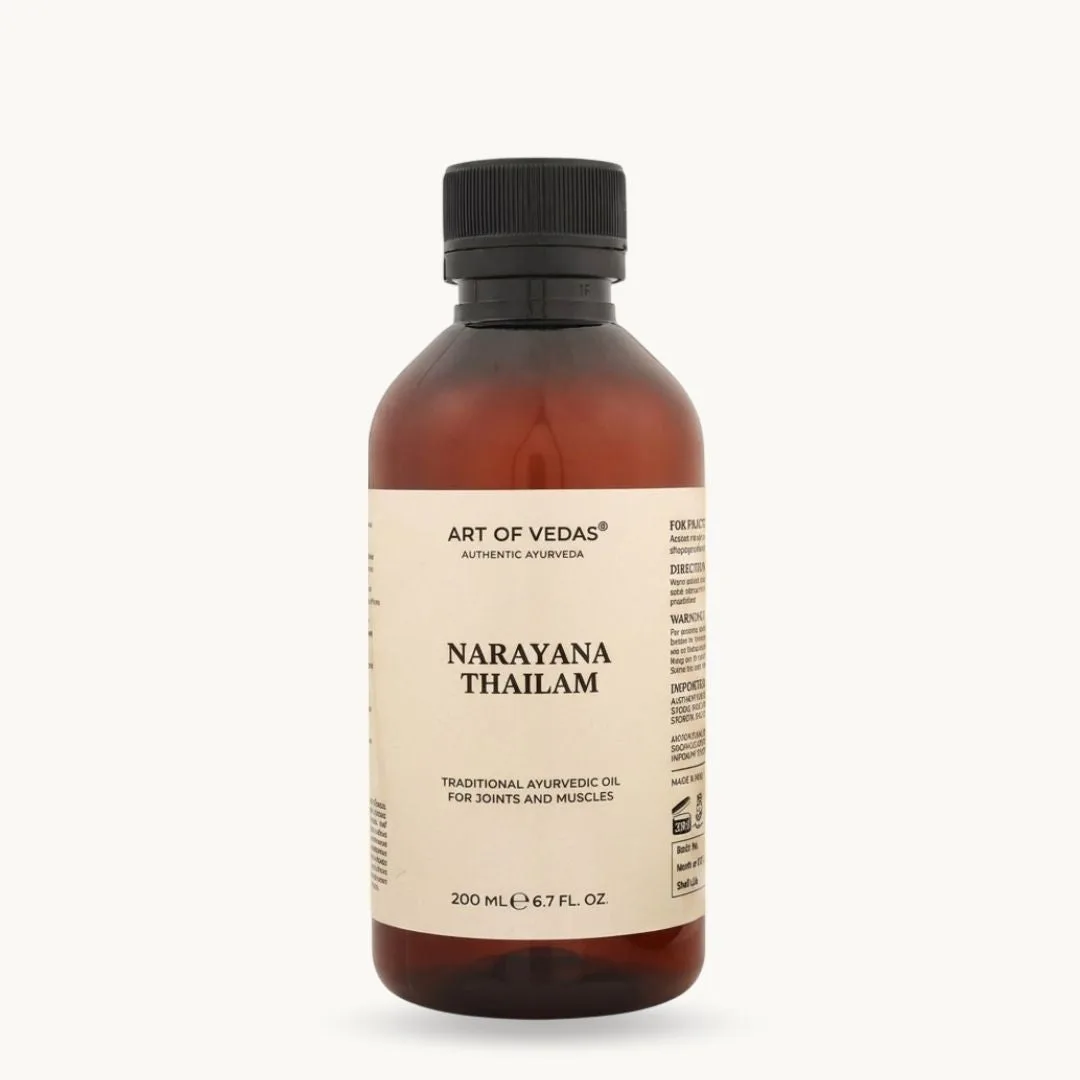
Narayana Thailam is a classical Ayurvedic medicated oil described in the Ashtanga Hridayam (Chikitsa Sthana) and the Sahasrayogam. Its base is sesame oil (Tila taila), processed with a complex combination of herbs that includes Ashwagandha (Withania somnifera), Bala (Sida cordifolia), Shatavari (Asparagus racemosus), Rasna (Alpinia galanga), and a number of other classical Vata-balancing herbs. The number of ingredients in classical Narayana Thailam is substantial - the full formulation as described in the Sahasrayogam includes twenty or more separate herbs processed through the standard Taila paka vidhi (classical oil preparation method).
The name Narayana refers to the Vedic tradition of naming significant preparations after divine principles - in this case reflecting the high regard in which the classical physicians held this formulation's scope of application.
You can find Narayana Thailam in the Art of Vedas classical oil range.
The Classical Designation: Sarva Vata Hara
The phrase Sarva Vata hara - meaning "that which addresses all Vata [conditions]" - appears in the Ashtanga Hridayam Chikitsa Sthana chapter on Vata Vyadhi (Vata disorders). It is applied to Narayana Thailam in a way that distinguishes it from formulations with narrower classical indications.
In practical Ayurvedic terms, this broad indication arises from the formula's composition. The classical Vata oils generally fall into patterns: some are primarily heating (like Mahamasha, for deep musculoskeletal Vata), some are primarily nourishing (like Ksheerabala, for depleted, dry Vata), and some are primarily analgesic in emphasis. Narayana Thailam's composition includes herbs covering multiple Vata-balancing actions - nourishing, warming, muscle-supporting, and nerve-supporting - which is what the classical writers were indicating with the Sarva Vata hara description.
This does not mean the oil is appropriate for every person or situation - Ayurvedic selection always involves individual assessment. It means that within the Vata framework, Narayana Thailam is described as having the broadest range of traditional application.
Key Ingredients and Their Classical Roles
Ashwagandha (Withania somnifera)
Ashwagandha is classified in the classical texts as one of the primary Brimhana herbs with specific affinity for Mamsa dhatu (muscle), Majja dhatu (nervous tissue), and Shukra dhatu (reproductive and vital tissue). In the context of a Vata-targeting Thailam, Ashwagandha contributes deep nourishing support and the warming, grounding quality for which it is well known. Our standalone Ashwagandha guide covers its classical properties in full.
Bala (Sida cordifolia)
Bala is one of the primary Brimhana herbs in the classical tradition and appears in many of the most important nourishing Vata formulations, including Ksheerabala and Bala Ashwagandha oils. In Narayana Thailam, its role is to support the nourishing dimension of the formula - building and sustaining the tissue layers that Vata tends to deplete when aggravated. See also our Ksheerabala Thailam guide for more context on Bala's properties.
Shatavari (Asparagus racemosus)
Shatavari is the classical herb most associated with Ojas - the refined essence of all tissue layers - and with nourishment of the deep tissue layers. Its inclusion in Narayana Thailam adds a dimension of deep vital nourishment to the formula. The Charaka Samhita classifies Shatavari among the Rasayana herbs - substances that support long-term vitality and tissue renewal. Our Shatavari guide covers its classical properties in detail.
Rasna (Alpinia galanga)
Rasna is a classical Vata herb with specific traditional use in musculoskeletal applications. The Ashtanga Hridayam includes Rasna in the Vata herb category with descriptions of its warming, penetrating quality. In Narayana Thailam, Rasna contributes a more directed musculoskeletal-supporting action alongside the broader nourishing herbs.
Classical Uses of Narayana Thailam
The Ashtanga Hridayam describes Narayana Thailam in the Vata Vyadhi Chikitsa chapter in the following contexts:
Full-Body Abhyanga for Vata Presentations
Narayana Thailam is described as appropriate for full-body Abhyanga in Vata presentations that include muscle and nervous system involvement - the combination of structural support and nourishing qualities in the formula makes it one of the more complete single-oil solutions for general Vata Abhyanga.
Head and Spine Applications
Classical texts describe the use of Narayana Thailam in applications targeting the spine, neck, and head - areas where Vata disorders affecting the nervous system and musculoskeletal structures commonly manifest. This is consistent with the presence of nourishing herbs like Ashwagandha and Shatavari that have classical affinity for the nervous system.
Back and Lower Body Vata
The lower body - particularly the lower back, hips, and legs - is classically associated with the seat of Vata (Apana Vata, the downward-moving form of Vata, resides in the lower abdomen and pelvis). Narayana Thailam is traditionally used in applications targeting these areas where Vata presents as tightness, discomfort, or weakness. The Narayana Thailam safety guide provides guidance on contraindications and correct use parameters.
In Panchakarma Clinical Settings
Narayana Thailam appears in classical descriptions of Basti (medicated enema therapy - the most important Vata treatment in the Panchakarma system) and Pizhichil (Ayurvedic oil drip therapy) in the clinical Panchakarma tradition. Its Sarva Vata hara designation makes it one of the formulations suitable across multiple Panchakarma application contexts.
Who Is Narayana Thailam Suited For?
Within the classical Ayurvedic framework, Narayana Thailam is suited to:
- People with a predominantly Vata constitution (Vata Prakriti) who want a nourishing daily Abhyanga oil with broad Vata-balancing properties
- Those experiencing general signs of Vata aggravation: dryness, tension, irregularity, fatigue, mental restlessness, or a sense of being ungrounded
- People who want a single classical oil that covers nourishing, structural, and nervous system dimensions rather than targeting one specific aspect
- Post-activity recovery - the combination of Ashwagandha, Bala, and Shatavari makes this a nourishing choice for physical recovery support
- Seasonal Vata management, particularly in autumn and winter when Vata naturally increases
Narayana Thailam is more broadly applicable than highly targeted oils like Mahamasha (deep musculoskeletal Vata) or Ksheerabala (primarily nourishing and cooling), which is consistent with its classical Sarva Vata hara description. For specific targeted presentations, a more focused formulation may be more appropriate - consult a qualified Ayurvedic practitioner for individual guidance.
How to Apply Narayana Thailam
Warming the Oil
Warm the oil before use by placing the bottle in a bowl of hot water for five minutes. The oil should be comfortably warm when applied to the skin - this is described in the classical texts as essential for effective oil absorption and for the nourishing intention of Abhyanga to be fulfilled.
Full-Body Abhyanga Application
Apply the warmed oil using long, even strokes along the limbs (in the direction of hair growth) and circular motions at the joints. Pay particular attention to the feet, lower back, and neck - classical Ayurveda identifies these as primary sites of Vata accumulation. The full classical Abhyanga sequence is described in our Complete Abhyanga Guide.
Allow the oil to remain on the skin for 15 to 30 minutes before bathing with warm (not hot) water. The contact time allows the oil to act through the skin layers.
Frequency
Classical Ayurveda recommends daily Abhyanga as part of Dinacharya. For most home practitioners, three to five times per week is both practical and beneficial. During autumn and winter (the Vata seasons), more frequent application is traditionally considered supportive.
Local Application
Narayana Thailam can be applied locally to specific areas - the lower back, neck, or legs - where Vata-related tension is experienced, without requiring full-body application. Warm oil applied to a localised area with gentle circular massage is a straightforward way to work with this oil if a full Abhyanga is not practical on every occasion.
Narayana Thailam Compared to Other Classical Vata Oils
Understanding where Narayana Thailam fits in the range helps with informed selection:
-
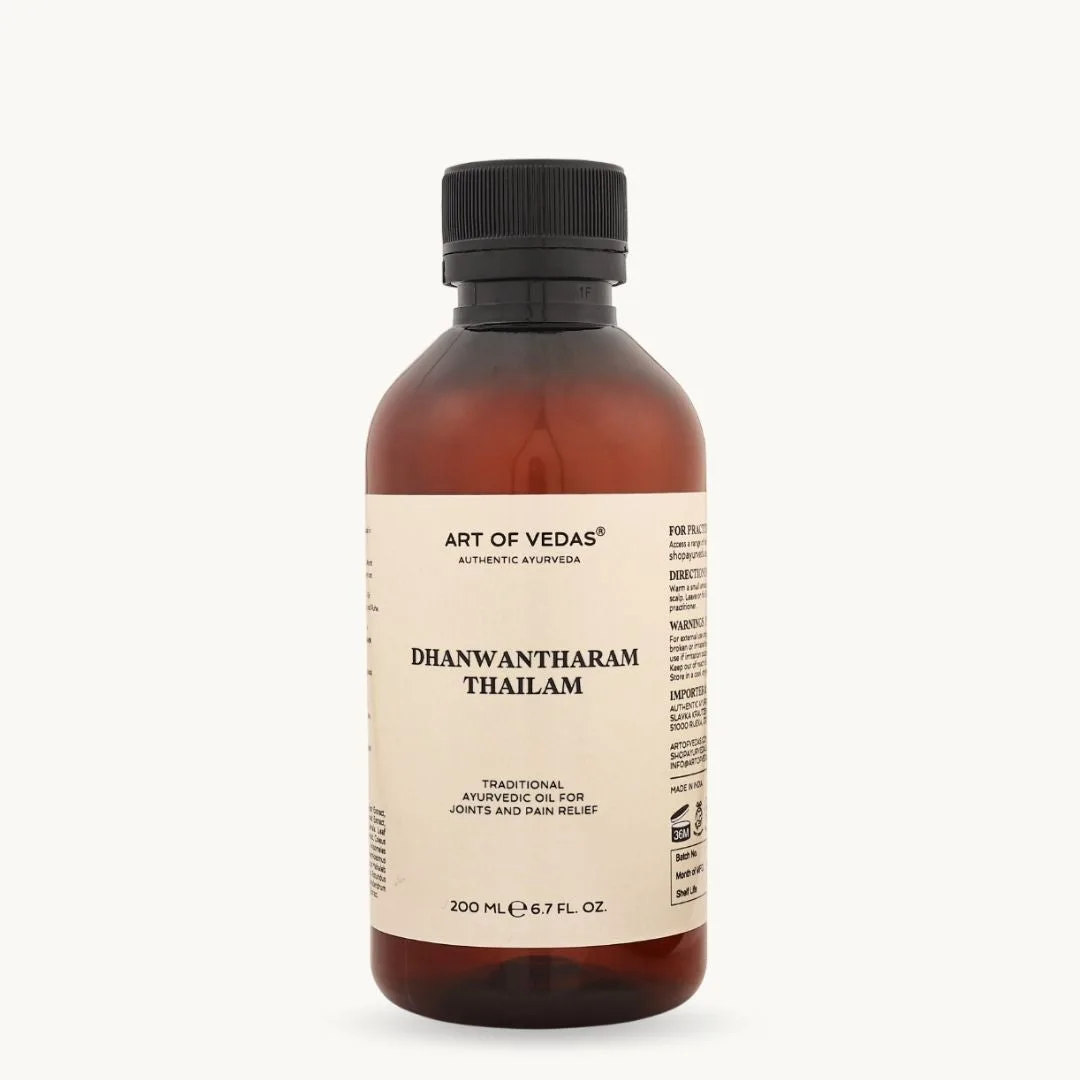
Narayana vs Dhanwantharam: Dhanwantharam Thailam is the primary classical Vata oil for musculoskeletal conditions, particularly post-natal care and joint-related presentations. Narayana has a broader nervous-system-inclusive range
-
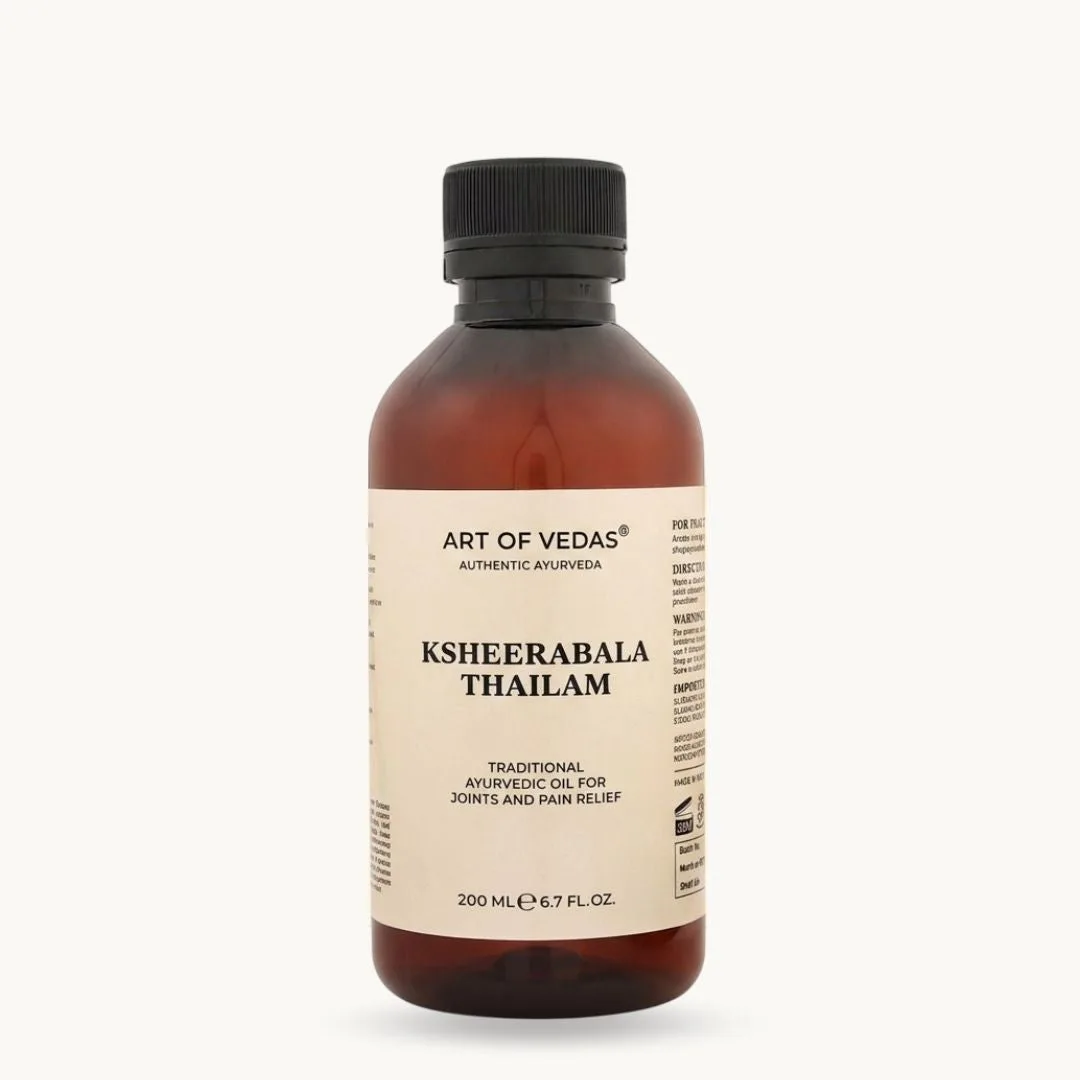
Narayana vs Ksheerabala: Ksheerabala emphasises nourishment and is cooler; Narayana is warmer and more broadly acting with a more complex formula
-
Narayana vs Mahamasha: Mahamasha is the most heating of the major classical Vata oils and is reserved for more intense structural presentations. Narayana is suitable as a regular daily oil
-
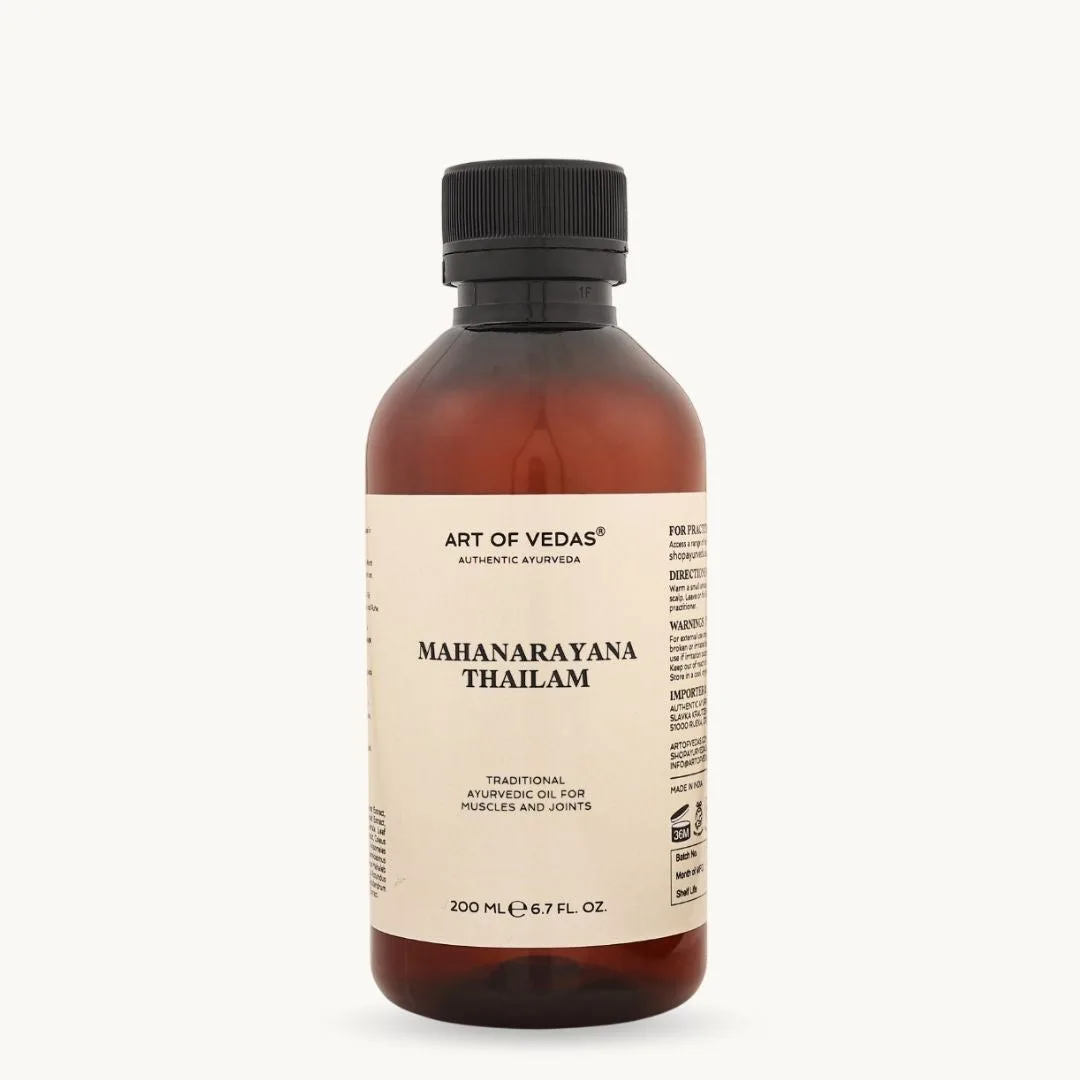
Narayana vs Mahanarayana: These are different formulations. Mahanarayana Thailam is a larger, more complex formula described in the classical texts as the most comprehensive Vata therapeutic oil. Narayana Thailam is a distinct preparation
For a full comparative treatment of the classical Vata oils, see our guide to comparing Ayurvedic massage oils.
Frequently Asked Questions
Is Narayana Thailam safe to use every day?
Yes, Narayana Thailam is appropriate for regular daily or near-daily external use in healthy adults. For anyone with specific health conditions, particularly those involving the liver or digestion, consultation with a qualified Ayurvedic practitioner is recommended before beginning a sustained daily practice with any classical therapeutic oil.
Can Narayana Thailam be used for head massage?
Yes. Classical texts describe applications targeting the head and neck, and the nervous-system-supporting herbs in the formulation (Ashwagandha, Shatavari, Bala) are particularly relevant in this context. Use warmed oil and apply to the scalp with gentle circular massage.
What is the difference between Narayana Thailam and Mahanarayana Thailam?
These are distinct formulations. Mahanarayana Thailam is a larger, more complex preparation - often containing 50 or more ingredients - described in the classical texts as the broadest therapeutic Vata oil. Narayana Thailam is a distinct, somewhat simpler formulation that nonetheless carries the Sarva Vata hara designation. Both are classical; both are appropriate for Vata conditions; the Mahanarayana is the more comprehensive of the two.
Can I use Narayana Thailam for the lower back?
Yes. The lower back is one of the primary classical application areas for this oil, consistent with the classical association of the lower body with Vata and the oil's Sarva Vata hara properties. Apply warmed oil to the lower back area with circular massage, ideally followed by a period of gentle warmth.
Does Narayana Thailam have any contraindications?
See our dedicated Narayana Thailam safety guide for a full account of contraindications and classical guidance on correct use. As with all Ayurvedic therapeutic oils, there are specific presentations where caution is advised.
Conclusion
Narayana Thailam's classical description as Sarva Vata hara reflects a real compositional breadth. The combination of Ashwagandha, Bala, Shatavari, Rasna and the other herbs in this formulation creates an oil that addresses multiple dimensions of Vata - nourishing, structural, nervous system, and vital tissue - within a single preparation.
For people who want a classical Vata oil that they can use consistently through the seasons without needing to alternate formulations, Narayana Thailam is one of the most considered choices in the classical repertoire. Its traditional designation is not marketing language - it is a description that has been consistent across classical Ayurvedic literature for over a thousand years.
Find Narayana Thailam in the Art of Vedas range. Explore the full classical Vata oil collection at Ayurvedic Oils. To understand how to integrate this oil into a complete daily self-care practice, our Dinacharya guide provides the full classical framework.
This article is for educational purposes only. The information reflects traditional Ayurvedic knowledge as described in classical texts including the Ashtanga Hridayam and Sahasrayogam. It is not medical advice and does not constitute a claim that any product prevents, treats, cures or diagnoses any medical condition. Please consult a qualified practitioner for personal health guidance.