This article is educational and describes traditional Ayurvedic concepts and self-care practices. It is not medical advice and is not intended to diagnose, treat, cure or prevent disease. If you are pregnant, taking medication, managing a health condition, or unsure whether a practice is appropriate for you, speak with a qualified healthcare professional or Ayurvedic practitioner.
In brief: Straight answers to the questions European readers ask before trying Ayurveda for beginners: what the tradition actually is, what Dosha theory does and does not claim, which single practice is worth starting with, how to read a European label properly, and which questions belong with a qualified practitioner rather than a product page.
What Ayurveda is, in plain terms
Almost everyone researching Ayurveda for beginners arrives with the same short list of questions. Very few pages answer them plainly. Most either oversell the tradition or shrink it down to a personality quiz with a shopping basket attached. This guide answers the questions directly, and says clearly where an honest answer stops.
Ayurveda is a classical South Asian system of health knowledge. The name joins two Sanskrit words, ayus, meaning life, and veda, meaning knowledge, so it is usually rendered as the knowledge of life. It covers daily conduct, food, seasonal adjustment, bodywork, herbal preparation and clinical practice. It has been written down, argued over and revised across many centuries, which is why its internal literature disagrees with itself in places, as any long living tradition does.
In Europe, Ayurveda usually reaches people first as a shelf of oils and powders. That is a narrow entry point. The oils are the visible end of a much wider framework, and they make considerably more sense once you know what sits behind them.
Which texts does it come from?
The tradition is documented in a body of classical literature, and the names are worth recognising because they appear constantly in product descriptions.
- The Charaka Samhita concerns itself largely with internal practice, reasoning and the conduct of the practitioner.
- The Sushruta Samhita is known for its surgical and procedural material.
- The Ashtanga Hridayam condenses the earlier two into a more usable form, and is the text most European students meet early.
- The Sahasrayogam and the Bhaishajya Ratnavali are formulation collections. They record the recipes themselves: which herbs, in which base, prepared by which method.
When a label calls a formula classical, that is what the word should mean: the recipe appears in one of these sources, rather than having been assembled recently to fit a marketing line. A fuller account of the tradition is set out in the complete beginner guide.
Is Ayurveda a religion?
No. It grew up inside a culture with a rich religious life and it shares vocabulary with the philosophical schools of the same era, but the practice itself is not devotional. You are not required to adopt any belief in order to oil your feet before bed.
Where a beginner should actually start
The honest answer is smaller than most people expect. The common mistake is to begin with the most specialised thing available: a concentrated herbal formulation, or a week of intensive procedures, chosen from a website. That is starting at the wrong end.
Ayurveda places most of its weight on what you repeat. The classical emphasis falls on Dinacharya (the daily routine) rather than on occasional interventions. So the sensible order is roughly this:
- Learn what the basic vocabulary means, so that labels stop being opaque.
- Adopt one simple external practice and keep it for several weeks.
- Adjust food and sleep timing before adding anything concentrated.
- Speak to a qualified practitioner before anything taken internally.
That sequence is unglamorous and it is the one most experienced practitioners recommend.
A realistic first month
In week one, change nothing except your information. Read about the three Dosha and about daily routine. In week two, add a single practice: warm oil on the feet at night, or tongue cleaning in the morning. In weeks three and four, keep that practice and pay attention to the timing of your largest meal.
Nothing in that month requires a purchase beyond a plain oil. If a source tells you a beginner needs eight products, regard the advice with suspicion.
Dosha, Prakriti and Vikriti: what the theory actually claims
Dosha (the three functional principles of Ayurvedic physiology) is the idea most people meet first, and it is the one most often misrepresented.
Vata is the principle associated in classical Ayurveda with movement, dryness and irregularity. Pitta is associated with transformation, heat and sharpness. Kapha is associated with structure, moisture and steadiness. Every person is described as containing all three in some proportion.
Two further terms matter. Prakriti (your constitutional pattern, understood as the proportion you were born with) is considered stable across life. Vikriti (your current state, where that proportion has shifted) is considered changeable, and is what a practitioner is looking at during a consultation.
The distinction is the whole point. Knowing a supposed type tells you very little on its own. What a trained practitioner assesses is the gap between the two. The classical principles are set out in more detail in the guide to Vata, Pitta and Kapha.
Why an online quiz is not an assessment
Quizzes are useful as an introduction to the vocabulary and nothing more. A ten question form cannot weigh your history, your current pattern, your medication, your climate, your work or your sleep against each other. It also cannot notice when your answers describe a temporary state rather than a lifelong tendency, which is exactly the confusion between Vikriti and Prakriti that the tradition warns against.
Use a quiz to learn the words. Do not use it as a basis for taking anything internally.
Dinacharya: the daily routine question
Dinacharya is the classical structure of the day, and it is where Ayurveda puts most of its practical attention. The underlying argument is straightforward: regular, modest actions repeated daily are held to matter more than dramatic ones performed rarely.
A traditional Dinacharya typically includes rising before the day gets busy, cleaning the tongue, attending to the mouth and nose, some oil application, movement, and eating the main meal in the middle of the day rather than late at night. Ritucharya (the seasonal counterpart) applies the same logic across the year, adjusting food and routine as conditions change.
Most European readers cannot adopt a full classical routine, and do not need to. Picking two elements and keeping them is more in the spirit of the tradition than adopting twelve and abandoning them by February. The practical structure is laid out in the complete daily routine guide.
Oils, Thailam and Abhyanga
Oil is the most recognisable part of Ayurveda in Europe, and the most common first practice.
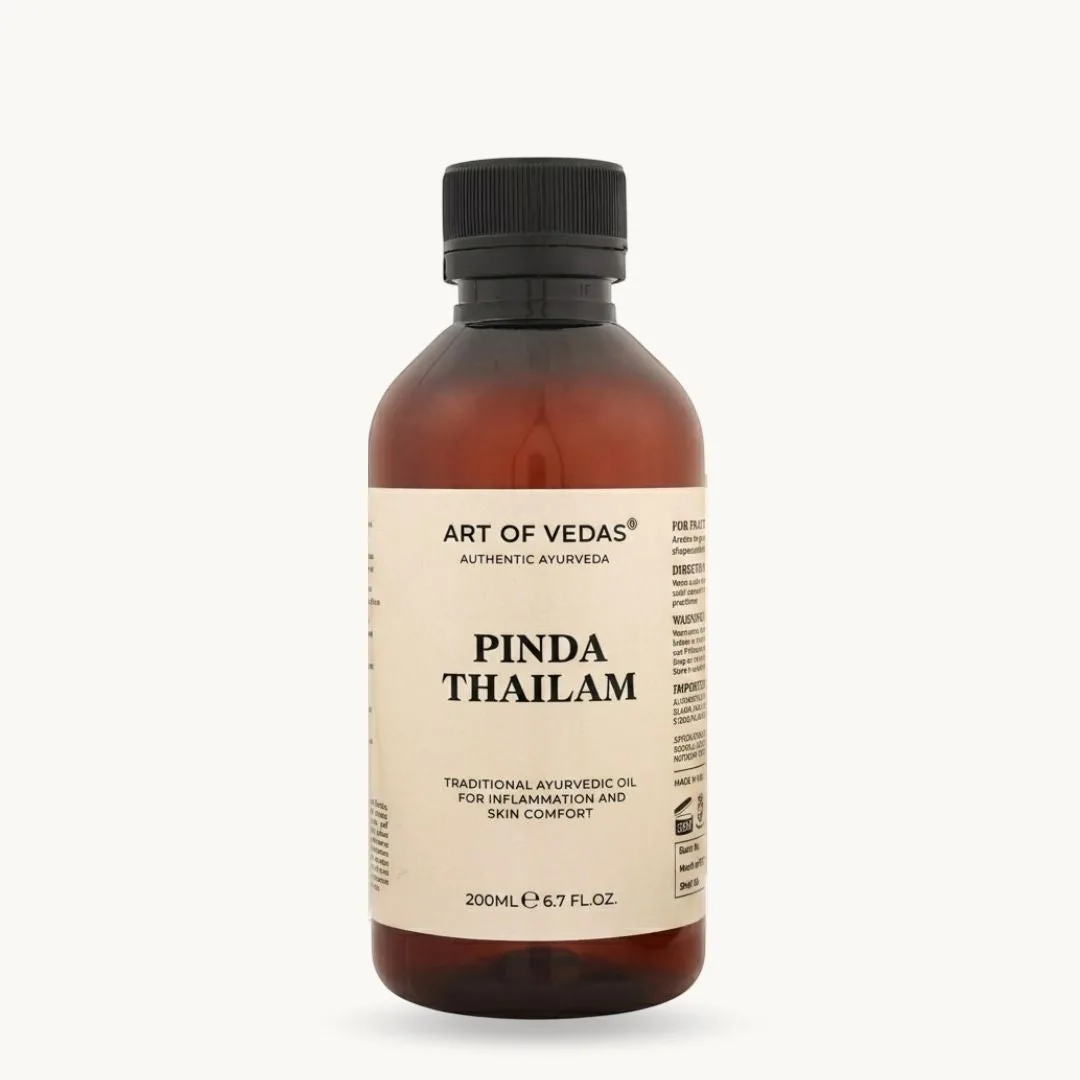
Thailam (a medicated oil, made by cooking herbs into a base oil by a defined classical method) is not the same thing as a scented cosmetic oil. The preparation matters: the herbs are processed into the oil over time, following a recipe from the classical literature, which is why two products with similar ingredient lists can be quite different objects.
Abhyanga (warm oil self-massage) is the practice these oils are traditionally used for. It is classically described as part of Snehana (the oleation practices), and in Ayurveda it is regarded as a daily act of maintenance rather than an occasional indulgence. It is external, it is gentle, and it is genuinely a reasonable place for a beginner to start.
Two practical cautions. Oil makes floors and bathtubs slippery, so plan accordingly. And test any new oil on a small area of skin first, particularly if your skin reacts easily. If you are weighing up which oil to begin with, the guide to choosing an Ayurvedic massage oil compares the classical options, and the practical Abhyanga guide covers the method itself.
How to read an Ayurvedic label in Europe
This is the question that saves beginners the most trouble, and it is the one least often answered.
A product sold in the European Union sits in a specific legal category, and the category determines what the label may say. An oil sold as a cosmetic carries an INCI ingredient list and is for external use. Something sold as a food supplement carries a different set of obligations and a different statement. A genuine Ayurvedic product from a serious business will tell you plainly which one it is.
Useful things to look for:
- A clear product identity, including the classical name of the formulation where one applies.
- A full ingredient declaration rather than a vague botanical gesture.
- Explicit directions and explicit cautions.
- The name and address of the responsible business, not just a brand word.
- Batch and date information.
Be wary of the opposite signals: a product that promises specific outcomes, names conditions, or describes itself only in atmospheric language. In the European Union those claims are not permitted on these categories, and their presence tells you something about the seller. Art of Vedas sets out the practical checks in the guide to identifying genuine Ayurvedic products.
Herbs, Churnam and anything taken internally
Here the answer genuinely changes. External practices are low risk and forgiving. Internal preparations are neither, and beginners routinely underestimate the difference.
The classical internal formats include Churnam (a herbal powder), Kashayam (a water decoction), Arishtam (a fermented preparation) and Ghritham (a medicated ghee). Rasayana covers formulations traditionally used in Ayurveda to support strength and vitality over time. These are not interchangeable, they are not mild by default, and several have important cautions attached in the classical sources themselves.
Concentrated herbs can interact with medication. Dose depends on the person. Some formulations are unsuitable in pregnancy, for children, or alongside particular medicines. None of that can be worked out from a product page, and no responsible seller will pretend otherwise.
The rule is simple: external first, internal only with qualified advice.
When to speak to a qualified practitioner
Some questions cannot be answered by any article, including this one. Take them to a professional.
- Pregnancy, breastfeeding, or planning either.
- Anything concerning children.
- Any prescribed medication, without exception.
- Any ongoing condition under medical care.
- Known allergies or strongly reactive skin.
- Fasting, Panchakarma (the classical purification procedures), or any intensive programme.
A consultation looks at constitution, current pattern, Agni (digestive capacity), routine, climate and context together. That is the work a practitioner does and a website cannot. The consultation guide explains what to expect and what to bring. Ayurveda is also meant to sit alongside medical care in Europe, not in place of it, and any source suggesting otherwise should be set aside.
For the wider context behind this year's campaign, see the Ayurveda Day explainer.
Frequently asked questions
Can Ayurveda replace my doctor?
No, and no reputable practitioner will suggest it can. Ayurveda is a system of routine, food and traditional practice, and in Europe it operates alongside conventional medical care rather than as a substitute for it. If you are under medical care, continue it, and tell both your doctor and your Ayurvedic practitioner what else you are doing. Openness in both directions is what keeps the combination sensible.
Do I need to know my Dosha before I buy anything?
Not for external products. A plain classical oil used for Abhyanga is a reasonable starting point for most people regardless of constitutional type, and you will learn more from using one consistently for a month than from reading about types for a month. Knowing your Prakriti becomes genuinely useful later, when choices get more specific, and it is best established with a practitioner rather than a questionnaire.
Is Ayurveda safe during pregnancy?
That is precisely the question to take to a qualified professional rather than to an article. Some practices and preparations are traditionally avoided during pregnancy, some are traditionally associated with it, and the distinction depends on the specific product, the stage, and the individual. Do not extrapolate from general advice, and tell your midwife or doctor about anything you are using.
How long before I notice anything?
Ayurveda is built around repetition, so the honest answer is that its logic works on the scale of seasons rather than days. Daily practices such as oil application or tongue cleaning are traditionally kept up indefinitely, in the way you would keep up brushing your teeth, and are not evaluated after a week. Anyone promising you a specific result on a specific date is not describing this tradition.
Is Ayurvedic skincare the same as Ayurvedic medicine?
No, and in Europe the difference is legal as well as practical. Cosmetic products are regulated as cosmetics, are for external use, and carry an INCI ingredient list. Traditional internal formulations sit under entirely different rules with different safety considerations. A face oil and a Ghritham are not two strengths of the same thing. Read the label and note which category the product belongs to before using it.
Can I take herbs without advice?
For anything concentrated, no. Culinary quantities of common kitchen spices are a different matter from a standardised herbal preparation taken daily at a set dose. Several classical herbs carry cautions and can interact with prescribed medication, and the appropriate amount varies between people. Ask a qualified professional before starting anything internal, and mention every medicine and supplement you already take.