This article is educational and describes traditional Ayurvedic concepts and self-care practices. It is not medical advice and is not intended to diagnose, treat, cure or prevent disease. If you are pregnant, taking medication, managing a health condition, or unsure whether a practice is appropriate for you, speak with a qualified healthcare professional or Ayurvedic practitioner.
In brief: Ayurvedic health claims arrive in four different forms: traditional description, modern evidence, personal experience and regulated product wording. Learning to tell them apart is the single most useful skill for reading a label, an article or a product page without being misled.
Why ayurvedic health claims deserve a careful reading
Ayurveda is an old system of practice. The vocabulary now used to sell it in European shops, magazines and product pages is not. When a classical description passes through marketing language, it tends to gain a certainty the original never had, and most confusion about ayurvedic health claims begins in exactly that gap.
The cause is rarely outright dishonesty. More often four separate kinds of statement are folded into a single sentence: what a classical text describes, what a study can show, what one person experienced, and what a product is legally permitted to say. Each carries a different weight. Presented together without labels, they read as one continuous body of proof.
This guide sets out how to pull them apart again. It is written for readers who want to buy and use Ayurvedic products sensibly, not for specialists, and it assumes no prior knowledge of the tradition.
Four different kinds of statement
Almost every sentence you will read about an Ayurvedic product belongs to one of four categories. Naming the category is the fastest way to judge what the sentence is actually worth.
Traditional description
This is what classical compendia and practitioners have historically said. Texts such as the Charaka Samhita, the Sushruta Samhita and the Ashtanga Hridayam describe substances through their qualities and actions rather than through measured outcomes. The Sahasrayogam and the Bhaishajya Ratnavali record formulations in the same descriptive register. A traditional description tells you how a substance was classified and how it was used. It does not tell you what a modern trial would find, because that question was never being asked.
Modern evidence
Evidence is what a properly designed study can show, within the limits of its own design. Those limits matter: who was studied, how many people, for how long, against what comparison, and whether anyone has repeated the result. A single small study is a signal rather than a settled fact. Careful writing states what was examined and then stops.
Personal experience
An individual report is genuine information about one person. It is not evidence that the same thing will happen for anyone else. Experience is useful for describing texture, scent, absorption, routine and practicality, all of which are difficult to learn any other way. It is weak ground for any statement about a health outcome.
Regulated product claim
A product claim is a legal statement rather than an opinion. What a product may say depends on the category it belongs to. In Europe a cosmetic oil and a food supplement sit under different frameworks, are assessed differently, and may use different wording. The seller must be able to stand behind the claim for that specific category, which is why responsible product pages often read more plainly than the articles around them.
What "traditionally used in Ayurveda" actually means
This phrase does a great deal of work on a label, and it repays a precise reading. It reports a historical fact: inside Ayurveda, this substance was placed in a particular category and applied in a particular way. It makes no prediction about what will happen to you.
Classical descriptions are built from a vocabulary with no direct modern equivalent. A substance is characterised by its Rasa (taste), its Virya (heating or cooling potency), its Vipaka (the effect that appears after digestion) and sometimes its Prabhava (a specific action the other three do not explain). These are classification terms within a traditional system. They are not measurements, and they were never intended to function as measurements.
The constitutional vocabulary works the same way. Ayurveda describes function through three Doshas (functional principles governing movement, transformation and structure): Vata, Pitta and Kapha. It separates Prakriti (the constitution a person is born with) from Vikriti (the current state of imbalance). It speaks of Agni (digestive capacity), Ojas (vitality and resilience) and Srotas (the channels through which the body carries things). These terms are the language in which traditional statements were originally made. Rendering them into modern clinical vocabulary changes their meaning and inflates their certainty at the same time.
Our guide to the three Doshas explains the constitutional model in more detail, including how the same vocabulary is applied in practice.
How product category shapes the wording you see
Two products can contain overlapping plant material and still be described in entirely different language, because they belong to different regulated categories. Recognising the category tells you in advance what kind of sentence you should expect.
Products applied to the skin
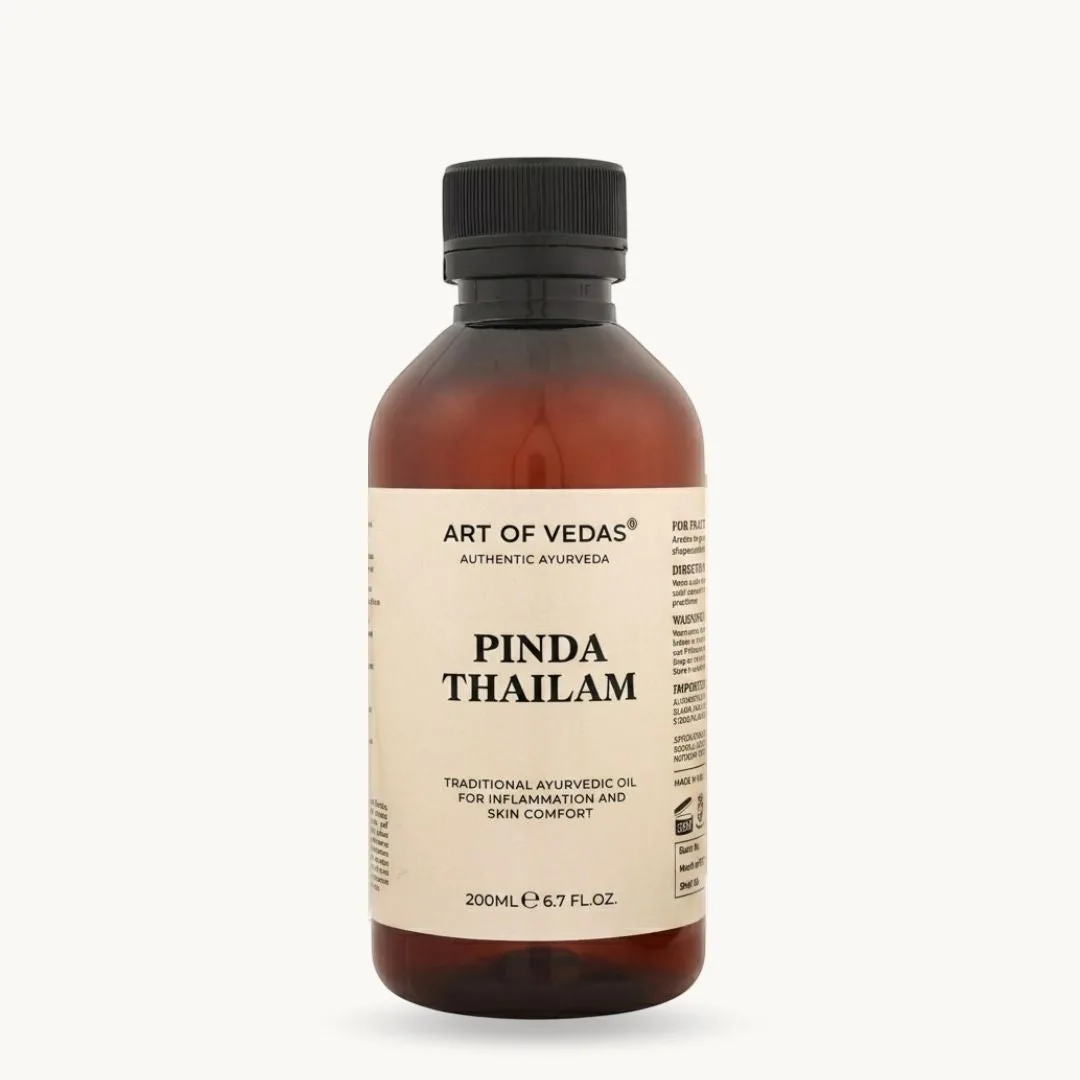
An oil used for Abhyanga (the traditional practice of self-massage with warm oil) is a cosmetic product. Cosmetic wording describes what the product does at the surface: how it is applied, how it feels, how the preparation behaves on the skin. A Thailam (a classical preparation in which herbs are processed into an oil base) sold for external use is described in precisely this register, and a page that suddenly starts describing internal effects has left its own category.
Products taken internally
A food supplement is regulated as a food. Its wording is bound by the rules that apply to foods and by what may be said about a substance in that category. It carries a different set of statements on the label and a different disclaimer, and those differences are not decorative.
If the category is not obvious from the page, that absence is itself a signal. A clear page states plainly whether a product is for external or internal use, usually within the first few lines. Our label guide and beginner FAQ apply the same standard to practical buying questions.
Words that quietly promise too much
Some words have drifted so far from any fixed meaning that they now signal very little. They feel informative while committing to nothing, or they imply a medical outcome without ever stating one plainly enough to be challenged.
- Detoxifies: in classical usage, Panchakarma (a set of traditional cleansing procedures carried out under supervision) is a defined and demanding process. On a consumer product page the word usually means nothing specific at all.
- Boosts: implies a measurable increase in something that is almost never named. The useful question is simple: boosts what, and measured how?
- Balances: meaningful inside Dosha theory, where it refers to a traditional model of function. Lifted out of that context and applied to a product, it is decoration.
- Clinically proven: a strong phrase that requires correspondingly strong support. With no named and accessible study attached, treat it as marketing language.
- Ancient secret: the classical texts are published, translated and widely studied. There is nothing secret about them, and the phrase exists only to create urgency.
The honest alternative is duller and far more useful: say who said it, within what system, and for what purpose. A sentence such as "traditionally used in Ayurveda to support the skin during colder months" is a much smaller statement than the sweeping version a marketer might prefer, and it has the advantage of being one that can actually be defended.
A short checklist for reading a page critically
Five questions handle the great majority of cases, and none of them requires any specialist knowledge.
- Who is speaking? A classical text, a practitioner, a customer, or the seller's marketing copy. The four are not interchangeable.
- What is actually being claimed? Strip out the adjectives and restate the sentence plainly. Very often almost nothing remains.
- Which category is the product in? External use or internal use. The answer should take seconds to find.
- Are the full ingredients shown? A page that lists everything is easier to trust than one that names two appealing plants and moves on.
- Does the page say when to seek professional advice? Responsible writing names its own limits rather than waiting to be asked.
If a page fails three of these five, the problem usually lies with the writing rather than with the product itself. That distinction is worth holding on to, because good preparations are regularly sold behind poor copy.
Where tradition and modern thinking genuinely meet
Separating tradition from evidence does not mean treating tradition as worthless. Classical Ayurveda is a structured system of observation refined over a very long period, with an internal logic that holds together on its own terms. Its practical value lies in that framework: matching what you do to your constitution, to the season, and to the shape of an ordinary day.
This is where daily practice belongs. Dinacharya (the classical daily routine) and Ritucharya (the seasonal routine) are organising principles rather than health claims. They describe when to do something and why it was traditionally recommended at that point in the day or year. Applied sensibly they are practical, low in risk and entirely compatible with modern working life.
Reading them as instructions for living rather than as promised outcomes keeps the whole subject in proportion. Our guide to Dinacharya and guide to Ritucharya set out both routines in full, with the same separation between practice and promise.
How Art of Vedas writes about its products
We work to one standard: describe the tradition accurately, describe the product honestly, and promise nothing about your health.
In practice that means naming the classical category a preparation belongs to, publishing the full ingredient list, stating clearly whether a product is for external or internal use, and using traditional framing wherever traditional framing is what we actually have. When we write that a preparation is classically indicated in Ayurveda for a particular purpose, we are reporting the tradition rather than predicting your result.
It also means what we leave out. We do not name conditions. We do not promise outcomes. We do not present traditional standing as clinical proof, and we do not use proof language we cannot support. If you would like to see the same standard applied to a catalogue rather than an article, our Thailam collection and Abhyanga oils are written exactly this way, and choosing an Ayurvedic oil works through the decision without a single health promise.
Frequently asked questions
Does traditional use prove that something works?
No. Traditional use is a historical record of how a substance was classified and applied within a particular system. It is valuable context, and it is frequently the reason a substance attracted modern research interest in the first place, but it is not the same as clinical proof of a medical effect. The two belong to different kinds of knowledge, and any page that blurs them is telling you considerably less than it appears to.
Is Ayurveda scientifically proven?
The question is too broad to answer as it is usually asked, because Ayurveda is not a single thing. It is a system containing daily routines, dietary principles, external preparations and internal preparations, and each of those would have to be examined separately. Some individual substances have drawn modern research attention; many practices have never been studied in that way at all. The honest position is that traditional standing and modern evidence are separate questions, and neither one settles the other.
Why do responsible pages carry disclaimers?
A disclaimer tells the reader how to interpret what they have just read. Educational writing about a traditional system is not medical advice, and saying so plainly protects the reader at least as much as it protects the writer. It also marks the point at which a general article stops being useful and a qualified professional should be consulted instead, which is information every reader deserves to have.
Can an Ayurvedic product claim to cure something?
No. Product claims must follow the rules that apply to the product's category and market, and those rules do not permit that kind of promise for cosmetics or for food supplements. A page that makes one is either written carelessly or overreaching deliberately. In both cases it is a reason for caution rather than a reason for confidence, and it says something about the seller more broadly.
How should benefits be described instead?
By describing what can genuinely be described: the classical category the preparation belongs to, its traditional indication within Ayurveda, its sensory qualities, how and when it is applied, and what a reasonable routine looks like in practice. This is less dramatic than a promised outcome and a good deal more useful, because it tells you what you will actually be doing with the product and how to fit it into your week.
What should make me stop reading a page altogether?
A named condition sitting next to a named product is the clearest signal of all. Several others follow close behind: proof language with no study attached, an ingredient list that mentions only the appealing plants, no statement of whether the product is for external or internal use, and any suggestion that you should set aside professional advice. One of these is a reason to read on carefully. Three or four together are a reason to close the page.