This article is educational and describes traditional Ayurvedic concepts and self-care practices. It is not medical advice and is not intended to diagnose, treat, cure or prevent disease. If you are pregnant, taking medication, managing a health condition, or unsure whether a practice is appropriate for you, speak with a qualified healthcare professional or Ayurvedic practitioner.
In brief: Learning how to read an Ayurvedic product label takes about two minutes per product. Check the category first, then the full product identity, the ingredient list, the directions, the warnings and the traceability details. A label that answers all six gives you enough to make a considered decision.
How to read an Ayurvedic product label: the six checks that matter
The front of a bottle is designed to attract you. The back panel is designed to inform you. When you learn how to read an Ayurvedic product label, almost all of your attention belongs on the back panel, because that is where the legally required information sits.
Six checks cover nearly everything worth knowing. Work through them in order, because each changes how you read the next.
- Category: a cosmetic, a food supplement or a tool?
- Identity: which preparation, in what format and quantity?
- Ingredients: named in a system you can check?
- Directions: how much, how often, by which route?
- Warnings: who should avoid it, and what should you test first?
- Traceability: batch, dates and the responsible business.
A label that answers all six is not automatically the better product. It is the product about which you can make an informed decision.
Start with the category, because it decides everything else
An Ayurvedic range usually mixes at least three regulated categories on one shelf. A massage oil is a cosmetic. A capsule or powder taken with water is a food supplement. A tongue cleaner or Kansa wand is a tool. Each category carries its own labelling requirements, so the first question is always which one you hold.
Cosmetics
A cosmetic label carries an ingredient list in INCI form, the nominal content, a durability indication or a period after opening symbol, any necessary warnings, a batch identifier, and the name and address of the business responsible for placing the product on the European market. A Thailam (a classical Ayurvedic oil preparation) sold for Abhyanga (Ayurvedic self massage with oil) normally sits in this category.
Food supplements
A food supplement label carries the designation "food supplement", the portion recommended for daily consumption, a warning not to exceed that portion, a statement that supplements do not replace a varied diet, and a note to keep the product out of the reach of young children. A Churnam (a dried Ayurvedic herbal powder), a capsule or a tablet is usually labelled this way. The Art of Vedas guide to Ayurvedic food supplements sets out the detail.
Tools and accessories
Copper, brass and Kansa items are not cosmetics and carry no ingredient list. Here you read material composition, cleaning instructions and care advice instead. A missing INCI list on a tongue cleaner is correct, not a gap.
Once you know the category, you know what the label should contain. A missing mandatory element in a regulated category is a fair question to put to the seller.
The product name is not the whole identity
Sanskrit names are precise about a formulation family and silent about almost everything else. Different preparations can share one name across different makers and different classical sources, so the name alone will not tell you what is in the bottle.
Read the name together with the preparation format, the classical attribution where given, and the net quantity.
Preparation formats you will meet
- Thailam: an oil preparation in which herbs are processed into a base oil.
- Kuzhambu: a denser oil-based preparation, usually thicker than a Thailam.
- Ghritham: a preparation built on clarified butter rather than oil.
- Churnam: a dried herbal powder.
- Kashayam: a water-based decoction.
- Arishtam: a naturally fermented liquid preparation.
The same herb name can appear on one shelf as a Thailam and on the next as a Churnam. The two are not interchangeable. Our explanation of what a Thailam actually is covers how these oil preparations are made, and the guide to Churnam powders does the same for dried preparations.
Classical attribution
Some labels name the classical text a formulation follows, such as the Sahasrayogam or the Ashtanga Hridayam. That attribution tells you which recipe lineage is being followed and lets you compare two products sharing a name. It is a statement about the formulation, not about what the product will do for you.
Net quantity and format
Net quantity appears in millilitres or grams, usually near the bottom of the panel. Compare price against net quantity rather than against the size of the bottle. Heavy glass and generous packaging are common here and say nothing about the contents.
How to read the ingredient list
This is the section most buyers skip, and the one carrying the most information per line.
INCI on cosmetic labels
INCI, the International Nomenclature of Cosmetic Ingredients, is the standard naming system used for cosmetics across the European market. It gives every ingredient a single name, usually botanical Latin, so the same plant reads identically on every label in every language. Sesamum Indicum Seed Oil is sesame oil, whatever the front of the bottle calls it.
INCI lists run in descending order of weight down to one percent, after which the order is free. The first two or three entries therefore tell you what the product mostly is, and on a classical oil preparation the base oil should lead.
What to look for beyond the names
- The plant part where it is specified, because a root, a leaf and a seed are different materials.
- The base or carrier, which is usually the single largest ingredient by weight.
- Added fragrance or essential oil, and any allergen components named separately.
- Preservatives, which a water-based product needs and an oil-based one often does not.
Food supplement declarations
Supplement labels do not use INCI. They declare the botanical name and the plant part, the quantity of each per recommended portion, and any carriers, bulking agents or anti-caking agents. The capsule shell is an ingredient too, which matters if you avoid gelatine. A blend listed without per-ingredient quantities tells you less than one that breaks the amounts out.
Directions for use, dose and route
The directions tell you three things: the route, the amount and the frequency. Read them before anything on the front.
"For external use only" is a route instruction and means precisely that: the product is not to be taken internally, however traditional the name on the front may sound. This is the most important line on many Ayurvedic labels and it is often set in the smallest type.
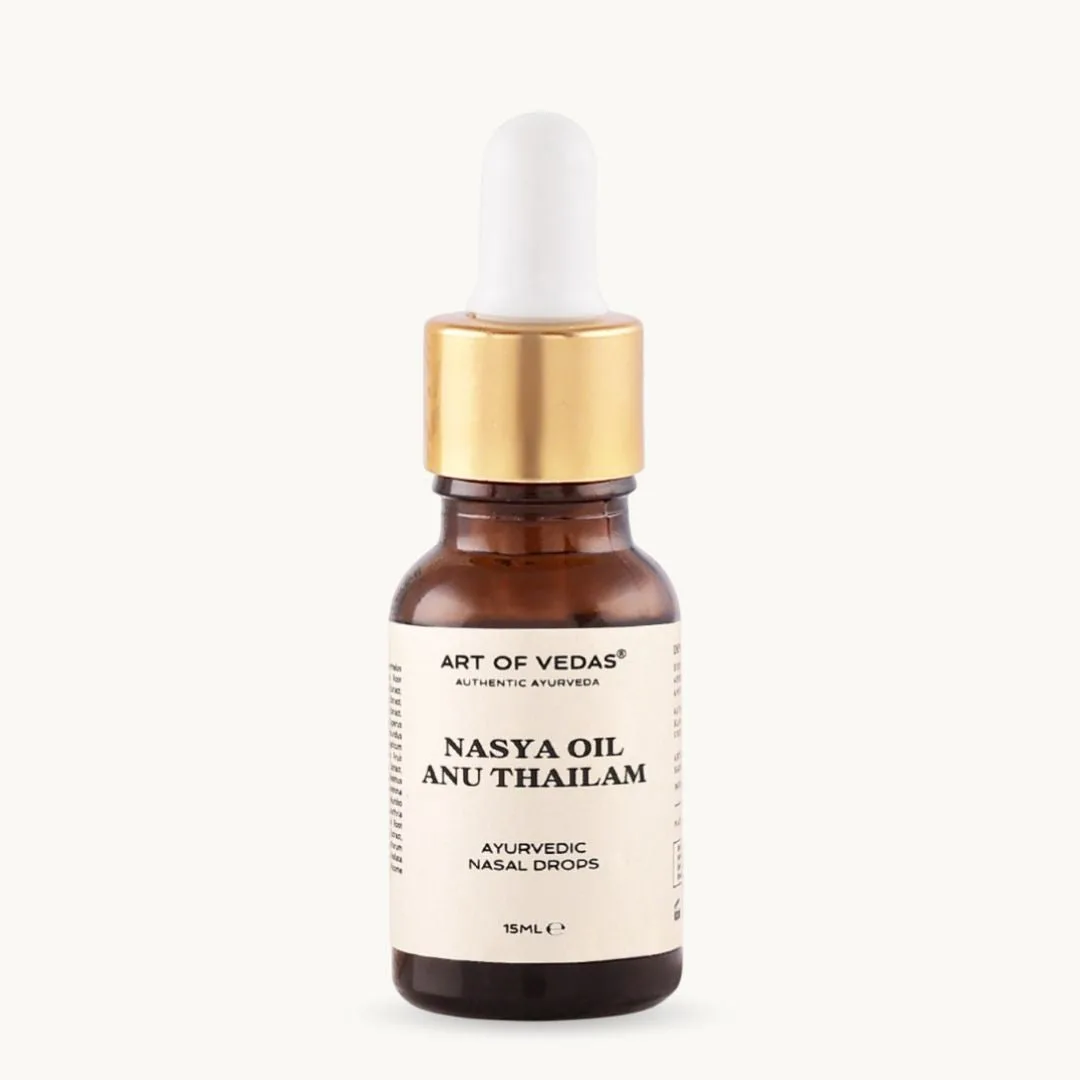
On cosmetic oils, check whether the product is intended for the body, the scalp, the face, or a specific practice such as Nasya (the Ayurvedic practice of applying oil in the nostrils). A Nasya oil and a general body oil are formulated for different purposes and are not substitutes for one another. Our guide to choosing an Ayurvedic massage oil works through the practical differences.
On supplements, check the portion, the frequency, and whether the label asks you to take it with food or with water. Where a label states a maximum portion, that figure is a limit rather than a suggestion.
Storage instructions matter more than most buyers expect, particularly for oil preparations and for anything fermented. Look for the temperature range, any instruction to keep the product out of direct light, and advice on closing the cap after use.
Warnings, allergens and suitability
The warnings section is written for the people a product is not suitable for. If you read only one block of small print, read this one.
- Patch test advice, and how long to wait before using the product fully.
- Allergen declarations, including sesame and nut bases, which are common in classical oil preparations.
- Age restrictions, where the product is not intended for young children.
- Statements covering pregnancy and breastfeeding.
- Advice to speak to a healthcare professional if you take prescribed medication.
A patch test is the cheapest safety step available to you. Apply a small amount to the inner forearm, leave it uncovered, and wait a full day before wider use. Do this with any new oil, including one you have used in a different formulation.
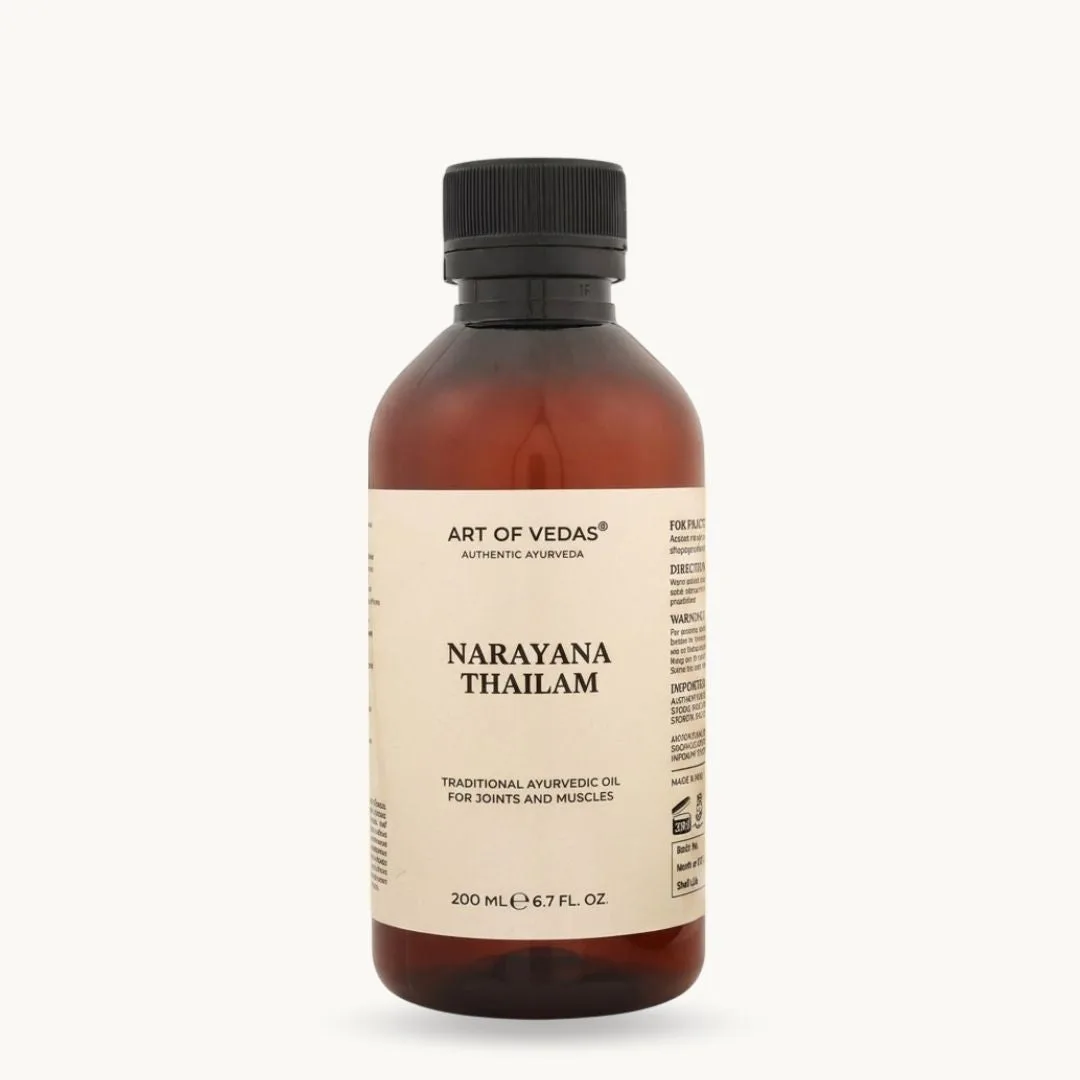
A missing warnings section is not evidence of a gentle product. It is more often evidence of an incomplete label. Products that set out their limits clearly, as in the safety notes published for Narayana Thailam, are easier to use sensibly than products that say nothing at all.
Batch numbers, dates and the business behind the product
Traceability is the least attractive part of a label and the most useful when a question arises. Four elements do the work.
- A batch or lot identifier, which ties your specific unit to a production run.
- A date: a minimum durability date on supplements, and either a durability date or a period after opening symbol on cosmetics, shown as an open jar with a number of months beside it.
- The name and address of the business responsible for placing the product on the European market.
- A contact route, such as an email address or a website.
None of this tells you anything about quality. It tells you that a named business has accepted responsibility for the product and can be reached about it. If a label carries no batch identifier and no responsible business, you have no practical way to raise a question about the unit in your hand.
What a compliant label will not claim, and a checklist before you buy
This is where buyer expectations and European rules part company. Neither a cosmetic nor a food supplement may be presented as a medicine. A label that promises a medical outcome is not the sign of a stronger product. It is the sign of a business that has not read the rules it trades under.
What a careful label gives you instead is traditional framing: a description of how a preparation has classically been used, its qualities in Ayurvedic terms such as warming or cooling, and the practice it belongs to. The Charaka Samhita and the Ashtanga Hridayam describe these preparations in the language of qualities, timing and practice rather than of outcomes, and a well written modern label follows the same restraint.
Before you buy, run this short check:
- Is the category stated, and does the label carry what that category requires?
- Does the full product identity appear: name, format, net quantity?
- Is there an ingredient list you can read, in INCI or with botanical names and quantities?
- Are the route, amount and frequency of use stated plainly?
- Are the warnings, allergens and age limits present?
- Is there a batch identifier, a date and a named responsible business with a contact route?
Where the label and a website disagree, the physical label is the source of truth, and the responsible business is the right party to ask. Product pages are edited continuously; labels are printed against a specific batch. For a wider view of careful buying in this category, see our guide to buying authentic Ayurvedic products.
Use this checklist when exploring Ayurvedic oils and daily massage oils.
Frequently asked questions
What does INCI mean on an Ayurvedic oil label?
INCI stands for the International Nomenclature of Cosmetic Ingredients, the standard naming system for cosmetic ingredients across the European market. It gives each ingredient one fixed name, usually in botanical Latin. The practical benefit is comparison: because the naming does not change between brands or between languages, you can hold two Ayurvedic oils side by side and see exactly where they differ, even when the front labels use very different marketing language.
Is a Sanskrit product name enough to identify what I am buying?
No, and this is the most common misunderstanding in the category. A Sanskrit name identifies a formulation family, not a specific product. The same name can be prepared as an oil by one maker and as a powder by another. Read the name together with the preparation format, the net quantity, the ingredient list and, where given, the classical text the formulation follows.
What should I do if the label and the website say different things?
Regard the physical label as authoritative and contact the responsible business about the discrepancy. A label is printed against a particular batch and reflects what is in that unit, whereas a website is edited continuously and can lag behind a reformulation. The business named on the label is the right party to ask, and the batch identifier lets them check your specific unit rather than answering in general terms.
Should I avoid a product that has no warnings on the label?
A missing warnings section should make you curious rather than reassured. It is tempting to read the absence of warnings as evidence that a product is mild, but it more often indicates an incomplete label. Sesame and nut bases are common in classical oil preparations and are genuine allergen considerations, so a label mentioning neither has left something out.
What is the period after opening symbol, and does it apply to Ayurvedic oils?
The period after opening symbol is a small drawing of an open jar with a number and the letter M beside it, meaning the number of months the product is intended to be used within once opened. It appears on cosmetics that carry no minimum durability date, and it applies to Ayurvedic cosmetic oils exactly as it applies to any other cosmetic. The clock starts when you open the bottle rather than when you buy it, so writing the opening date on the base is a sensible habit.
Does a classical text named on the label mean the product is better?
It means the formulation follows a documented recipe lineage, which is useful information, but it is not a quality grade. An attribution to a source such as the Sahasrayogam tells you which version of a formulation the maker has worked from, and that helps you compare two products sharing a Sanskrit name. Read it alongside the ingredient list, the directions and the traceability details rather than in place of them.