This article is part of our Ghrithams: Classical Ayurvedic Medicated Ghee guide series.
Ghritham - medicated ghee - represents one of the most distinctive pharmaceutical innovations in classical Ayurveda. While Thailams use oil as a carrier and Kashayams use water, Ghrithams use clarified butter (ghee) to extract, preserve, and deliver herbal compounds. This is not an arbitrary choice - ghee possesses unique pharmacological properties that make it the optimal carrier for specific therapeutic applications that neither oil nor water can match.
The Charaka Samhita states that ghee is the best substance for Pitta pacification, that it improves intelligence and digestion, and that it is the supreme medium for carrying herbs to the deepest tissue layers. Modern lipid science confirms the logic: ghee's fatty acid profile provides exceptional bioavailability for fat-soluble compounds and crosses the blood-brain barrier more readily than other lipid carriers.
Why Ghee as a Carrier
Lipophilic Delivery
Many herbal compounds are fat-soluble rather than water-soluble - meaning they dissolve in and are transported by fats, not water. Ghee captures these compounds during processing and delivers them into the body's lipid-rich tissues: the nervous system (Majja Dhatu), the reproductive tissues (Shukra Dhatu), and the deeper structural layers that water-based preparations reach poorly.
Pitta Pacification
Ghee is inherently cooling (Sheeta Virya) - one of the very few fats classified this way in Ayurveda. This makes it the natural carrier for conditions involving Pitta inflammation, heat, and irritation. Where sesame oil is the Vata carrier, ghee is the Pitta carrier.
Agni Enhancement
Paradoxically for a fat, ghee is classified as Agni-enhancing (Deepana) - it stimulates rather than suppresses digestive fire, provided it is used in appropriate quantities. This means Ghrithams support their own absorption: the ghee carrier enhances the Agni needed to metabolise both the ghee and its herbal payload.
Panchakarma Preparation (Snehapana)
Internal oleation (Snehapana) - drinking measured quantities of plain or medicated ghee over several days - is the classical preparatory procedure before Panchakarma purification. The ghee saturates the tissues and loosens deeply lodged toxins, preparing them for elimination through subsequent purification procedures.
Major Classical Formulations
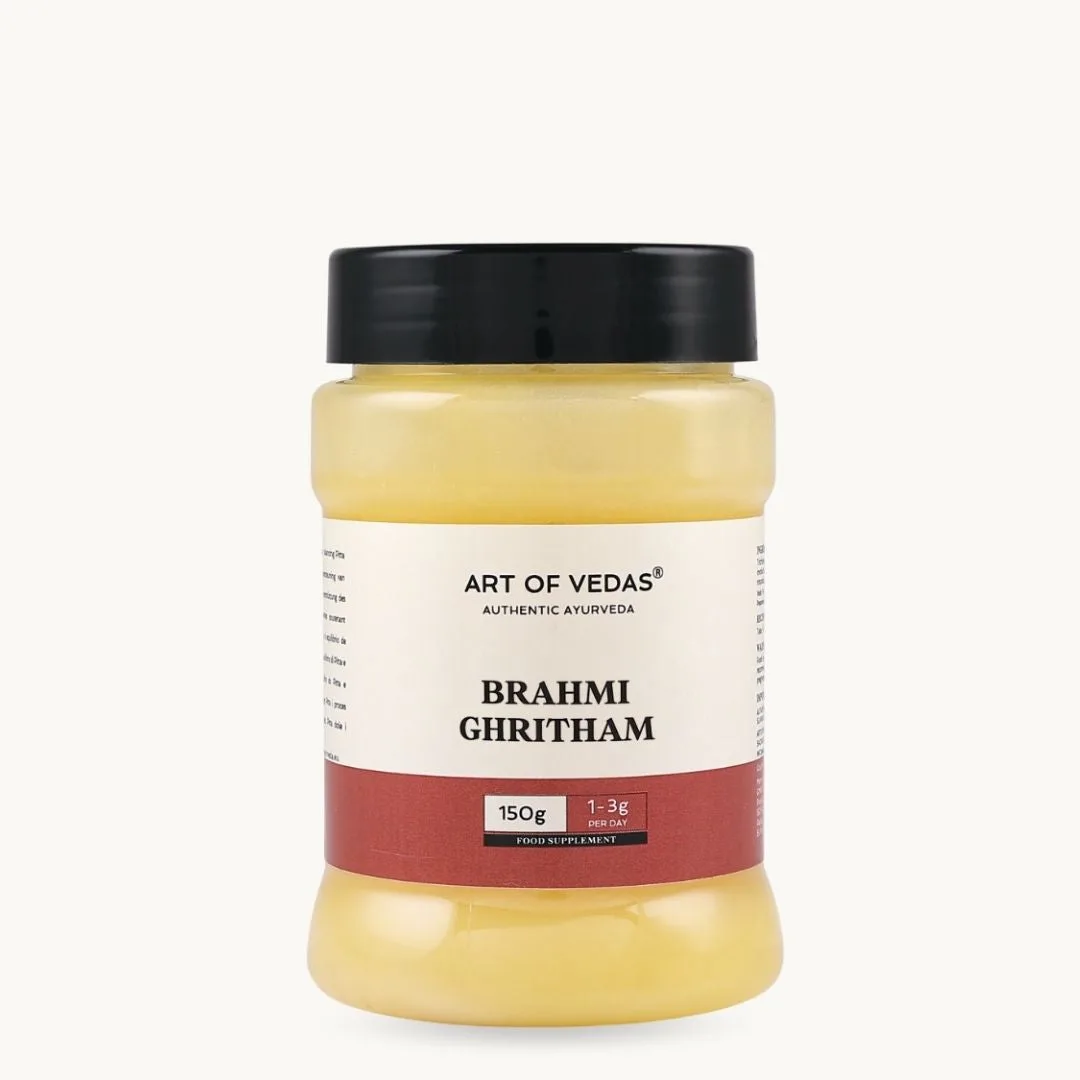
Brahmi Ghritham: Medicated with Brahmi (Bacopa monnieri) - the classical formulation for cognitive support, memory enhancement, and nervous system nourishment. One of the most important Rasayana preparations for mental function.
Triphala Ghritham: Medicated with the three fruits of Triphala - traditionally valued for eye health, vision support, and general Pitta pacification. Classical texts specifically recommend it for conditions affecting the eyes and visual capacity.
Indukantham Ghritham: A broad-spectrum digestive and Vata-pacifying Ghritham - traditionally used where both Agni weakness and Vata aggravation are present.
Kalyanaka Ghritham: A complex, multi-herb Ghritham traditionally valued for psychiatric and neurological support - one of the most sophisticated Medhya preparations in the classical repertoire.
Mahatiktaka Ghritham: A bitter (Tikta Rasa) Ghritham - the classical formulation for chronic Pitta skin conditions. The bitter herbs pacify Pitta while the ghee carrier delivers them to the skin's tissue layer.
Sukumara Ghritham: Traditionally valued for gynaecological health and reproductive system support.
Dhanwantharam Ghritham and Thikthakam Ghritham are also available in our European Ayurvedic range - covering Vata-pacifying and Pitta-pacifying applications respectively.
Administration
Ghrithams are typically taken orally in small quantities - 5, 15ml (one to three teaspoons) - on an empty stomach with warm water. The warm water is essential: it liquefies the ghee and supports absorption. Dosage, timing, and duration are determined by the prescribing practitioner based on the patient's constitution, condition, and Agni strength.
For Snehapana (preparatory internal oleation): doses are progressively increased over 3, 7 days under clinical supervision. This is a medical procedure, not a self-care practice.
Practical Considerations
Storage: Ghee-based preparations are naturally stable and do not require refrigeration in moderate climates. Store in a cool, dark place with a tight seal. Shelf life is typically 2, 3 years for well-manufactured Ghrithams.
Dietary compatibility: Ghrithams are generally well tolerated, but high Kapha individuals or those with very sluggish digestion may find ghee-based preparations heavy. In such cases, Kashayams or Arishtams may be more appropriate starting points.
Ghritham selection is a clinical decision requiring knowledge of the patient's Dosha pattern, Agni strength, and target tissues. An Ayurvedic consultation ensures the right formulation for your specific needs.
Classical Ayurvedic knowledge for educational purposes. Food supplement - not intended to diagnose, treat, cure, or prevent any disease.