In brief: Neem (Azadirachta indica) is the Nimba of classical Ayurveda. When people look up neem benefits, Ayurveda answers with its qualities: a strongly bitter taste (Tikta Rasa), a cooling Virya, light and dry qualities, classically described as calming Pitta and Kapha. Leaf, bark, seed oil and twig each have their own traditional use. Neem tea, a simple leaf infusion, is traditionally taken in small amounts and for short periods, and neem capsules offer a measured form. Internal use belongs in short courses guided by a qualified practitioner.
What is neem?
Neem is a large evergreen tree with dense, feathery foliage, small white flowers and olive-like fruits. Its botanical name is Azadirachta indica. In Sanskrit it is called Nimba, and the classical lexicons give further names such as Pichumarda and Arishta. You can read more about these names in our guide to Nimba, Arishta and Pichumarda.
So what is neem in Ayurveda? It is one of the best-known bitter plants of the tradition. The classical texts, including the Charaka Samhita, the Ashtanga Hridayam and the Bhavaprakasha Nighantu, refer to Nimba many times, and in daily life almost every part of the tree has a traditional use: the leaf, the bark, the flowers, the oil from the seeds and the young twigs.
Neem benefits in Ayurveda: bitter Rasa and cooling Virya
Ayurveda does not list neem benefits as a series of promises. It describes the plant through its qualities, which explain how it is understood and when it is traditionally chosen. For Nimba, the classical profile reads as follows:
- Rasa (taste): Tikta (bitter), the dominant taste, with an astringent note
- Guna (qualities): Laghu (light) and Ruksha (dry)
- Virya (potency): Sheeta (cooling)
- Vipaka (post-digestive taste): Katu (pungent)
- Dosha: classically described as calming Pitta and Kapha; in excess it can increase Vata
Tikta, the bitter taste, is made of the elements air and space. It is light, dry and cooling, and in Ayurveda it is the taste that most directly balances Pitta and Kapha. Our guide to Tikta, the bitter taste explains this in more depth. The same lightness and dryness are the reason for caution: used for too long or in large amounts, a bitter, cooling plant can increase Vata, which is itself light, dry and cool.
The parts of the neem tree and their traditional uses
Few plants are used as completely as Nimba. Each part has its own role, and some are meant only for external use. Our guide to the parts of the neem tree covers them in detail.
- Leaf (Nimba Patra): the most widely used part. Fresh leaves are ground into a paste for external use, dried leaves are steeped as an infusion or ground into powder, and in some households a few tender leaves are cooked with other vegetables.
- Bark: the bitter bark appears in classical decoctions (Kashayam). These are prepared and prescribed by practitioners, not for home use.
- Seed oil: neem oil is pressed from the seeds. It has a strong smell and a dense texture, and it is used externally only, usually diluted in a carrier oil for hair and body care. It is not taken internally. More on this in our guide to neem oil and neem leaf.
- Twig: the classical Dinacharya, the daily routine, describes cleaning the teeth with a fresh twig of a bitter or astringent tree (Dantadhavana). The end of a neem twig is chewed until it becomes soft and brush-like, and it is then used to clean the teeth.
- Flowers: in parts of India the flowers are part of a festive dish of the new year, in which all six tastes are combined.
How to use neem: external and internal
When people ask how to use neem, the first distinction is between external and internal use.
External use is the most common. Neem oil is mixed in a small proportion with a carrier oil such as sesame or coconut oil and applied to the scalp or body. A leaf paste may be applied for a short time and then rinsed off. Always test a small amount on the inside of the forearm first.
Internal use is more serious, and Ayurveda approaches it with care. Because neem is so bitter, cooling and drying, it is traditionally taken in short, defined courses rather than continuously, and under the guidance of a practitioner who considers your constitution, the season and your overall situation. Neem internally, whether as a leaf infusion, a powder or in capsules, is not something to start on your own for longer periods.
Neem tea: traditional preparation
Neem tea is simply an infusion of neem leaves. It is not a product we sell, but it is one of the most traditional ways in which the leaf is taken, and many people ask how it is made.
- A few fresh or dried neem leaves are placed in a cup.
- Hot water, just off the boil, is poured over them.
- The leaves are left to steep for a few minutes and then strained.
- The infusion is drunk warm, in small sips.
The taste is intensely bitter, and that is intended: in Ayurveda the bitter taste is part of the plant's character. Traditionally neem tea is not sweetened heavily and not drunk in large cups. It is taken in small amounts, for a short period, often in spring, the season of Kapha, and then paused. Leaves for an infusion should be clean, clearly identified and stored dry. Before trying neem tea, please speak to a qualified Ayurvedic practitioner, who can tell you whether it is suitable for you and for how long.
Neem capsules as a measured form
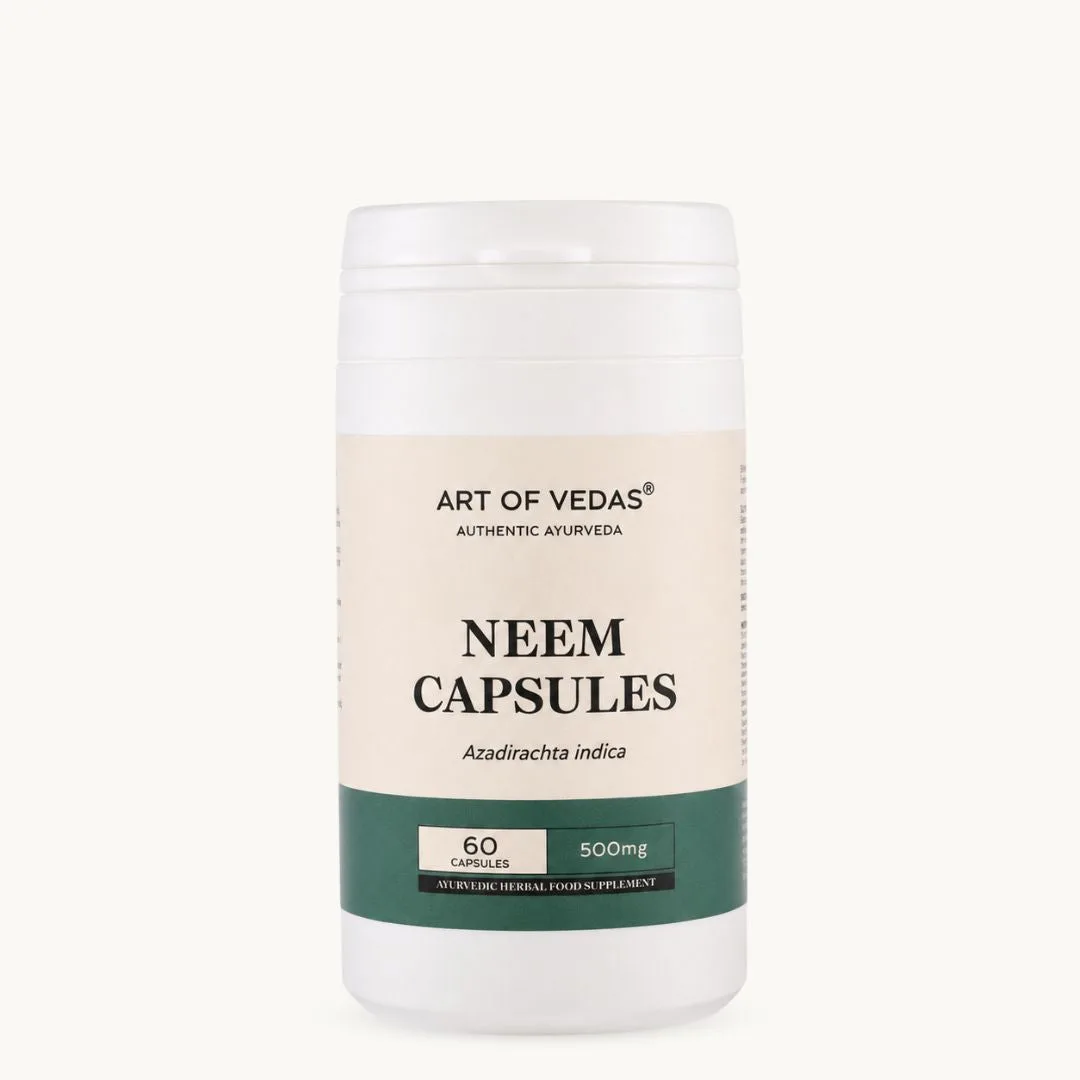
For people who prefer a precise amount to a home-made infusion, capsules are the simplest form. Neem capsules from Art of Vedas contain Azadirachta indica, with 60 capsules of 600 mg in each pack. They are taken with water, after a meal, in the daily amount stated on the label. As with every internal form of neem, they are traditionally used in a short course and best taken with the advice of a practitioner.
Neem and the three Doshas
Neem is classically most suited to Pitta and Kapha. In the warm season, or for a person with a strong Pitta nature, its cooling quality is traditionally valued. In spring, when Kapha is high, its lightness and bitterness are welcome. People with a predominantly Vata nature, and anyone who feels dry, cold or depleted, are usually advised to use neem sparingly, for a short time, and often together with nourishing foods.
Practitioner advice and cautions
Neem is a strong bitter plant, and its internal use needs care. Please keep the following points in mind:
- Internal neem is traditionally taken only in short, guided courses, not continuously.
- Do not take neem internally during pregnancy, while breastfeeding, if you are trying to conceive, or give it to children, without professional advice.
- Consult a qualified Ayurvedic practitioner or your doctor before use, especially if you take medication.
- Do not exceed the recommended daily amount stated on the label. Food supplements do not replace a varied and balanced diet.
- Neem oil is for external use only.
Frequently asked questions about neem
What is neem? Neem (Azadirachta indica) is an evergreen tree known in Ayurveda as Nimba. Its leaf, bark, seed oil, flowers and twigs all have traditional uses, some internal and some only external.
What are the neem benefits in Ayurveda? Ayurveda describes neem through its qualities: Tikta Rasa, light and dry Guna, cooling Virya and pungent Vipaka. Classically it is considered calming for Pitta and Kapha and, if overused, increasing for Vata.
How is neem tea traditionally prepared? A few fresh or dried leaves are steeped in hot water for a few minutes, strained and drunk warm in small amounts. It is very bitter and is traditionally taken only for a short period, with a practitioner's advice.
How do I use neem internally? Internal use, as a leaf infusion, powder or capsules, is traditionally limited to short courses guided by a qualified practitioner. Neem capsules offer a measured form of 600 mg per capsule.
Can neem be taken every day? Not over long periods. Because of its bitter, cooling and drying nature, neem is traditionally taken in short courses with pauses in between, in the amount advised by a practitioner.
Who should not take neem? Neem should not be taken internally during pregnancy or breastfeeding, when trying to conceive, or by children without professional advice. Anyone taking medication should consult a doctor first. Neem oil is never taken internally.
This guide describes the traditional Ayurvedic view of neem and is for general information only. Neem capsules are a food supplement, not a medicine. Food supplements do not replace a varied diet. Please consult a qualified Ayurvedic practitioner or doctor before use. Explore our Neem Capsules at Art of Vedas.