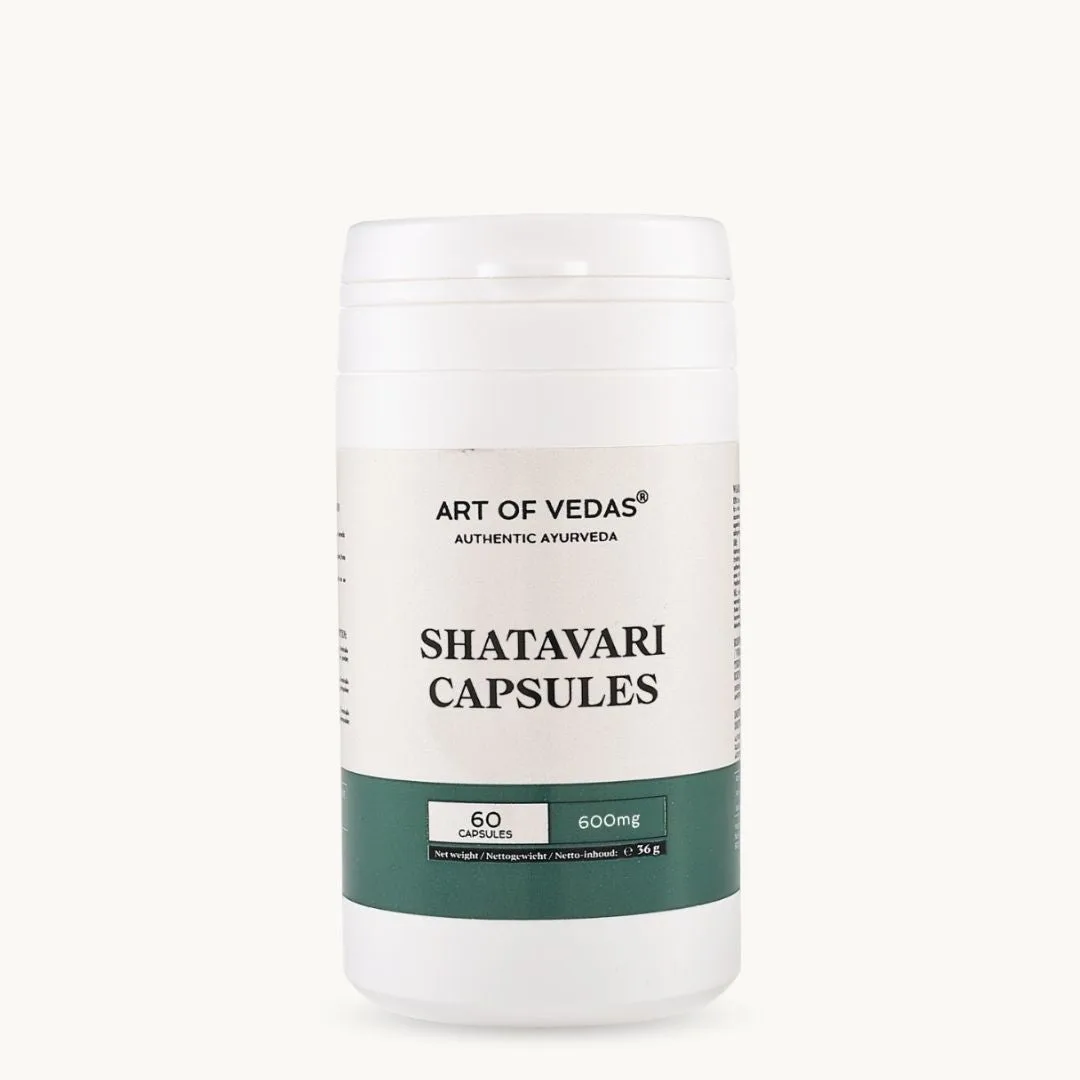
Two herbs, one sweet and one astringent, in a ghee base. Varanadi Ghritham from Art of Vedas is the shortest formula on our Ghritham shelf, and the pairing it rests on is one the classical texts describe carefully.
Shatavari, the sweet root
Asparagus racemosus is recorded in the classical literature as Shatavari. The texts describe it as Madhura in Rasa, sweet, and Sheeta in Virya, cooling. It belongs to the small group of roots the tradition returns to whenever a building preparation is wanted, alongside Ashwagandha.
Haritaki, the first of the three fruits
Terminalia chebula is Haritaki, the first fruit of Triphala. Its dominant Rasa is Kashaya, astringent, and the texts note that it carries five of the six tastes, lacking only salt. It is among the most frequently named single substances in the classical literature.
Why a short formula is not a lesser one
The classical pharmacy contains formulas of forty herbs and formulas of two. The texts do not treat length as a measure of quality: some preparations are deliberately short so that the character of the chosen substances is not diluted. A two-herb ghee carrying one sweet and one astringent element is a legible preparation, and the range comparison describes it as the gentlest entry to the family.
On the shelf
Varanadi Ghritham holds exactly these two herbs in a pure ghee base. For the wider group the name points to, see the Varanadi group guide; for the customs of taking a Ghritham, see how Ghritham is traditionally taken.
Frequently Asked Questions
What are the tastes of the two herbs?
Shatavari is described as sweet and cooling; Haritaki as predominantly astringent, and the texts note it carries five of the six tastes.
Is a two-herb formula unusual?
No. The classical pharmacy contains both very long and very short formulas, and length is not treated as a measure of quality.
Which Ghritham is simplest?
Varanadi Ghritham, with two herbs, followed by Triphala Ghritham with the three fruits.
This article is for educational purposes and describes the classical Ayurvedic record. The products mentioned are food supplements, not a substitute for a varied, balanced diet, and are not intended to diagnose, treat, cure or prevent any disease. Take classical ghee preparations under the guidance of a qualified Ayurvedic practitioner.