Warmth is not a uniform quality in Ayurvedic oils. Some classical Thailams are gently warming - appropriate for daily use across most constitutions, suited to the face and the full body, mild enough to use through most of the year. Others are substantially more heating - deeply penetrating, intensely Vata-clearing, appropriate for specific seasons, specific constitutions, or specific therapeutic purposes. Choosing the right level of warmth is part of choosing the right oil.
The concept at the centre of this distinction is Virya - the potency or energetic quality of a substance in classical Ayurvedic material science. The two primary Virya categories are Ushna (heating/warming) and Sheeta (cooling). Classical Thailams are classified by the Virya of both their base oil and their herbal components. A sesame-based Thailam prepared with Ushna herbs produces a deeply warming preparation. The same sesame base processed with cooling herbs produces a preparation with different qualities. Understanding this is the foundation of oil selection.
Why Warming Oils Are Central to Classical Ayurvedic Massage
The classical rationale for external oil application - particularly in Abhyanga, the traditional full-body self-massage - is primarily the counteraction of Vata Dosha. Vata, the principle of movement, dryness, cold, and irregularity in classical Ayurvedic physiology, is inherently cold (Sheeta), dry (Ruksha), light (Laghu), and mobile (Chala). Its opposite qualities - warmth, moistness, heaviness, stability - are what bring it into balance.
Sesame oil, the classical base for most Vatahara Thailams, has inherent Ushna Virya (warming energy), heavy and unctuous quality, and the capacity to penetrate deeply into tissues. This is why the Ashtanga Hridayam and Charaka Samhita consistently recommend sesame as the primary oil for Abhyanga: it counteracts Vata directly through its own qualities, before the herbal components of a classical Thailam have even been considered.
Warm oil applied warm - the Ashtanga Hridayam specifies that Abhyanga oil should be Ushna, heated before application - doubles the warming effect: the oil's inherent quality combined with the temperature of application. A warm classical Vatahara Thailam absorbed through warm skin, into tissues prepared by the friction of massage, is what classical texts describe as the complete external Snehana (oleation) practice.
The alternative - a cold, light, or cooling oil - does not produce the same classical effect on Vata, regardless of how many herbs it contains.
The Spectrum of Warming: From Gentle to Potent
Classical Thailams used for external massage fall along a spectrum of warming intensity. This is not about product quality - it is about the intended classical purpose of each preparation and who it is suited for.
Gently Warming: For Daily Use and Most Constitutions
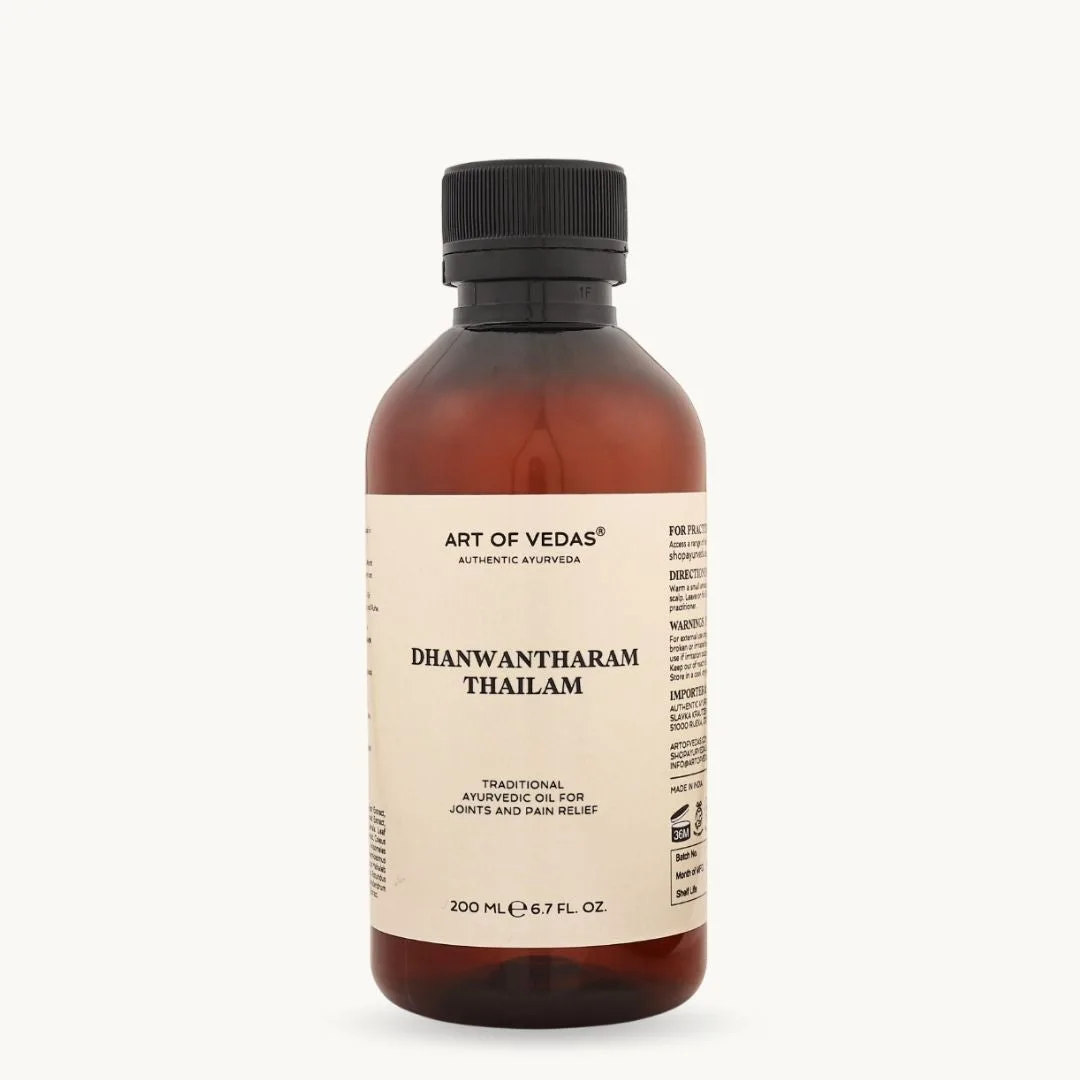
At the gentler end of the spectrum sit preparations like Dhanwantharam Thailam - one of the most widely referenced classical Vatahara oils, named after Dhanwanthari (the Ayurvedic deity of medicine) and described in the Ashtanga Hridayam as a primary oil for external use in Vata conditions.
Dhanwantharam is warming, deeply nourishing, and broadly appropriate across constitutions. It is one of the most referenced oils for regular daily Abhyanga - the kind of oil you could use every morning or evening without concern about accumulating too much heat over time, and that works well across most seasons. For Vata constitutions, it is foundational; for Pitta types who still want the benefits of daily oil massage, its gentler warmth is better tolerated than more potent preparations. Kapha types may use it in moderation, though they generally benefit from more stimulating options.
For most people beginning a daily Abhyanga practice, a gently warming Vatahara oil like Dhanwantharam is the right starting point. The guide to selecting the best oil for Abhyanga covers this in the context of the full massage practice.
Moderately Warming: For Deeper Vata, Musculoskeletal Use, and Cold Seasons
Further along the spectrum sits Ksheerabala Thailam - a milk-processed (Ksheera) preparation built on Bala root (Sida cordifolia), one of the classical Brimhana (nourishing, tissue-building) herbs in Ayurvedic pharmacology. The combination of sesame oil's warming penetration with milk's nourishing quality and Bala's strengthening classical action produces a preparation with a particular affinity for the musculoskeletal system and the nervous tissue.
Ksheerabala is classically referenced for conditions involving Vata in the joints, muscles, and peripheral nervous system - stiffness, reduced mobility, and the dryness that classic Vata accumulation produces in connective tissue. It is appropriate for Vata types as a regular practice, and for others during periods of physical exertion, cold weather, or pronounced Vata elevation. It is more nourishing and heavier than Dhanwantharam, which makes it less suited to daily full-body use for Kapha types, but more targeted for specific musculoskeletal application.
Potently Warming: For Pronounced Vata Elevation and Therapeutic Use
At the most warming end of the common external oil spectrum sits Mahanarayana Thailam - a complex formula containing 24, 30 herbs in a sesame base, described across the Sahasrayogam and other classical texts as a primary oil for significant Vata conditions affecting the musculoskeletal system and broader physiological function.
Mahanarayana is potently warming and penetrating. It is appropriate for: pronounced Vata seasons (autumn and early winter particularly), periods of physical recovery, Vata types who run cold and dry, and applications where deeper penetrating heat is clinically indicated. For Pitta types, Mahanarayana requires caution in warm weather or during Pitta-aggravating periods - the intensity of its warming action can overstimulate Pitta. For Kapha types, the warmth and penetration of Mahanarayana can be beneficial in cold-damp conditions, applied locally rather than as a full-body daily oil.
Selecting by Constitution
Constitution (Prakriti) is the primary guide to oil selection in classical Ayurveda. Each Dosha has a different relationship to warming oils:
Vata constitution: Warming oils are central - not optional. Vata's cold, dry, mobile nature is most directly counteracted by the heavy, warm, stable qualities of sesame-based Vatahara Thailams. Vata types generally tolerate warming oils well and benefit from daily Abhyanga with them year-round. The intensity of warming can be adjusted seasonally - a gentler oil like Dhanwantharam in spring and summer, more potent preparations like Mahanarayana in autumn and winter. The Vata dosha guide covers the full constitutional picture.
Pitta constitution: Pitta's inherent fire and heat means warming oils require more consideration. In temperate weather and for most of the year, a gently warming oil like Dhanwantharam is appropriate - Pitta types still benefit substantially from daily Abhyanga, and avoiding all warming oils entirely misses this. In peak summer or when Pitta is significantly elevated, lighter or cooler oils (coconut-based, or specific Pitta-formulated preparations) are more appropriate. Potent Vatahara oils like Mahanarayana are best reserved for specific cold-season or musculoskeletal applications in Pitta types. The Pitta dosha guide covers these distinctions.
Kapha constitution: Kapha benefits from warming and stimulating oils, but classical Ayurveda also cautions against excessively heavy and unctuous preparations for Kapha, which can increase the heaviness already characteristic of the constitution. For Kapha types, a sesame-based oil with more stimulating herbal components - or a warming Thailam used in smaller quantities with more vigorous application - is preferable to deep oleation with very heavy preparations. The Kapha dosha guide covers how Abhyanga and oil selection adapt for Kapha constitutions.
Selecting by Season
Classical Ayurvedic texts describe Ritucharya - seasonal adjustment of daily practice - as an essential part of sustained health. Oil selection follows the season as much as it follows constitution:
Autumn and early winter (Vata season): The peak period for warming oils. The cold, dry, windy qualities of autumn are inherently Vata-aggravating for all constitutions, not only Vata types. This is the season to warm Abhyanga oil carefully, to increase frequency if possible, and to use more potent preparations - Mahanarayana and Ksheerabala are most relevant here. The Ayurvedic autumn guide covers the full seasonal regimen.
Late winter and spring (Kapha season): As temperatures begin to rise and Kapha accumulation increases, the heaviest oils become less appropriate. Lighter warming preparations - or warming oils used in reduced quantity with more vigorous application - suit this transition. The spring cleanse guide addresses this seasonal shift in detail.
Summer (Pitta season): The season for lightest oil use, cooler preparations for Pitta and mixed types. Warming oils continue to be appropriate for Vata types in summer - Vata does not disappear in warm weather - but application adapts: smaller quantities, slightly cooler temperature at application, briefer contact time.
Warming Oil Application: What Makes the Difference
The warming quality of a classical Thailam is activated and delivered through the application method. Several factors determine how effectively the oil works:
Oil temperature. The single most important practical variable. Warm oil - heated to approximately body temperature or slightly above - penetrates more effectively, has greater capacity to counteract Vata's cold quality, and is absorbed more readily than oil applied at room temperature. For a warming oil to work as a warming oil, it must be applied warm. Place the bottle in a cup of hot water for 5, 10 minutes before use.
Duration of contact. Classical texts describe a minimum of 15, 20 minutes of Abhyanga followed by allowing the oil to rest on the skin for a period before bathing - traditionally 30 minutes or more. This rest time, often overlooked in modern adaptations, is when deeper absorption occurs. The warming, nourishing qualities of a classical Thailam require time on the skin to penetrate to the level of deeper tissues (Dhatus).
Application pressure. Warming and penetration are enhanced by application pressure that creates friction - a gentle but firm gliding stroke that generates mild heat at the surface. This is qualitatively different from a light, effleurage-style application, and different again from the deep-tissue pressure of Swedish massage. The classical Abhyanga stroke is firm, rhythmic, and directional.
Frequency. Daily Abhyanga with a warming oil produces cumulative effects. A single application produces transient warmth; consistent daily application over weeks and months produces the deeper tissue-nourishing effects classical texts describe - changes in skin quality, Vata regulation, nervous system tone.
The complete Abhyanga guide covers application technique in full, and the at-home Abhyanga guide provides a practical step-by-step protocol. For a complete framework for choosing between oils based on constitution, season, and use, the oil selection guide covers every decision point in detail.
For Practitioners
For Ayurvedic practitioners working with clients - in Panchakarma centres, yoga studios, spas, or private practice - the selection of classical warming Thailams for external treatments follows the same constitutional and seasonal principles, applied with greater precision through a full classical assessment. Art of Vedas supplies a dedicated range of professional-grade Ayurvedic oils for practitioners, including bulk quantities of Dhanwantharam, Mahanarayana, Ksheerabala, and other classical Thailams.
If you are a consumer uncertain which warming oil is most appropriate for your constitution and circumstances, an Ayurvedic consultation with one of our AYUSH-certified Ayurvedic doctors provides a complete classical assessment with specific oil recommendations.
All Thailams described in this guide are classical Ayurvedic preparations for external use. They are intended for general wellbeing as part of a daily self-care routine. They are not medicines and are not intended to diagnose, treat, cure or prevent any disease. For personalised guidance, consult a qualified AYUSH-certified Ayurvedic doctor.