This article is part of our Ashwagandha: The Classical Ayurvedic Rasayana for Strength and Vitality guide series.
The information in this article is provided for educational purposes and reflects traditional Ayurvedic knowledge. It is not intended as medical advice and should not replace consultation with a qualified healthcare professional.
In brief: The ashwagandha supplement market in Europe is saturated with competing products, extract ratios, branded ingredient names, and certification claims. Most of the marketing obscures a few genuinely important distinctions and amplifies several that are largely irrelevant. This guide cuts through the noise: what actually matters when choosing an ashwagandha supplement, what you can safely ignore, and what classical Ayurveda says about the form that has two thousand years of documented use.
How to Choose the Best Ashwagandha Supplement: A No-Nonsense Buyer's Guide
The marketing language is heavy on clinical study citations, proprietary names, and percentage claims that imply scientific precision.
None of this complexity was present when the Charaka Samhita described Ashwagandha (Withania somnifera) as one of the most important Rasayana herbs in the classical pharmacopoeia. The classical texts describe the whole root, properly sourced and prepared, as the definitive form. The question of how to navigate the modern supplement market while staying close to the classical standard is what this guide addresses.
Root Powder versus Root Extract: The Most Important Distinction
The single most consequential choice in the ashwagandha market is between whole root powder and root extract. This distinction matters more than organic certification, branded ingredient names, or withanolide percentage claims.
Whole root powder is exactly what the name suggests: the dried root of Withania somnifera, ground to a powder and encapsulated. This is the form the classical texts describe. It contains the full spectrum of the root's constituents, withanolides (the most studied group of active compounds), alkaloids, sitoindosides, iron, and numerous other identified and unidentified compounds, in the proportions they naturally occur in the plant.
Root extract is a concentrated preparation in which specific compounds (most commonly withanolides) are isolated and the extract standardised to a defined percentage. A 5% withanolide extract, for instance, contains approximately five times the withanolide concentration of an equivalent weight of whole root powder. Extracts are produced by solvent extraction, the specifics of the solvent and method vary between manufacturers and branded preparations.
The classical framework's position is clear: the whole root is the intended preparation. Ayurvedic pharmaceutical texts describe the complete plant matrix as essential, the compounds that are not isolated in an extract are understood as contributing to the preparation's overall action, providing buffering effects that prevent the excessive or isolated action of any single constituent. The modern evidence base also suggests that whole-plant preparations frequently outperform isolated fractions in clinical outcomes, even when the isolated fraction includes the compound considered most pharmacologically active.
That said, for those who specifically want a higher withanolide dose without taking larger quantities of capsules, a quality extract from a whole-root source is a pragmatic compromise. The key is to ensure the extract is root-based (not leaf or stem, which have different constituent profiles) and water or milk-extracted rather than solvent-extracted where possible, the Ksheera Pak (milk extraction) method referenced in classical texts is increasingly available in quality supplement preparations.
Organic Certification: Relevant but Not Decisive
Organic certification for ashwagandha addresses two genuine concerns: pesticide residue and agricultural practice. Both matter, Withania somnifera is a root crop, and roots accumulate more soil-based contaminants than above-ground plant parts. In markets where agricultural chemical use is poorly regulated or poorly monitored, organic certification provides meaningful assurance.
In the European market, certified organic ashwagandha from reputable suppliers with third-party contaminant testing is a meaningful quality indicator. It is not, however, the only indicator that matters, and a conventionally grown ashwagandha from a supplier with rigorous third-party heavy metal and pesticide testing may be cleaner than a certified organic product from a supplier without transparent testing documentation.
The classical Ayurvedic criterion for herb quality, Dravyaguna (the quality of the raw material), emphasises sourcing from the correct region, correct harvest time, correct plant part, and correct storage conditions. Classical texts describe Ashwagandha carefully selected, hotter regions of India (Rajasthan, Madhya Pradesh) as producing the most potent roots. These classical quality indicators are not captured by organic certification alone.
Withanolide Percentage: Useful but Overmarketed
Withanolide percentage claims in ashwagandha marketing imply that more withanolides means more effect. This is a significant oversimplification. They are important constituents, but they are one constituent group among many, and there is no established relationship between withanolide percentage and clinical outcome that would justify choosing a product solely on this basis.
A whole root powder with naturally occurring withanolide levels (typically 0.5-1.5% in quality preparations) has two thousand years of clinical use behind it. A high-percentage withanolide extract has a much shorter history and, in some cases, a different side effect profile from whole root preparations. For most adults using ashwagandha for general Rasayana support, the classical primary indication, whole root powder or a moderate extract (2-5% withanolides) from a quality source is the most classical and most practically supported choice.
How to Take Ashwagandha: Classical Guidance
The Charaka Samhita and Sahasrayogam describe ashwagandha root powder as traditionally taken with warm water (Ksheera), ghee, or honey, the classical Anupana (vehicle) that both enhances absorption and directs the herb's properties toward the deeper tissues. warm water is the most broadly applicable vehicle: the fat and protein in milk are understood in classical terms as carrying ashwagandha's properties into the deeper tissue layers (particularly Mamsa and Shukra/Artava dhatu) more effectively than water-based vehicles.
Classical dosing guidance describes quantities between three and six grams of root powder daily for sustained Rasayana use, taken over months, classical Rasayana practice is explicitly long-term. The effects of ashwagandha are cumulative; the classical texts describe meaningful Rasayana outcomes requiring sustained use, not acute dosing. See our complete guide to Ashwagandha and our guide to classical Rasayana.
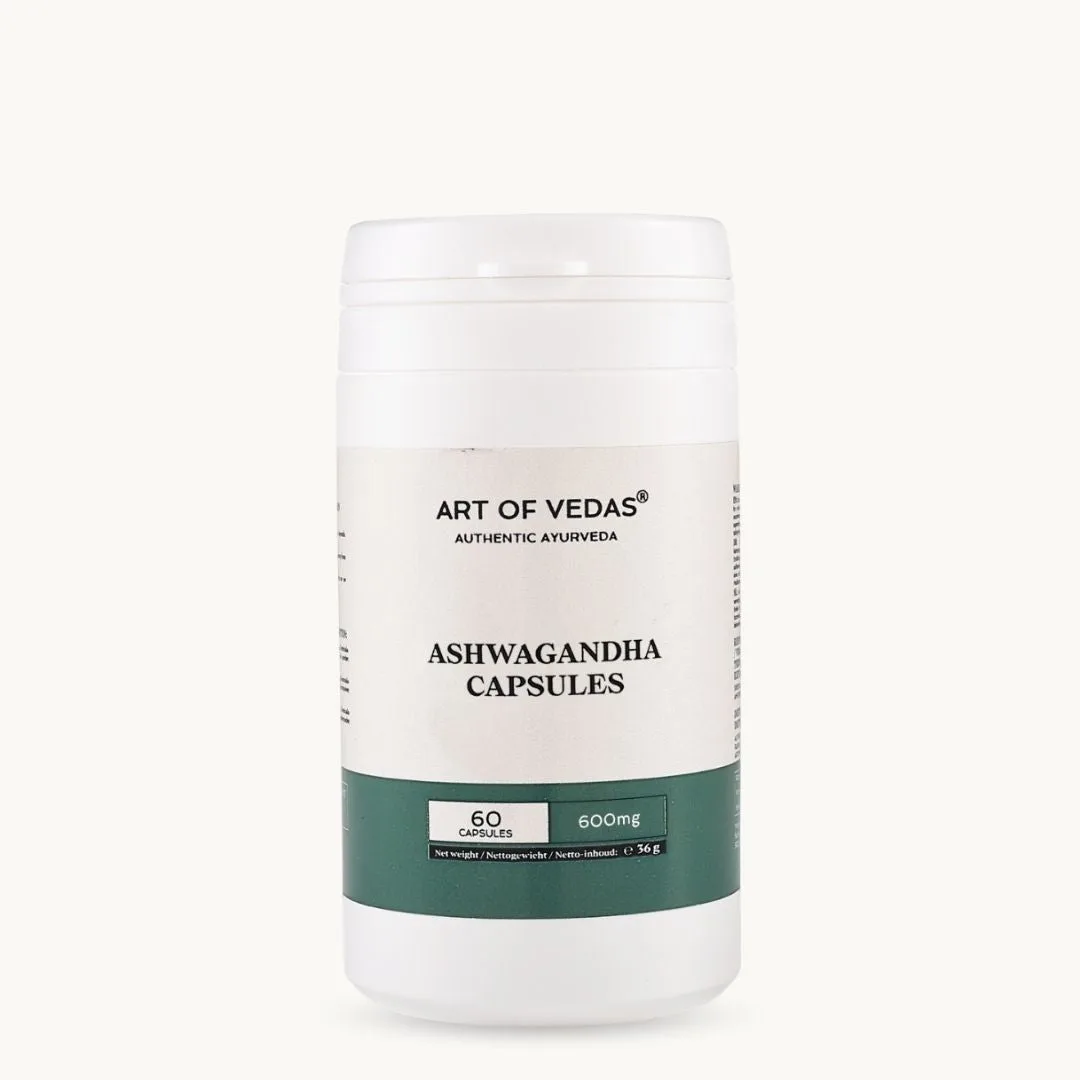
Find Art of Vedas Ashwagandha capsules in our supplements collection.
Frequently Asked Questions
What is the best form of ashwagandha to take?
Classical Ayurveda describes whole root powder as the definitive form, the Charaka Samhita references the whole root for Rasayana use, as it contains the complete constituent spectrum in natural proportions. Leaf-based or very high-percentage extracts depart more significantly from classical preparation.
Its main advantage over generic root powder is quality assurance rather than a fundamentally different clinical effect, well-sourced whole root powder with third-party testing is also an appropriate choice. The clinical significance of the higher withanolide concentration versus quality whole root is not established.
How long does it take for ashwagandha to work?
Clinical research has found measurable effects on stress markers and sleep within four to eight weeks. Daily consistency matters more than dose level for these outcomes.
What should ashwagandha be taken with for best results?
Classical Anupana (vehicle): the fat and protein carry ashwagandha's properties toward deeper tissue layers. warm water with a touch of ghee and natural sweetener is the classical preparation. Classical timing: before sleep on a relatively empty stomach, for maximum absorption and the nourishing overnight tissue-building context.
Ashwagandha at Art of Vedas
Find Art of Vedas Ashwagandha capsules, classical whole root preparation, in our supplements collection. Related reading: Ashwagandha complete guide, classical Rasayana guide, Ojas, Tejas and Prana, and fatigue and Ojas guide.
This product is a food supplement and not intended to diagnose, treat, cure or prevent any disease.