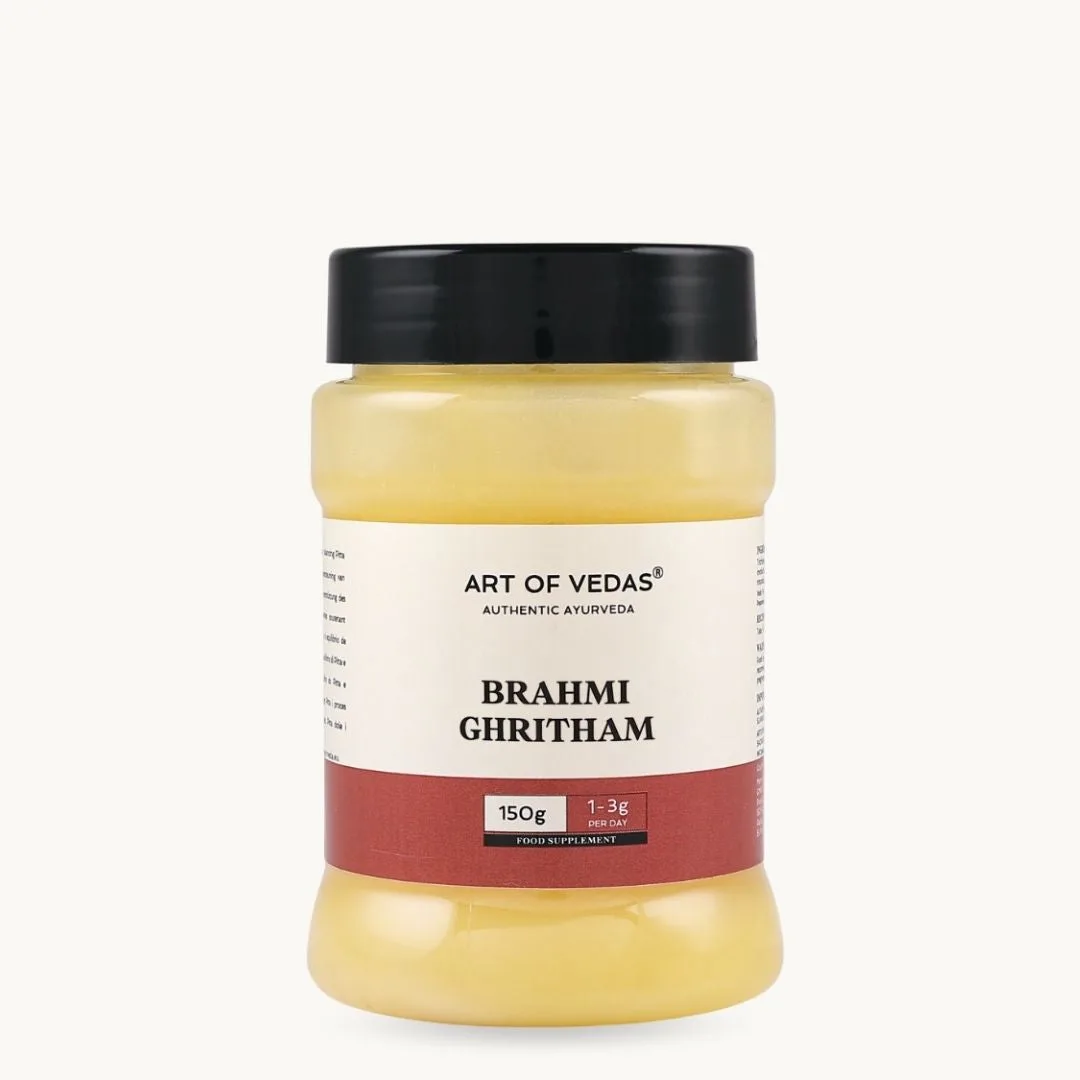
Classical Ayurveda sorts its preparations by form as much as by content: a Churnam is a powder, a Kashayam a decoction, a Thailam an oil and a Ghritham a ghee. Knowing where a pungent ghee such as Indukantham Ghritham sits in that scheme explains more about it than any single ingredient does.
Ghee as the chosen fat
Among the four fats the texts name, ghee is placed first. The classical argument is that it takes on the qualities of what is cooked into it without losing its own, which is the sense of the word Yogavahi. That is why an entire family of preparations, the Ghrithams, was built on it while the oils became the Thailams used externally.
The pungent group
Shunthi and Pippali belong to the small group of warming, pungent herbs that recur across the classical pharmacy, and they appear together so often that the texts treat the pairing as a unit. Rock salt joins them in several formulas. A ghee built on this group is classified as warming, and the classical literature positions it opposite the bitter ghees, which is the distinction the range comparison follows.
Sneha in the wider sequence
Ghee preparations also appear in the preparatory stage of Panchakarma, where internal oleation precedes the main procedures. That practice belongs to trained practitioners and is described in the Snehana guide; it is heritage context here, not a home practice.
How the tradition treats the taking of it
The customs are as considered as the formula: warmth, a modest quantity, an Anupana such as warm water, and steadiness rather than volume. They are set out in how Ghritham is traditionally taken. Indukantham Ghritham belongs to this tradition, and like every Ghritham it is taken under the guidance of a qualified practitioner.
Frequently Asked Questions
Why did the tradition build a whole family on ghee?
Because the texts describe ghee as Yogavahi: able to carry the qualities of what is cooked into it while keeping its own. The oils became the Thailams for external use.
Is a pungent ghee interchangeable with a bitter one?
No. The classical scheme classes them differently, and the herbs decide the classification. The range comparison sets them side by side.
Where does internal oleation fit?
In the preparatory stage of Panchakarma, under professional supervision. It is described here as classical context, not as something to undertake at home.
This article is for educational purposes and describes the classical Ayurvedic record. The products mentioned are food supplements, not a substitute for a varied, balanced diet, and are not intended to diagnose, treat, cure or prevent any disease. Take classical ghee preparations under the guidance of a qualified Ayurvedic practitioner.