In brief: This page answers the questions people most often search about Vata, Pitta, Kapha and Prakriti. Where Art of Vedas has a longer guide, a free Dosha test or a matching product, the answer links to it.
Ayurveda describes three Doshas, Vata, Pitta and Kapha, and every person carries all three in a proportion of their own; our guide to the three Doshas sets out the basics. The answers below follow the Art of Vedas guides and product descriptions. They do not tell you your own type: for that, ask a qualified Ayurvedic practitioner.
How do I find my Dosha type, and is there a free Dosha test?
Art of Vedas has a free Dosha test, a questionnaire that gives a first indication of the Doshas that lead in your constitution. Answer by how you have been for most of your life, not by how this week feels. Our guides call such a test a compass, not a map: the classical standard remains an assessment by an experienced Ayurvedic practitioner.
The result arrives by e-mail. More in How to Find Your Dosha Type.
What is Prakriti, and does it change during life?
Prakriti is the individual constitution: the proportion of Vata, Pitta and Kapha a person is born with. The word is formed from Pra (first, original) and Kriti (creation). According to our Prakriti guide, the classical texts are clear that it is fixed at conception and does not change during life.
The guide lists seven types: three with one leading Dosha, three dual types and Sama Prakriti, in which all three are about equal.
What is the difference between Prakriti and Vikriti?
Prakriti is the constitution a person is born with, and it stays the same. Vikriti, from Vi (deviation, change) and Kriti (creation), is the present state: how the Doshas stand today compared with that starting point. In our guides it moves with diet, season and circumstances.
A questionnaire picks up the present state more readily than the constitution, so Prakriti and Vikriti are read together by a practitioner.
What is the difference between Prakriti and Bhoomi?
The two words name different things. Prakriti, which our guides translate as primary nature or original form, describes a person. Bhoomi, also written Bhumi, is the plain Sanskrit word for earth, ground or land, so it describes a place. How a given text relates the two is a question for a qualified Ayurvedic practitioner.
What are the characteristics of Vata Dosha?
Vata is composed of air and ether and is the Dosha of movement. Our Vata guide gives six classical qualities: dry (Ruksha), light (Laghu), cold (Sheeta), rough (Khara), subtle (Sukshma) and mobile (Chala). Mobility is named as the defining one; Sukshma can also be translated as fine or minute.
The season classically associated with Vata is autumn into early winter. There is no fixed date: it begins when the weather turns cold, dry and windy.
What is the Pitta type in Ayurveda?
Pitta is the Dosha of transformation, formed from fire (Agni, also called Tejas) and water. Its classical qualities in our Pitta guide are hot (Ushna), sharp (Tikshna), light (Laghu), liquid (Drava), oily (Snigdha) and spreading (Sara). A Pitta type is a person in whose constitution this Dosha leads.
What is Kapha Dosha, and how is the Kapha constitution classically described?
Kapha is the Dosha of structure and cohesion, composed of earth and water, which our Kapha guide calls the two heaviest and most stable of the five elements. Its classical qualities are heavy (Guru), slow (Manda), cold (Sheeta), oily (Snigdha), smooth (Shlakshna), dense (Sandra), soft (Mridu) and stable (Sthira). In the words of the guide: where Vata moves and Pitta transforms, Kapha sustains.
What are the types of Kapha, Pitta and Vata: the sub-Doshas?
Each Dosha is divided into five sub-Doshas. Our guides name Avalambaka, Kledaka, Bodhaka, Tarpaka and Shleshaka for Kapha, and Pachaka, Ranjaka, Sadhaka, Alochaka and Bhrajaka for Pitta. For Vata they are Prana, Udana, Samana, Apana and Vyana, each called a Vayu.
Udana is the upward-moving and Apana the downward-moving Vayu. The seat of each sub-Dosha is given in the three guides linked above; verses are not quoted here.
What is a dual Dosha, and can a person have Vata and Pitta together?
Yes. A dual Dosha constitution, also called a mixed Dosha type, is one in which two Doshas are prominent and neither clearly overshadows the other. The classical dual types are Vata-Pitta, Pitta-Kapha and Vata-Kapha, and our guide to mixed Dosha types describes them as the most common constitutions in practice. A questionnaire result with two Doshas close together points the same way.
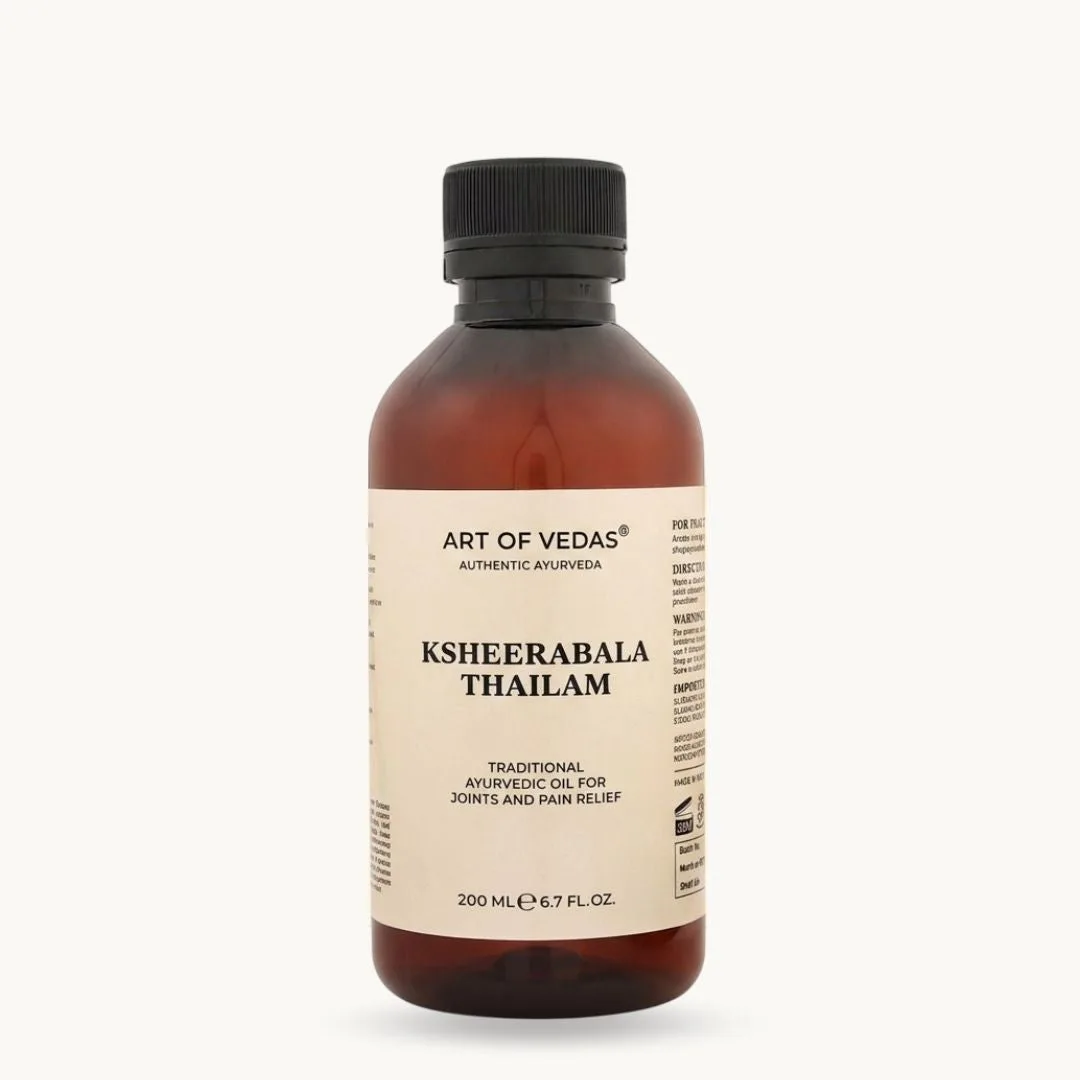
For Abhyanga where Vata and Pitta both lead, two product descriptions fit: Ksheerabala Thailam, a cooling oil associated first with Vata and also with Pitta, and the Tri Dosha Massage Oil, composed for all three.
Vata-Kapha vs Kapha-Vata: what is the difference?
Both names describe the same pair of Doshas. The order shows which one leads: our Prakriti guide lists each dual type both ways round, depending on dominance, so the first-named Dosha is the stronger of the two. What the pair shares, according to our Vata-Kapha guide, is the quality of cold (Sheeta).
If the two are about equal, which one to favour at a given time depends on the person and the season: a matter for a qualified Ayurvedic practitioner.
What is a Pitta diet, and what should the Pitta body type eat?
Our Pitta diet guide builds the classical Pitta diet on three tastes: sweet, bitter and astringent. Pungent, sour and salty are the tastes it lists to reduce. Its food lists include basmati rice, barley, leafy greens, cucumber, mung dal and sweet ripe fruit, with coriander, fennel and cardamom as spices.
Among meats the guide names white chicken as the most suitable for Pitta and lists red meat to reduce. These are classical lists, not personal advice: for your own diet, speak to a qualified practitioner or a doctor.
What is a Kapha diet, and which foods are chosen for Vata?
Our Kapha diet guide favours pungent, bitter and astringent tastes and puts vegetables first: bitter greens such as kale and rocket, broccoli, cauliflower, cabbage, celery, fennel and leeks. Our Vata diet guide favours sweet, sour and salty tastes and warm, cooked food such as basmati rice, oats, root vegetables and winter squash.
Sweet potato, pumpkin and potato are on the Kapha list to reduce. As with Pitta, these are classical lists, not personal advice.
Which Ayurvedic oils are cooling and classically associated with Pitta?
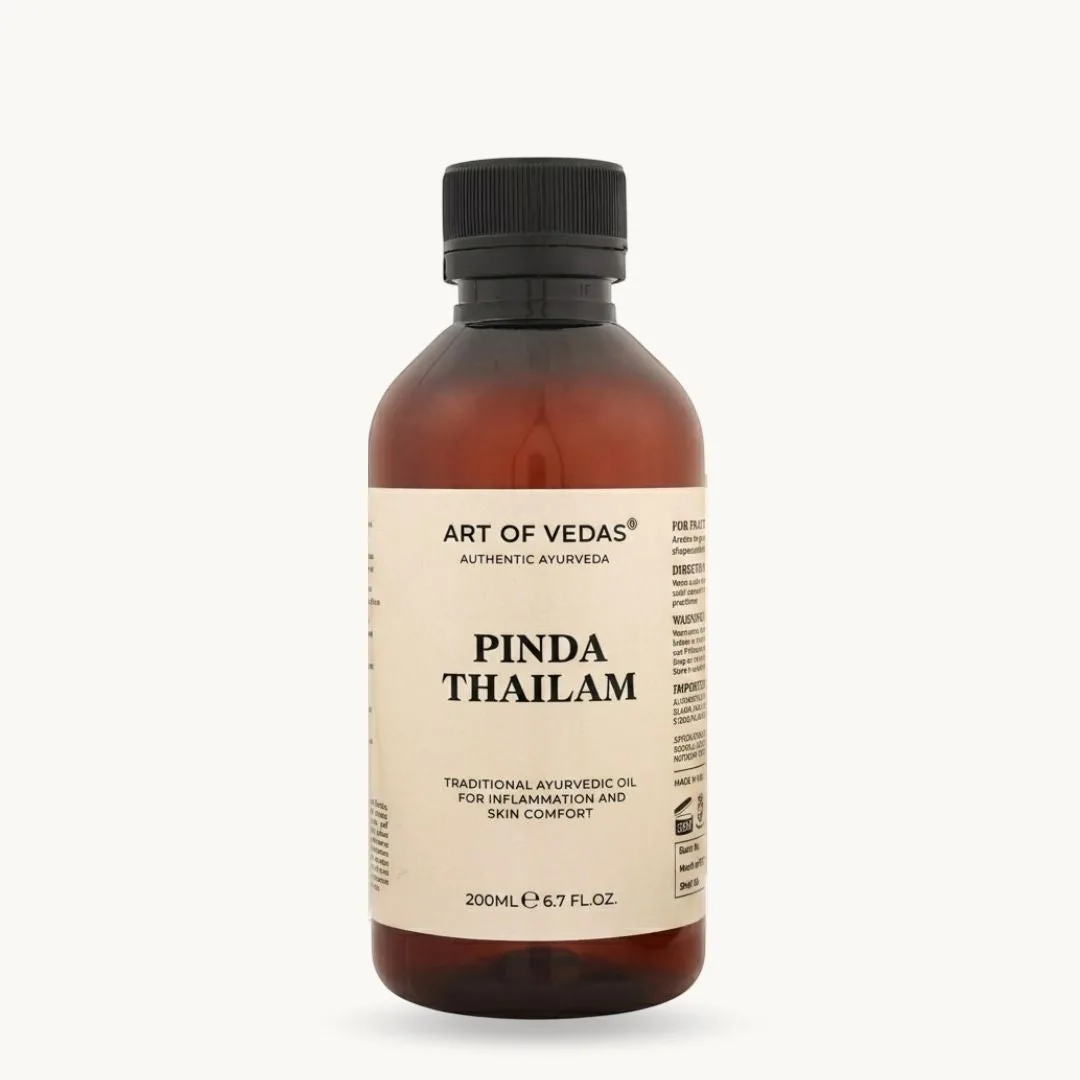
Our guides describe Pitta as hot by quality and pair it with oils of a cooling character. Two classical oils in the Art of Vedas range are described that way: Chandanadi Thailam and Pinda Thailam, both cooling and both classically associated with Pitta. As a plain base oil the guides name coconut oil for Pitta.
Chandanadi Thailam is used on face and body; its product description names Pitta first and Kapha second. More on the base oil in our coconut oil guide.
What is a good oil for Abhyanga for Vata, and which oil for Kapha?
For Vata our Abhyanga oil guide points to warming, substantial oils. The Vata Massage Oil is a warming Abhyanga blend composed for Vata, scented with patchouli, cedarwood, lavender and eucalyptus; Mahanarayana Thailam is a warming classical oil associated with Vata. For Kapha the guide favours lighter oils, smaller quantities and a brisker hand; Karpooradi Thailam, a warming oil with camphor, is associated with both Vata and Kapha.
If you do not yet know your constitution, the same guide suggests a composition made for all three Doshas.
What is the proper Garshana technique for the Kapha type?
Garshana is the classical dry massage with a raw silk glove, and our guides describe it as the practice most closely associated with Kapha. It is done on completely dry skin, without oil, before bathing. Start at the feet and work upward with long, brisk strokes along the legs and arms and clockwise circles on the abdomen. A few minutes are enough; a bath or Abhyanga follows.
Garshana Gloves at Art of Vedas are raw silk, sold as one piece. Leave out the face and any broken skin, and during pregnancy speak to a doctor or qualified practitioner first. Our Garshana guide has the full sequence.
Products mentioned on this page
Read further
More questions answered
For external use only. Not a substitute for professional medical advice.